
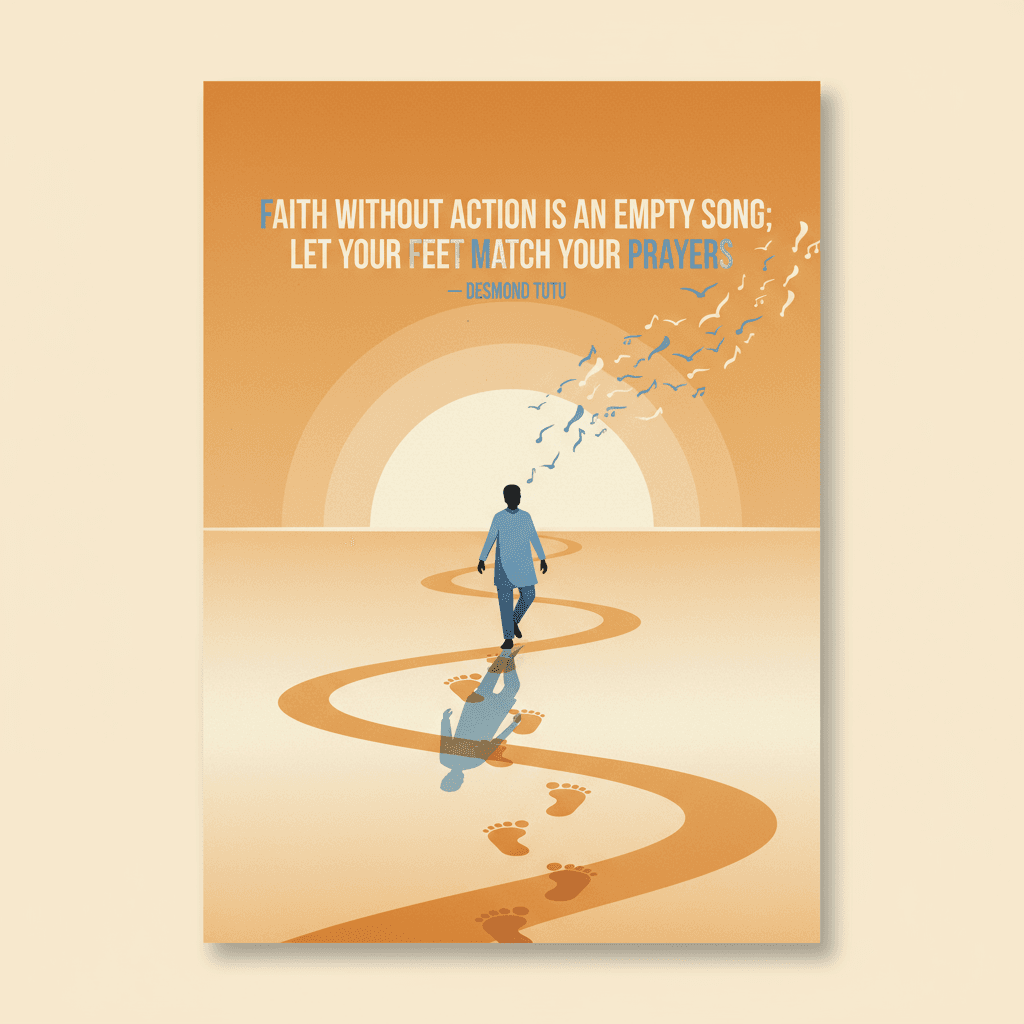
Faith without action is an empty song; let your feet match your prayers — Desmond Tutu
—What lingers after this line?
From Melody to Movement
Desmond Tutu’s image of an “empty song” invites us to hear faith not as a private tune but as music that demands choreography. A melody without steps charms the ear yet changes nothing; likewise, prayer without practice leaves injustice undisturbed. By urging our feet to match our prayers, Tutu reframes devotion as something audible and visible, a score written both in petitions and in paths taken. Thus, belief becomes a lived composition whose truth is verified in motion.
Scripture’s Rhythm of Justice
This call echoes ancient cadences. The Letter of James declares that faith without works is dead (James 2:17), insisting that trust in God must be embodied. Likewise, the prophet Amos rejects mere worship music—“the noise of your songs”—until justice rolls down like waters (Amos 5:23–24). These intertwined texts turn liturgy outward, pressing singers into service. Consequently, prayer ceases to be an escape and becomes an engine, propelling the faithful toward repair of the world.
Tutu’s Prayer in Motion
Building on these roots, Tutu fused intercession with action on the streets of apartheid South Africa. From St. George’s Cathedral in Cape Town, he led services that spilled into marches, treating sidewalks as aisles and placards as psalms. Later, as chair of the Truth and Reconciliation Commission, he turned moral vision into institutional practice, pairing confession with restitution (No Future Without Forgiveness, 1999). In his life, prayer did not soften resistance; it steeled it, directing courage toward restorative ends.
A Wider Chorus of Witness
Tutu’s refrain harmonizes with other voices. Dietrich Bonhoeffer warned against “cheap grace,” a grace unaccompanied by costly obedience (The Cost of Discipleship, 1937). Dorothy Day braided daily Mass with soup lines and tenant organizing (The Long Loneliness, 1952). Even beyond Christian tradition, Gandhi synchronized dawn prayers with satyagraha, as in the 1930 Salt March. Across contexts, the pattern holds: contemplation sets the tempo, but justice provides the downbeat.
Translating Prayer Into Practice
From here, the question becomes operational: how do we let our feet keep time? One useful move is to pair every petition with a concrete task—calendar a visit, email a representative, or redirect a portion of one’s budget. The monastic idea of a “rule of life” (The Rule of St. Benedict, 6th century) can align prayer, work, and rest. Imagine praying for a neighbor facing eviction; the same week, you join their court support, organize a meal train, and contribute to a rent relief fund. In this way, intercession becomes itinerary.
Guarding Against Performative Piety
Yet zeal needs guardrails. Jesus cautions against practicing righteousness to be seen by others (Matthew 6:1), and the thirst for optics can hollow out action into branding. To keep integrity, measure outcomes by the good of those affected, not by applause. Listen first to communities most impacted, let them set priorities, and accept correction. When prayer yields humility, action follows as service rather than spectacle.
Sustaining the Song Together
Finally, lasting faith-in-action is communal. Choirs don’t depend on a single voice; they share breath, blend timbres, and keep time together. Likewise, small, recurring commitments—mutual aid shifts, mentoring, neighborhood cleanups, policy advocacy—create a steady beat that solos cannot sustain. Over time, these rhythms reshape habits and institutions. And as the work continues, prayer keeps tuning hearts, ensuring the music does not fade and the feet do not fail.
One-minute reflection
What does this quote ask you to notice today?
Related Quotes
6 selectedYour life is an expression of your faith when you act on it. — John C. Maxwell, United States.
John C. Maxwell, United States.
This quote emphasizes that true faith is not merely a belief but should be demonstrated through our actions. It suggests that one's deeds reflect their inner convictions.
Read full interpretation →Let your hands do the believing; work translates hope into reality. — Frederick Douglass
Frederick Douglass
The line invites us to relocate belief from the tongue to the fingertips. Rather than treating hope as a feeling to be admired, it frames hope as a draft that must be cashed by labor.
Read full interpretation →Faith without work is a light without warmth; kindle it with deeds. — Desmond Tutu
Desmond Tutu
Tutu’s image draws a line between seeing and sustaining life. Light guides, yet without heat it remains sterile—useful for identification but useless for growth.
Read full interpretation →Speak with your feet as much as with your words; justice moves when we follow through — Desmond Tutu
Desmond Tutu
Desmond Tutu’s counsel to "speak with your feet" insists that moral language must become visible in public life. Words name what is right; steps enact it.
Read full interpretation →We are not here to carry the weight of the world alone. Strength is found in the simple, vulnerable act of asking for help. — Desmond Tutu
Desmond Tutu
Desmond Tutu’s words begin with a gentle correction to a common illusion: that dignity means handling everything alone. Instead, he reminds us that human life is fundamentally shared, and that suffering, responsibility,...
Read full interpretation →You don't choose your family. They are God's gift to you, as you are to them. — Desmond Tutu
Desmond Tutu
Desmond Tutu’s reflection begins with a simple but profound truth: family is not usually the result of personal selection. We arrive in the world already woven into relationships, and that lack of choice gives family a d...
Read full interpretation →More From Author
More from Desmond Tutu →We are not here to carry the weight of the world alone. Strength is found in the simple, vulnerable act of asking for help. — Desmond Tutu
Desmond Tutu’s words begin with a gentle correction to a common illusion: that dignity means handling everything alone. Instead, he reminds us that human life is fundamentally shared, and that suffering, responsibility,...
Read full interpretation →You don't choose your family. They are God's gift to you, as you are to them. — Desmond Tutu
Desmond Tutu’s reflection begins with a simple but profound truth: family is not usually the result of personal selection. We arrive in the world already woven into relationships, and that lack of choice gives family a d...
Read full interpretation →There is no true joy in a life lived closed up in the little shell of the self. When you take one step to reach out to people, when you meet with others and share their thoughts, you expand your world. — Desmond Tutu
Desmond Tutu begins with a striking image: the self as a little shell, enclosed and protected yet ultimately cramped. In that metaphor, he suggests that a life organized entirely around private comfort and self-concern m...
Read full interpretation →We are made for goodness. We are made for love. We are made for friendliness. We are made for togetherness. — Desmond Tutu
At its heart, Desmond Tutu’s statement presents a hopeful view of human nature. Rather than defining people by selfishness or conflict, he insists that goodness, love, friendliness, and togetherness are not accidental vi...
Read full interpretation →