
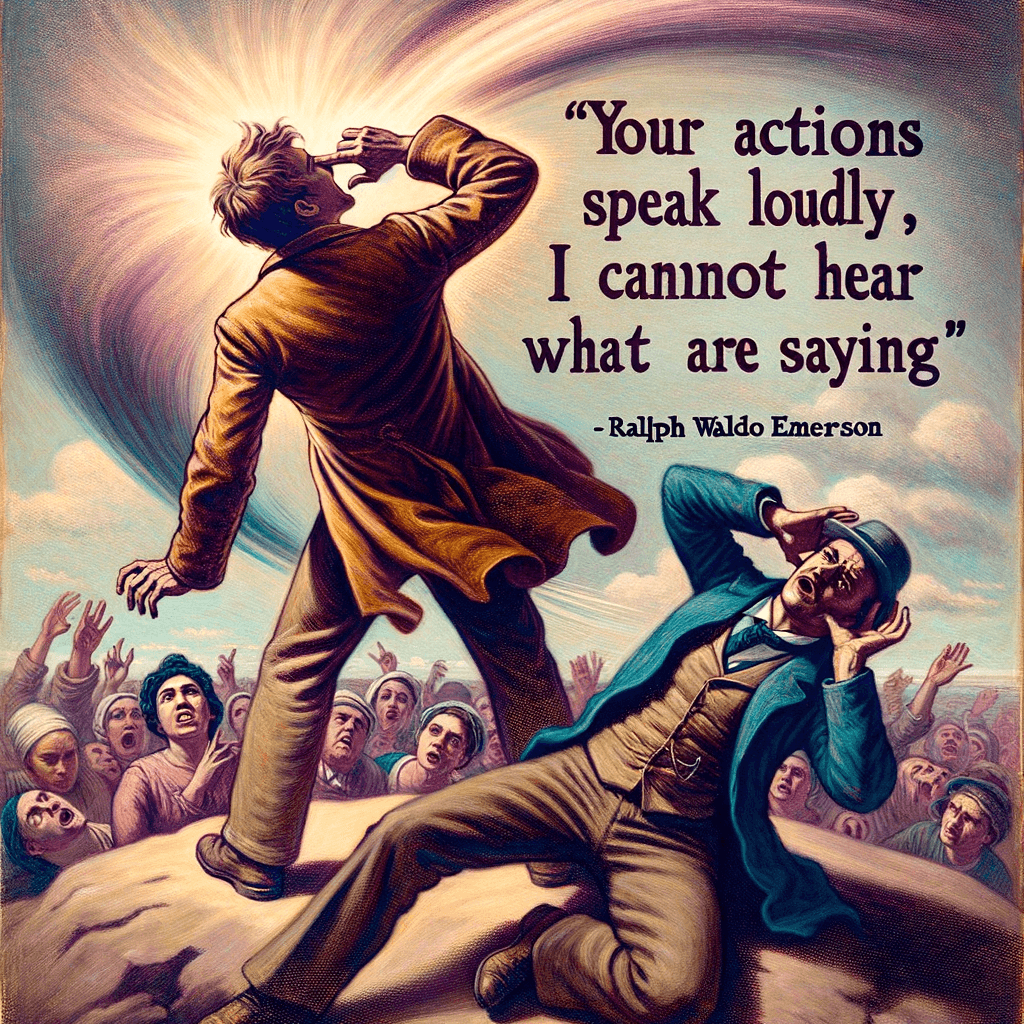
Your actions speak so loudly, I cannot hear what you are saying. — Ralph Waldo Emerson, United States.
—What lingers after this line?
Authenticity of Actions
This quote highlights the importance of aligning one's actions with their words. It suggests that actions are a more accurate reflection of a person's true intentions and character than their spoken words.
Communication Beyond Words
Emerson emphasizes that non-verbal cues often convey stronger messages than verbal communication. People are more likely to believe what they see rather than what they hear.
Impact of Actions on Trust
When actions contradict words, it can lead to mistrust and skepticism. This quote underscores how essential it is for individuals to ensure their actions foster trust and credibility.
Social Responsibility
In a broader context, the quote can be applied to society's leaders and influencers, suggesting that they must act responsibly and model the values they espouse in order to inspire genuine change.
Historical Context
Ralph Waldo Emerson was a 19th-century American philosopher, essayist, and poet associated with the Transcendentalist movement, which emphasized individuality and self-reliance, illuminating the relationship between thought and action.
One-minute reflection
Where does this idea show up in your life right now?
Related Quotes
6 selectedActions speak louder than words. Let your words teach and your actions speak. — Saint Anthony of Padua
Saint Anthony of Padua
This quote emphasizes that what we do has a greater impact and carries more weight than what we say. Actions can often convey our intentions and commitments more effectively than words.
Read full interpretation →Saying no is an act of integrity. It aligns what you do with what you believe. — Annie Wright
Annie Wright
Annie Wright’s statement reframes the word “no” not as rejection, but as moral clarity. At its core, saying no is a way of protecting the space between one’s values and one’s actions.
Read full interpretation →The best people possess a feeling for beauty, the courage to take risks, the discipline to tell the truth, the capacity for sacrifice. — Ernest Hemingway
Ernest Hemingway
Hemingway’s line presents goodness not as politeness or success, but as a demanding inner code. The “best people” are those who combine sensitivity, bravery, honesty, and self-denial—qualities that do not always coexist...
Read full interpretation →An ounce of action is worth a ton of theory. — Ralph Waldo Emerson, United States.
Ralph Waldo Emerson, United States.
This quote emphasizes that taking action is far more valuable than merely discussing or theorizing about a concept. Real-world application leads to tangible results.
Read full interpretation →How much time he gains who does not look to see what his neighbour says or does or thinks, but only at what he does himself, to make it just and holy. — Marcus Aurelius
Marcus Aurelius
Marcus Aurelius argues that a great deal of life is wasted in watching other people—what they say, what they do, and even what they might be thinking. Instead, he recommends a disciplined inward turn: focus on your own c...
Read full interpretation →Real integrity is doing the right thing, knowing that nobody's going to know whether you did it or not. — Oprah Winfrey
Oprah Winfrey
At its core, Oprah Winfrey’s remark defines integrity as an inner standard rather than a public performance. Doing the right thing when no recognition is possible strips away applause, reputation, and reward, leaving onl...
Read full interpretation →More From Author
More from Ralph Waldo Emerson, United States. →