
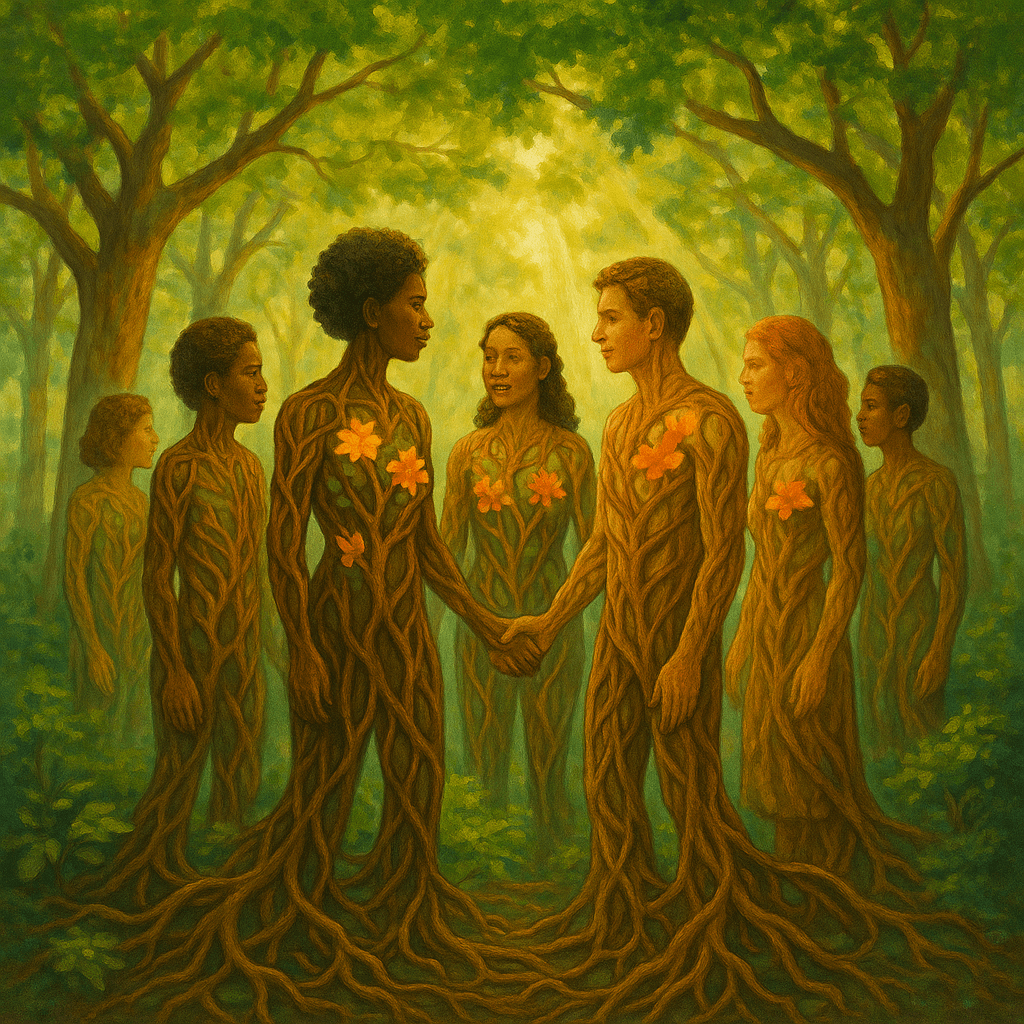
A person is a person through other persons. — Ubuntu Philosophy
—What lingers after this line?
The Essence of Ubuntu Philosophy
At the heart of this statement lies the core of Ubuntu, an African philosophy emphasizing communal interdependence. Ubuntu, often translated as 'I am because we are,' asserts that personal identity and dignity are inextricably linked to the fabric of relationships within a community. Unlike Western ideologies that prioritize individualism, Ubuntu posits that one’s humanity is realized only through mutual recognition and shared existence.
Historical and Cultural Context
To deepen our understanding, we can look to the societies where Ubuntu flourished. In many Southern African cultures, the saying is more than a proverb; it is a guiding principle. The philosophy informed tribal governance, conflict resolution, and social structure. For instance, in Nelson Mandela's South Africa, Ubuntu was invoked to unite a divided nation, as seen in the Truth and Reconciliation Commission, which promoted healing through collective responsibility rather than retribution.
Contrasting Philosophical Traditions
Transitioning from Ubuntu, Western traditions like those found in John Locke’s writings focus on the autonomous self, valuing independence and personal rights. In contrast, Ubuntu re-centers value on the community, suggesting that fulfillment arises not in isolation but in shared belonging. This contrast deepens our appreciation of Ubuntu’s challenge: it calls for a reevaluation of the very foundations upon which society is built.
Applications in Modern Society
Bridging history and philosophy with daily life, Ubuntu’s principles have relevance today in areas such as restorative justice, cooperative workplaces, and inclusive education. The approach is evident in team-based organizational structures and in societies that seek reconciliation over retribution after conflict. For example, community-based support networks during crises often embody Ubuntu's ethos by prioritizing collective welfare over individual gain.
Ubuntu’s Enduring Legacy
Ultimately, Ubuntu endures as an invitation to recognize our shared humanity. Its wisdom resonates in global challenges, from climate action to public health, where solidarity and empathy shape outcomes. As we navigate increasingly interconnected societies, Ubuntu's reminder is clear: our well-being is intertwined, and a compassionate world is one in which each person is uplifted by—and for—the other.
Recommended Reading
As an Amazon Associate, we earn from qualifying purchases.
One-minute reflection
Where does this idea show up in your life right now?
Related Quotes
6 selectedA sense of belonging is the best medicine for the human heart; it is the feeling that we are part of something larger than ourselves. — Maya Angelou
Maya Angelou
Maya Angelou’s insight begins with a simple but profound truth: emotional healing rarely happens in isolation. By calling belonging “the best medicine,” she suggests that the heart is restored not only through comfort, b...
Read full interpretation →Community does not mean that we all agree on everything. It means that we respect each other enough to stay in the room. — Audre Lorde
Audre Lorde
At its core, Audre Lorde’s statement challenges the comforting but shallow idea that community is built on sameness. Instead, she argues that real belonging depends on the willingness to remain present with one another e...
Read full interpretation →Belonging is not something we join—it's something we bring to life by how we live. — Parker J. Palmer
Parker J. Palmer
At first glance, Parker J. Palmer’s line shifts belonging away from membership and toward practice.
Read full interpretation →The only way we're going to make it is in the company of others. We need each other. In all ways. — Mia Birdsong
Mia Birdsong
Mia Birdsong’s statement begins with a simple but far-reaching truth: human life is not built for isolation. By saying “the only way we’re going to make it” is with others, she reframes survival as a collective act rathe...
Read full interpretation →Belonging is not a service to be outsourced to an app; it is made by people, in rooms, on purpose. — Samuel J. Abrams
Samuel J. Abrams
Samuel J. Abrams’s line pushes back against a modern fantasy: that loneliness can be solved as conveniently as food delivery or ride-hailing.
Read full interpretation →No man is an island, entire of itself; every man is a piece of the continent, a part of the main. — John Donne
John Donne
John Donne begins by dismantling the fantasy of complete self-sufficiency. To say that no man is an island is to argue that human beings cannot exist in any meaningful sense apart from others; our identities, duties, and...
Read full interpretation →More From Author
More from Ubuntu Philosophy →