
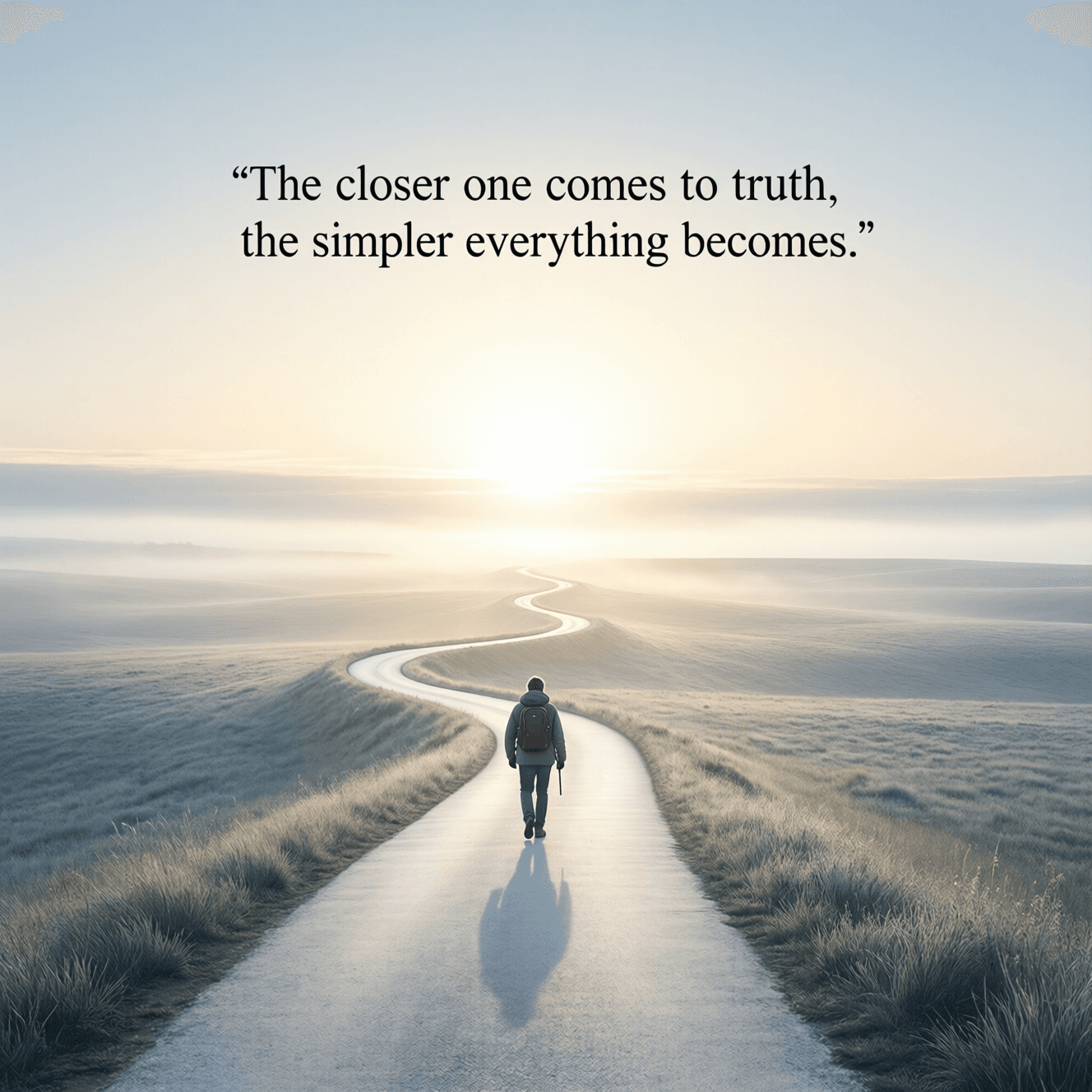
The closer one comes to truth, the simpler everything becomes. — African Proverb
—What lingers after this line?
Simplicity as a Sign of Truth
The proverb suggests that truth has a clarifying power: as you approach what is real, the extra clutter—misdirection, anxiety, and needless complication—falls away. In other words, complexity often signals that we are still circling the issue, relying on patches and assumptions rather than seeing the core. From this perspective, simplicity is not a shortcut or a lack of depth; it is the result of depth. When something is truly understood, it can often be stated plainly, because it rests on fewer hidden conditions and fewer defenses against contradiction.
How Confusion Creates Complexity
Building on that idea, the proverb also points to a common human habit: when we are uncertain, we pile on explanations. A shaky story needs elaborate details to sound convincing, while a solid one can remain straightforward. This is why confused thinking frequently produces tangled plans and brittle rules. Consider a workplace that doesn’t trust its own goals: it may generate endless metrics and procedures to substitute for clarity. As truth becomes more visible—what matters, what doesn’t, and why—many of those additions reveal themselves as noise, and the system naturally simplifies.
Wisdom Traditions and the Plain Core
Moving from everyday experience to broader tradition, many philosophies treat simplicity as the mark of wisdom. Laozi’s Tao Te Ching (c. 4th century BC) repeatedly praises the “uncarved block,” implying that the most reliable understanding is not ornate but essential. Likewise, Occam’s Razor, associated with William of Ockham (14th century), advises not multiplying assumptions beyond necessity. Although these traditions differ, they converge on a similar lesson: when an explanation relies on fewer moving parts, it often fits reality better. The proverb captures that convergence in a compact, memorable form.
Science, Models, and Elegant Explanations
In science, the journey toward truth frequently looks like a journey toward cleaner models. Newton’s laws (1687) did not list separate rules for each planet; instead, they unified motion under a small set of principles. Later, Einstein’s relativity (1905–1915) reorganized assumptions about space and time to explain observations with a different, but still tightly structured, framework. Importantly, “simpler” here doesn’t mean easy—it means coherent. A theory can be mathematically demanding while still being conceptually lean, because it reduces ad hoc exceptions and makes disparate facts hang together.
Personal Truth: From Overthinking to Clarity
Shifting from theories to the self, the proverb describes a familiar inner pattern: when you’re far from the truth, you argue with yourself; when you near it, you feel quiet certainty. A person might spend months justifying why they stayed in a harmful situation, and then, with one honest admission—“I was afraid to be alone”—the story becomes simpler and the next step becomes clearer. This doesn’t erase pain or complexity in life, but it reduces mental distortion. As self-deception drops away, choices can be guided by fewer, more honest reasons.
Simplicity Without Oversimplifying
Finally, the proverb invites a careful balance: simplicity should emerge from truth, not replace it. Some issues—trauma, poverty, history—are genuinely complex, and forcing them into neat slogans can be another form of untruth. The goal is not to flatten reality, but to remove what is unnecessary or false. In that light, the proverb becomes a practical compass: keep asking which parts are essential, which parts are defensive additions, and which parts are distractions. As the essentials come into focus, everything else naturally becomes easier to carry.
One-minute reflection
What's one small action this suggests?
Related Quotes
6 selectedA thousand truths leave a hundred lies behind. — African Proverb
African Proverb
The African proverb, 'A thousand truths leave a hundred lies behind,' immediately highlights the intricate relationship between truth and falsehood. Truth is seldom absolute; even when surrounded by many facts, unintenti...
Read full interpretation →The simplest things are often the truest. — Richard Bach
Richard Bach
This quote suggests that truth is often found in simple things, rather than in complexity or overthinking.
Read full interpretation →Truth is ever to be found in simplicity, and not in the multiplicity and confusion of things. — Isaac Newton
Isaac Newton
Isaac Newton’s assertion underscores his lifelong devotion to seeking foundational truths in uncomplicated principles. Rather than getting lost in a maze of details, Newton advocated for a return to the basic elements un...
Read full interpretation →Truth is ever to be found in simplicity, and not in the multiplicity and confusion of things. — Isaac Newton
Isaac Newton
Isaac Newton’s insight suggests that true understanding does not lie hidden in networks of confusion, but in clarity and simplicity. This principle powered many of Newton’s greatest discoveries, from the laws of motion t...
Read full interpretation →Complexity means distracted effort. Simplicity means focused effort. — Edward De Bono
Edward de Bono
At its heart, Edward de Bono’s remark draws a sharp distinction between motion and direction. Complexity, in this sense, is not merely having many parts; rather, it is effort scattered across too many priorities, decisio...
Read full interpretation →Make your life simple, but significant. — Maria Defillo
Maria Defillo
Maria Defillo’s line begins with an apparent contrast and then quietly resolves it: a life can be simple without being small. In fact, the quote suggests that reducing clutter—whether in possessions, ambitions, or distra...
Read full interpretation →More From Author
More from African Proverb →When the roots are deep, there is no reason to fear the wind. — African Proverb
The proverb frames life as weather and character as a tree: when roots run deep, wind becomes something to endure rather than something to dread. In that image, fear is not denied so much as put in its place—storms still...
Read full interpretation →The sun does not hurry to rise, yet it never misses its mark. — African Proverb
The proverb begins with an image so familiar it’s easy to overlook: sunrise. The sun appears without strain, without haste, and without visible anxiety about being “on time.” And yet, day after day, it arrives.
Read full interpretation →Do not look where you fell, but where you slipped. — African Proverb
The proverb urges a subtle but powerful change in attention: don’t fixate on the place where you landed in pain or embarrassment; instead, examine the moment your footing first failed. In other words, the visible setback...
Read full interpretation →Success is not for the lazy. — African Proverb
This proverb underscores the importance of diligence and effort. It highlights that achieving success requires consistent hard work and determination.
Read full interpretation →