
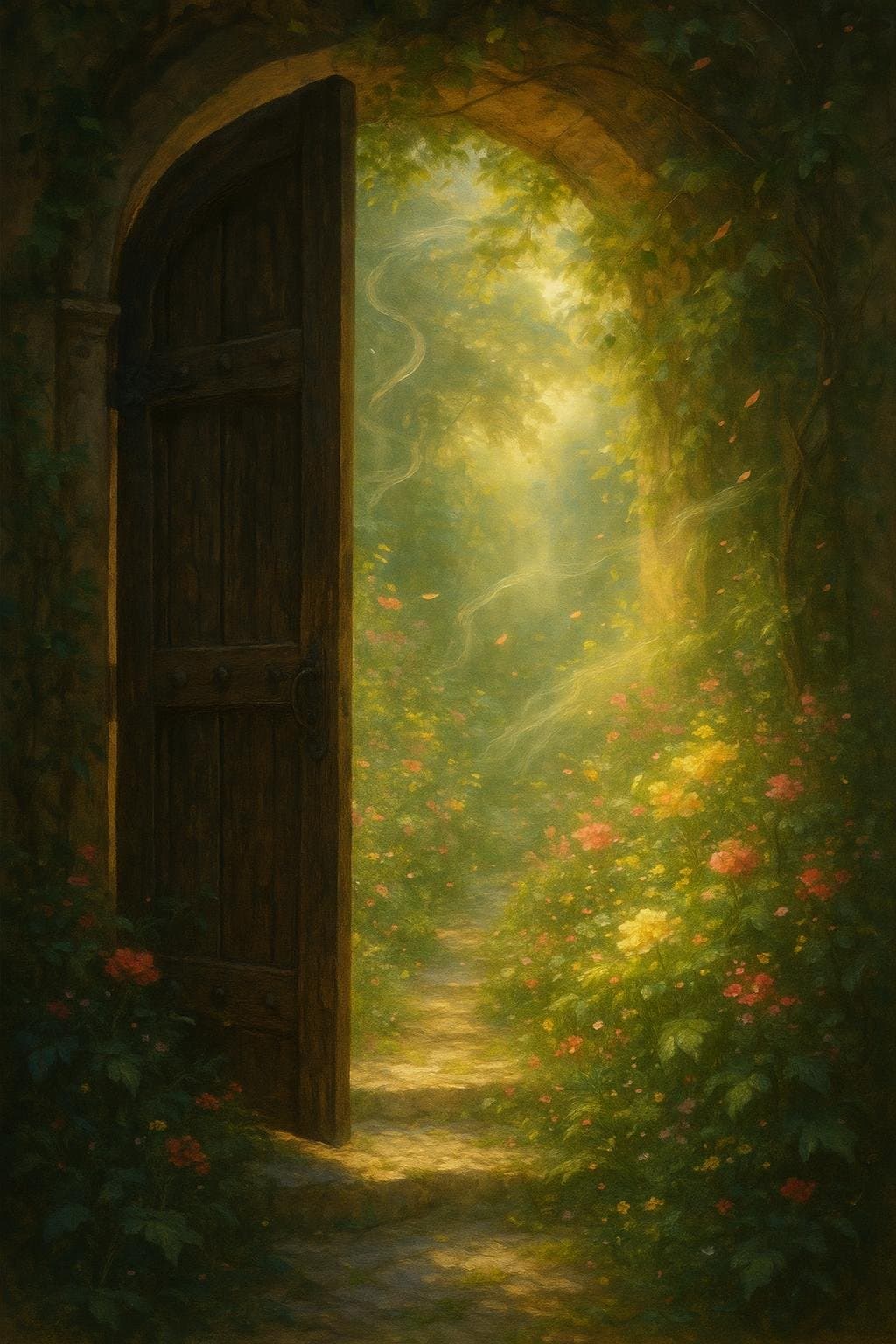
To desire truth, leave the door to the garden open. — Jalaluddin Rumi
—What lingers after this line?
The Symbolism of the Open Door
Rumi’s metaphor of leaving 'the door to the garden open' encapsulates a profound approach to truth-seeking. The open door suggests readiness to explore, welcoming uncertainty and the unexpected. Rather than confining oneself within preconceived notions, Rumi invites us to remain accessible to new insights, much as a garden’s beauty reveals itself only to those who step outside and look.
Embracing Curiosity as a Virtue
Building on this metaphor, curiosity becomes the essential quality for those who desire truth. In Rumi’s Sufi tradition, questions and wonder pave the way to deeper understanding; closed doors represent dogma and rigidity. Socrates’ method of inquiry, as depicted in Plato’s dialogues, similarly values an open exchange of ideas over the security of fixed answers.
The Transformative Power of Uncertainty
Openness to the unknown is not easy—it requires humility and the willingness to change. Rumi’s counsel parallels contemporary psychological insights: Carol Dweck’s 'growth mindset,' for example, posits that those receptive to new experiences evolve and learn more effectively. Thus, the open door is not mere passivity, but an active embrace of life’s mysteries and paradoxes.
Gardens as Spaces of Discovery
The garden itself, a recurring image in Rumi’s poetry, represents a place of cultivation and renewal. For seekers of truth, gardens symbolize rich, ever-changing terrains where answers may grow in unexpected forms. In Persian literary tradition, gardens such as those described in the poet Saadi’s 'Golestan' (The Rose Garden, 1258) serve both as literal refuges and allegories for the soul’s blooming.
Truth as a Journey Rather Than a Destination
Ultimately, Rumi’s invitation is to maintain a spirit of openness throughout life’s journey. Truth is not a locked treasure, but an ongoing process, discovered gradually as we allow ourselves to wander and wonder. By keeping metaphorical doors to the garden open, we foster not only the wisdom to see the world freshly, but also the compassion and flexibility to grow along with it.
One-minute reflection
What's one small action this suggests?
Related Quotes
6 selectedThe truth is rarely comfortable, but it is the only thing that will actually set you free. Stop hiding from your reality and start owning your choices. — Pema Chödrön
Pema Chödrön
At its core, Pema Chödrön’s statement argues that freedom does not come from denial, distraction, or carefully managed appearances. Instead, it begins with the willingness to confront what is real, even when that reality...
Read full interpretation →Be a loner. That gives you time to wonder, to search for the truth. Have holy curiosity. Make your life worth living. — Albert Einstein
Albert Einstein
At first glance, Einstein’s advice to “be a loner” may sound like a rejection of society, yet his deeper point is about protecting the inner space where thought can mature. Solitude gives a person room to hear their own...
Read full interpretation →Even in literature and art, no man who bothers about originality will ever be original: whereas if you simply try to tell the truth, you will, nine times out of ten, become original without ever having noticed it. — C.S. Lewis
C.S. Lewis
At first glance, C.S. Lewis presents a paradox: the harder an artist chases originality, the less likely it is to appear.
Read full interpretation →If you want the truth, you must be brave enough to hear it. — Margaret Heffernan
Margaret Heffernan
At first glance, Margaret Heffernan’s remark sounds like a simple call for honesty, yet it reaches further than that. She suggests that truth is not merely something we uncover through intelligence or investigation; rath...
Read full interpretation →Confrontation without receptivity leads to an oppressive aggression which hurts everybody. — Henri Nouwen
Henri Nouwen
At its core, Henri Nouwen’s sentence warns that confrontation alone is not a virtue. Speaking hard truths may seem courageous, yet without receptivity—a willingness to listen, receive, and be changed—the act quickly beco...
Read full interpretation →The truth is rarely a soft place to fall, but it is the only foundation you can actually stand on. — Criss Jami
Criss Jami
At first glance, Criss Jami’s line frames truth as something severe rather than comforting. It does not cushion disappointment, flatter illusion, or spare us from painful recognition.
Read full interpretation →More From Author
More from Jalaluddin Rumi →Your task is not to seek for love, but merely to seek and find all the barriers within yourself that you have built. — Jalaluddin Rumi
This quote suggests that the obstacles preventing you from experiencing love already exist within you. Instead of actively searching for love externally, the focus should be on removing your internal barriers, such as fe...
Read full interpretation →Every achievement is a victory of perception over reality. — Jalaluddin Rumi
This quote emphasizes the importance of one's mindset and perception in determining success. Achievements often begin as ideas or perceptions, and when one believes in their vision, they can shape reality accordingly.
Read full interpretation →Let your dreams outgrow the shell of your reality. — Jalaluddin Rumi
This quote encourages individuals to dream beyond their current circumstances and aim for higher aspirations. It suggests that one's present reality should not confine their potential.
Read full interpretation →The wound is the place where the light enters you. — Jalaluddin Rumi
This quote suggests that personal pain or suffering can be a source of growth and healing.
Read full interpretation →