
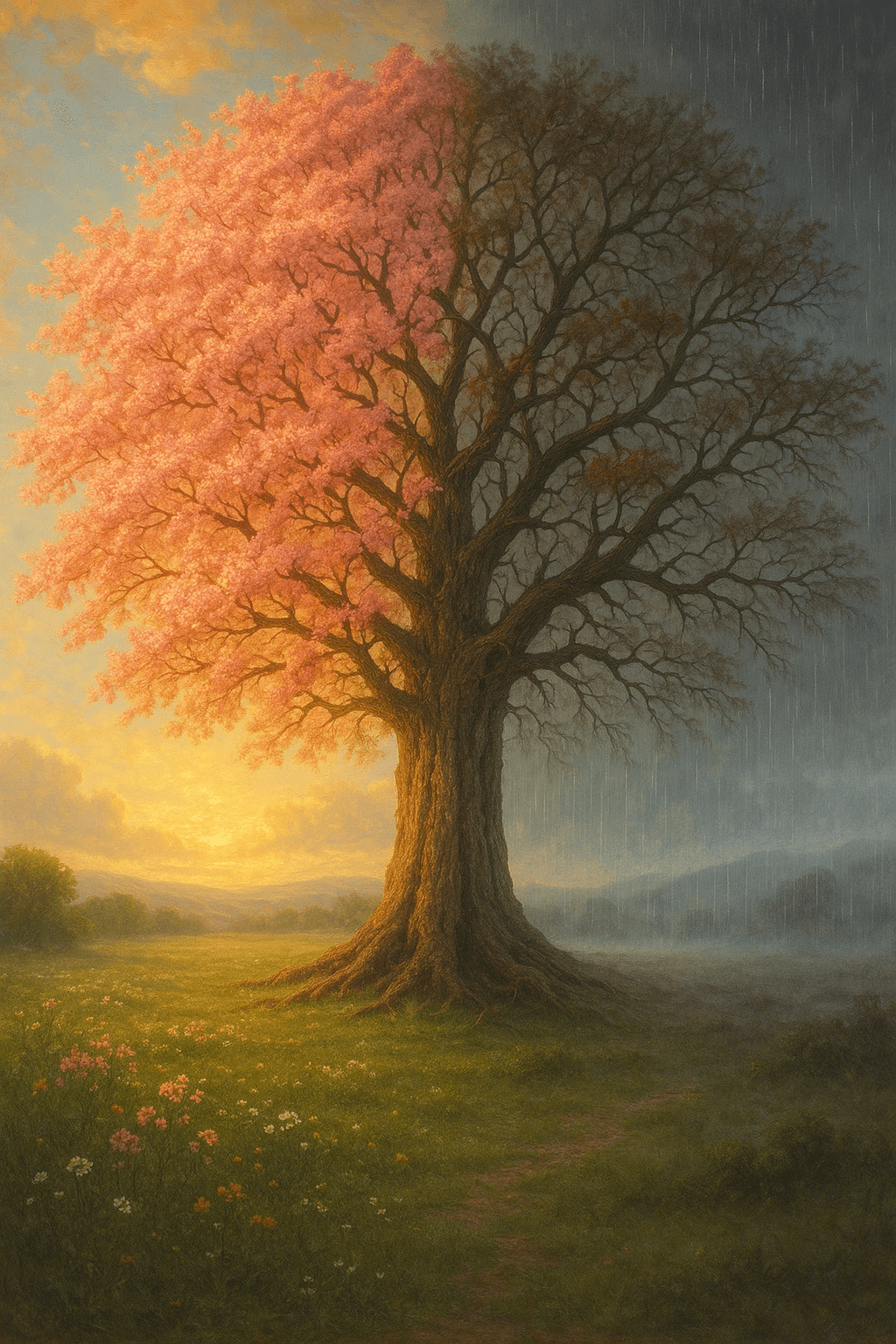
You cannot protect yourself from sadness without protecting yourself from happiness. — Jonathan Safran Foer
—What lingers after this line?
The Interconnected Nature of Emotions
Jonathan Safran Foer’s insight spotlights an elemental truth: emotions do not exist in isolation. To avoid sadness entirely, one would have to dull their emotional responses so thoroughly that happiness, too, becomes inaccessible. This duality echoes ancient philosophical discussions—Aristotle’s ‘Nicomachean Ethics’ suggests that the richness of pleasure is experienced only by those susceptible to pain. Blocking out negative emotions inadvertently dims life’s brighter moments as well.
Emotional Risk and the Human Experience
Extending this logic, embracing vulnerability is an essential part of living fully. When we armor ourselves against hurt or loss, we also build barriers that keep out joy and connection. C.S. Lewis, in ‘The Four Loves’ (1960), eloquently warned that locking your heart away to avoid suffering guarantees not only insulation from pain, but also from love itself. Thus, risk and reward, sadness and happiness, remain intrinsically linked.
Literary Examples of Emotional Openness
Literature abounds with characters who exemplify this connection. In Charlotte Brontë's ‘Jane Eyre,’ Jane’s willingness to experience grief and loss is precisely what enables her to ultimately enjoy profound love and happiness. Her emotional openness, though painful, enriches her life and grants her resilience—a demonstration of Foer’s principle in narrative form.
Scientific Perspectives on Emotional Range
Contemporary psychology supports the necessity of experiencing the full spectrum of emotion. Research on emotional suppression, such as that by Gross & Levenson (1997), has found that attempting to numb unpleasant feelings also lowers overall emotional satisfaction and connection. Inhibiting sorrow may provide temporary relief, but it stunts genuine joy and dampens everyday positive experiences.
Practical Wisdom in Embracing Both Sides
Ultimately, Foer’s observation encourages us to approach life with openness, even when that means facing discomfort. By welcoming both happiness and sadness, we cultivate resilience and deepen our appreciation of joy. The art of living, therefore, isn’t in avoiding sadness, but in accepting the full spectrum of emotion as the price—and privilege—of a rich, authentic life.
Recommended Reading
As an Amazon Associate, we earn from qualifying purchases.
One-minute reflection
Where does this idea show up in your life right now?
Related Quotes
6 selectedThe only way to find true happiness is to risk being completely cut open. — Chuck Palahniuk
Chuck Palahniuk
This quote expresses the idea that true happiness requires us to be vulnerable. By allowing ourselves to be emotionally 'cut open,' we can confront our deepest fears and desires, leading to genuine fulfillment.
Read full interpretation →Just keep in mind: the greater your capacity to love, the greater your capacity to feel pain. — Jennifer Aniston
Jennifer Aniston
This quote highlights the intrinsic connection between love and pain. The stronger one's ability to love, the more vulnerable they are to experiencing deep emotional pain when things go wrong in that relationship.
Read full interpretation →Growth is often uncomfortable, messy, and full of feelings you weren’t expecting. — Unknown, attributed to Brené Brown
Unknown, attributed to Brené Brown
Transformation rarely comes smoothly. This perspective echoes psychologist Carl Rogers, who noted, 'The curious paradox is that when I accept myself just as I am, then I can change.' Change often requires facing discomfo...
Read full interpretation →The best armor is to keep your heart soft. — Paulo Coelho
Paulo Coelho
Traditionally, armor is imagined as something hard and impenetrable, designed to shield us from external threats. Paulo Coelho’s insight turns this notion on its head, encouraging us to see vulnerability—not toughness—as...
Read full interpretation →Tears shed for another person are not a sign of weakness. They are a sign of a pure heart. — José N. Harris
José N. Harris
José N. Harris’s insight urges a reevaluation of societal attitudes toward tears.
Read full interpretation →To refuse to be harmed is to refuse to grow. — Friedrich Nietzsche
Friedrich Nietzsche
Friedrich Nietzsche’s assertion that ‘to refuse to be harmed is to refuse to grow’ invites us to reconsider our relationship with pain and adversity. Rather than seeing harm as merely destructive, Nietzsche regards it as...
Read full interpretation →More From Author
More from Jonathan Safran Foer →