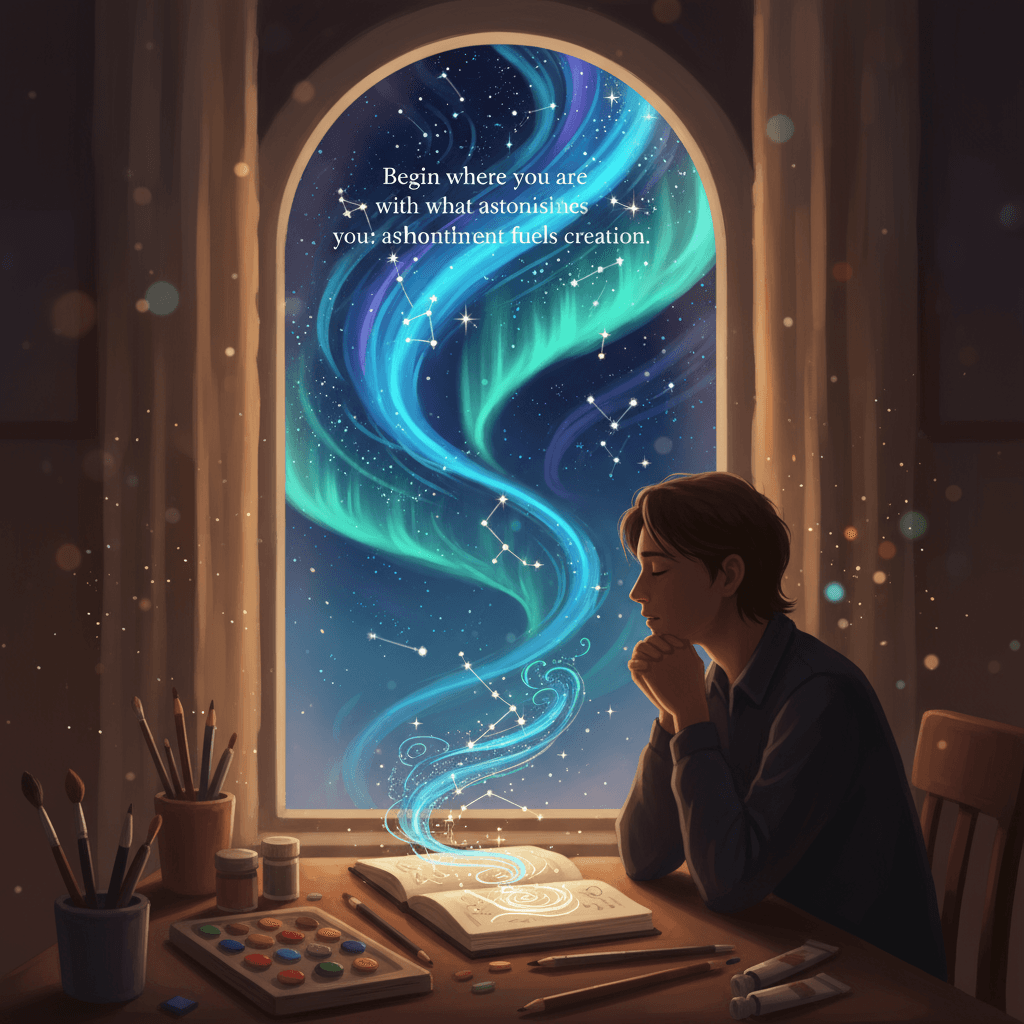
If Cummings roots creativity in immediacy, history echoes the same impulse. Mary Oliver’s “Instructions for living a life: Pay attention. Be astonished. Tell about it.” (“Sometimes,” Red Bird, 2008) traces a three-step arc from noticing to making. Likewise, Einstein’s remark that “the most beautiful thing we can experience is the mysterious” connects awe to discovery.
Artists and scientists have long treated astonishment as method. Leonardo’s notebooks swarm with observations of water eddies and bird flight; Darwin’s “I think” sketch (Notebook B, 1837) crystallizes awe into evolutionary insight. Across disciplines, wonder is both the compass and the engine. [...]