#Small Wins
Quotes tagged #Small Wins
Quotes: 7

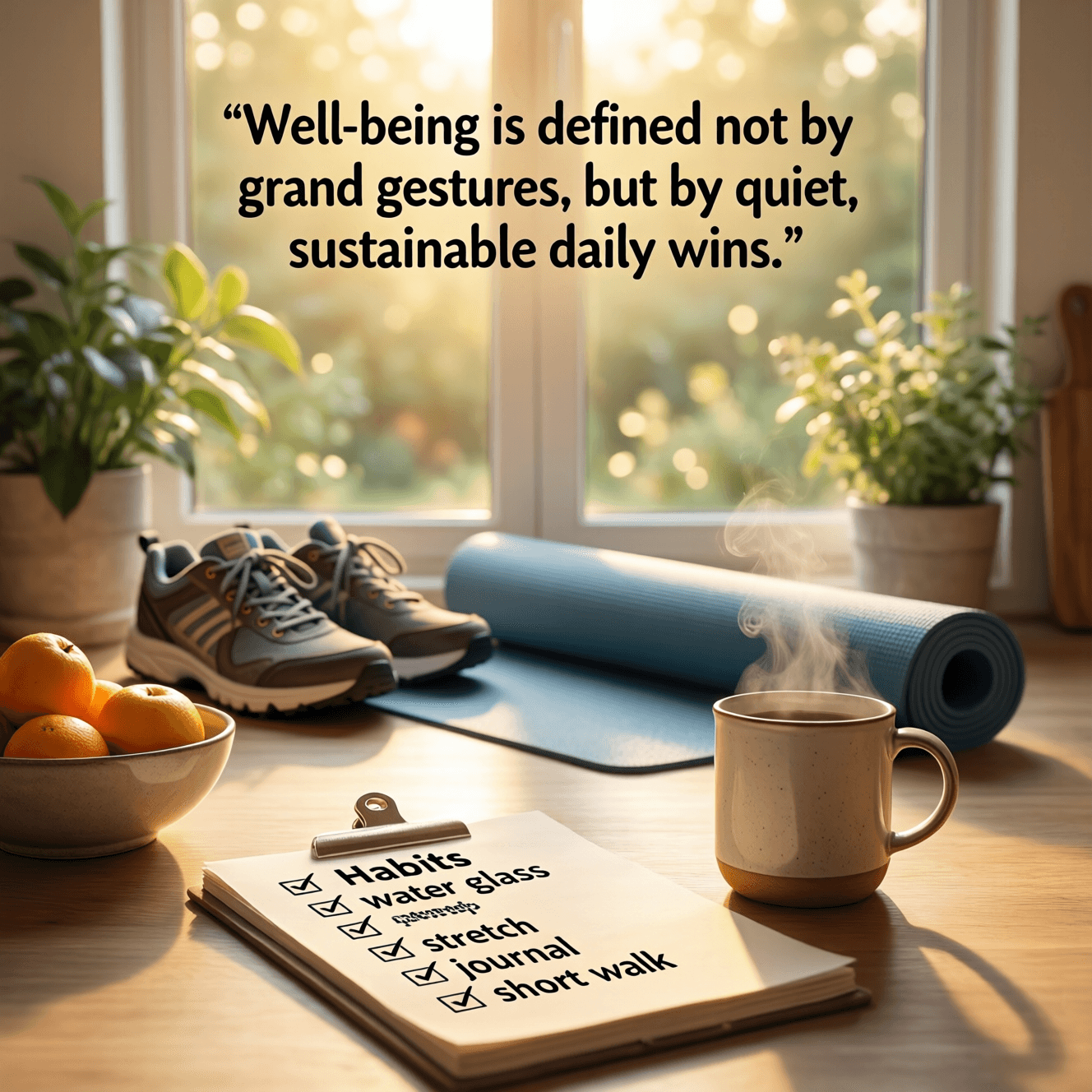
Well-Being Built Through Quiet Daily Wins
Building on that redefinition, the word “sustainable” becomes the moral center of the proverb. Intense efforts can create short-term change, but they can also invite burnout, guilt, and the sense of starting over repeatedly. Sustainable actions, by contrast, are designed to fit the life you actually have. This is why a ten-minute walk after dinner can outperform a once-a-week heroic workout plan that collapses under stress. Over time, sustainability turns self-care from a project into a default, making well-being resilient rather than fragile. [...]
Created on: 2/2/2026

Mapping Small Victories for Life’s Storms
Nin doesn’t specify the scale of the victories, and that openness is the point. A victory can be measurable (paid a bill, finished a draft, went to therapy) or subtle (asked for help, set a boundary, chose rest instead of self-punishment). Over time, the map becomes tailored to your real challenges rather than someone else’s standards. Importantly, this reframes identity: you’re not only the person who feels overwhelmed; you’re also the person who has repeatedly taken the next viable step. As the collection grows, the victories begin to connect like routes between landmarks—revealing patterns of coping that you can reuse. [...]
Created on: 12/14/2025

Gathering Small Wins as Evidence of Growth
Gibran’s image of shells scattered along a shoreline turns personal growth into a walk on the beach. Each shell, seemingly modest and ordinary, symbolizes a small win—a finished task, a learned skill, or a moment of courage. Just as no single shell defines the entire coast, no single achievement captures the whole of a life. Yet, taken together, they map the distance you have traveled. This metaphor gently shifts focus away from dramatic breakthroughs toward the quieter, cumulative steps that genuinely carry you forward. [...]
Created on: 11/24/2025

Small Wins as the Currency of Life
By analogy, consider finance: compound interest turns modest deposits into substantial wealth because time multiplies effort. Similarly, small skills and relationships accumulate optionality—new opportunities that weren’t visible at the outset. Organizational scholar Karl Weick’s “Small Wins” (1984) argues that reframing big problems into tractable pieces not only makes action possible but also generates momentum and learning. In personal terms, each micro-win builds capability and reputation, which then attract larger chances. Threshold effects apply: once enough coins pile up, you cross into rooms that were previously closed. Thus, the life you can “buy” is not a single purchase but a widening market of choices. [...]
Created on: 11/17/2025

Planting Small Wins to Grow Boldness
At first glance, Roy’s image of gathering and sowing reframes boldness not as a sudden leap but as a cultivated harvest. Small victories are the seeds: portable, numerous, and varied. Like good gardeners, we choose them intentionally, prepare the soil of context, and commit to steady tending. Thus courage becomes cumulative—less a flash of heroism than a season of patient cultivation. This shift matters, because it invites ordinary participation; anyone can collect a seed. And once we see boldness as the downstream result of many planted wins, we stop waiting for perfect conditions and begin sowing wherever we stand. [...]
Created on: 10/11/2025

Transform Your Life Through Daily Small Wins
Building on this, Karl Weick’s “Small Wins” (American Psychologist, 1984) argues that manageable targets shrink complexity and trigger momentum. Teresa Amabile and Steven Kramer’s The Progress Principle (2011) likewise found that the single best day-to-day motivator at work is making progress on meaningful tasks, however modest. By reliably closing tiny loops, we feel effective, which reduces anxiety and invites the next action. [...]
Created on: 9/10/2025

Small Wins, Big Momentum: Steinbeck’s Practical Wisdom
Similarly, organizations harness small goals at scale. The Toyota-inspired practice of kaizen—continuous, incremental improvement—popularized by Masaaki Imai’s Kaizen (1986), turns tiny process fixes into compounding performance gains. In software, agile teams structure work into short sprints, shipping slices of value and learning each cycle (Agile Manifesto, 2001). Both approaches echo Steinbeck’s logic: early, contained wins generate clarity, confidence, and feedback, which then power the next iteration. What begins as a small win becomes a system that reliably manufactures progress, reducing risk while steadily advancing toward ambitious outcomes. [...]
Created on: 9/10/2025