#Voice
Quotes tagged #Voice
Quotes: 6

Setting Fear Aside to Offer Your Answer
Helen Keller’s line begins by naming what most often stops people from contributing: fear. It’s not merely fear of danger, but fear of judgment, failure, misunderstanding, or being “not enough.” By putting fear first, she frames courage not as a personality trait reserved for a few, but as a practical step anyone can take—an action that clears the way for something more meaningful. This matters because fear is frequently disguised as caution or perfectionism. We tell ourselves we’re waiting for better timing, more expertise, or a clearer plan, when the real obstacle is the anxiety of being seen. Keller’s instruction is blunt precisely because the hesitation is usually self-reinforcing: the longer we wait, the larger fear feels. [...]
Created on: 1/8/2026

A Voice That Nourishes Doubt Into Hope
Furthermore, rivers don’t only irrigate; they connect distant places. In a similar way, personal stories can travel across borders and make private doubts feel shareable rather than isolating. When someone hears a credible voice describe fear, uncertainty, and perseverance, their own inner questions become less solitary. That is often when courage becomes thinkable. This helps explain why memoir and testimony can be politically powerful without being propaganda. Malala’s I Am Malala (2013) works in precisely this register: it does not simply announce ideals, but carries readers through the terrain that produced them—family life, community pressure, violence, recovery—so that doubt is met by a narrative current that keeps moving toward agency. [...]
Created on: 1/7/2026

How a Small Voice Transforms Silence
Sappho’s line begins by treating silence not as emptiness, but as a kind of held breath—an atmosphere with shape and tension. When she urges, “Let your voice fracture the silence,” she implies that quiet has weight, and that speaking is an event that changes the conditions around us. In that sense, silence is less a void than a room already furnished with expectation, fear, longing, or restraint. From this starting point, the quote suggests that the first sound matters most: it is the moment when an inner life becomes audible. The metaphor of fracture also hints at risk, because breaking silence can feel like breaking a rule, yet it is precisely that break that allows anything new to enter. [...]
Created on: 1/7/2026

Freedom Begins When Hope Refuses Silence
Finally, the quote implies a sequence: speak, then persist. Saying hopes aloud is only the beginning, but it is a beginning that reorganizes the self around intention. Once hope is expressed, it can be refined into goals, boundaries, or demands, and those, in turn, can guide decisions that make freedom durable. In practical terms, refusing silence might mean journaling honestly and then sharing selectively, advocating for yourself at work, naming needs in relationships, or joining others who want similar change. De Beauvoir’s point is that freedom is not granted by perfect conditions; it is chosen repeatedly, and one of its clearest signs is a voice that will not surrender its hopes. [...]
Created on: 1/1/2026

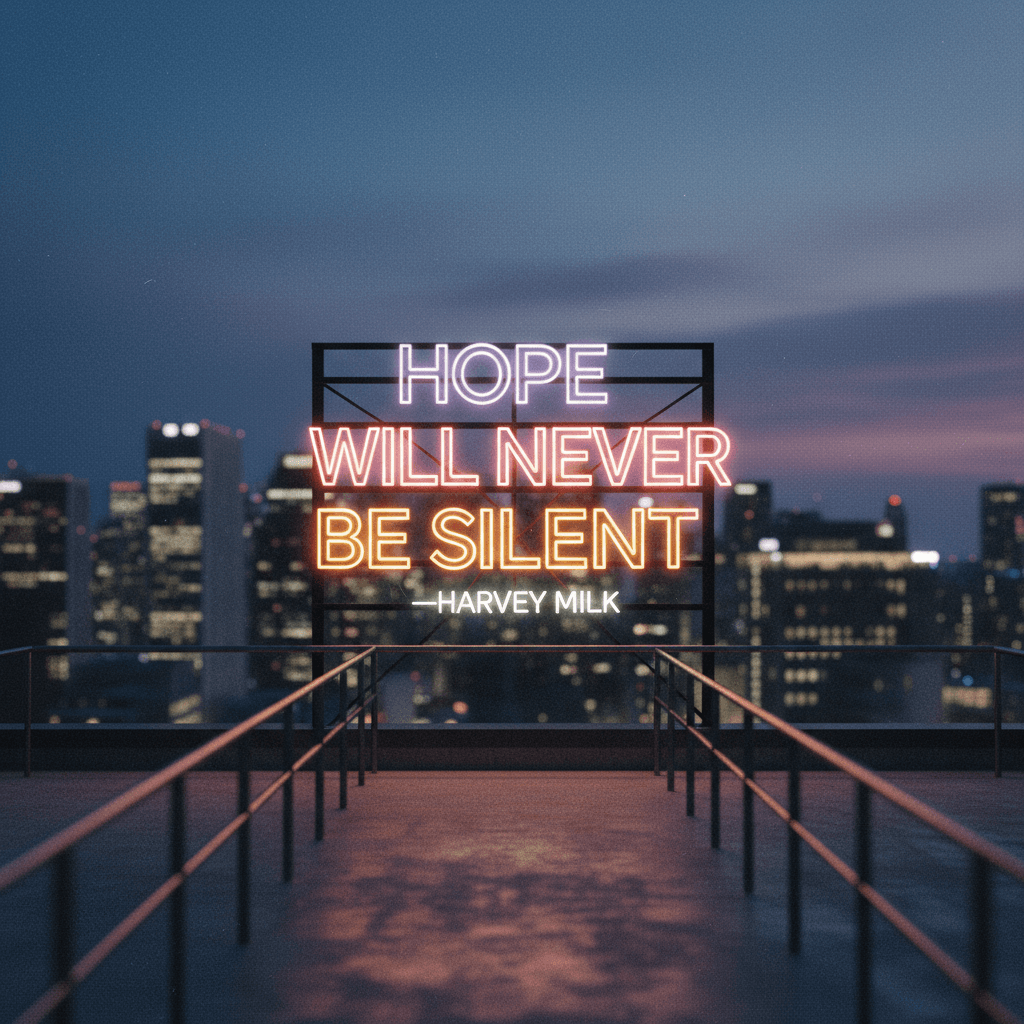
Hope’s Voice Refuses Silence and Surrender
Sociologist Elisabeth Noelle-Neumann’s Spiral of Silence (1974) shows how people conceal views they think are unpopular, allowing repression to harden. Milk’s strategy directly countered that spiral: public visibility normalizes presence. Moreover, Gordon Allport’s contact hypothesis (The Nature of Prejudice, 1954) suggests that authentic contact reduces bias—precisely the effect of coming out. Milk’s recorded words—“If a bullet should enter my brain, let that bullet destroy every closet door”—underline how breaking silence was, for him, a moral imperative. [...]
Created on: 11/17/2025

How One Clear Word Topples Silence
History frequently pivots on compact speech. In Chile’s 1988 plebiscite, the opposition organized under a single syllable—No—and won a peaceful transition from dictatorship. In South Africa’s townships, the call-and-response Amandla! (Power!) condensed a people’s insistence on agency. In Poland, Solidarność (1980) threaded worker dignity into a unifying banner. These instances show how brevity can rally the many by lowering the cost of joining—one word to remember, one word to repeat, one word to write on a wall or ballot. Moreover, the very economy of the message signals resolve; when the claim is pared to its essence, hesitation has nowhere to hide. [...]
Created on: 9/19/2025