Anne Frank
Anne Frank (1929–1945) was a German-born Jewish diarist who wrote The Diary of a Young Girl while hiding from Nazis in Amsterdam. Her diary, published posthumously, documents daily life in hiding and has become a seminal testimony of the Holocaust.
Quotes by Anne Frank
Quotes: 13

Quiet Hope as a Compass for Courage
The quote then turns hope into a tool: “let it guide.” This shifts hope from passive wishing to active orientation, like a compass that helps you choose direction when visibility is poor. In other words, hope isn’t meant to replace reality; it’s meant to keep you moving through it without surrendering your values. That guidance is especially relevant when choices are ambiguous. Quiet hope can help you interpret setbacks as information rather than verdicts, and it can keep long-term meaning in view when short-term fear tempts you toward numbness or resignation. [...]
Created on: 1/13/2026

Meeting Doubt with Determination’s Steady Reply
Once you accept that doubt will knock again, the useful question becomes: what does “answering” look like in real time? It can be as small as deciding on the next concrete step—sending the email, practicing for ten minutes, asking one honest question—rather than demanding total certainty upfront. In that way, determination operates like a doorman with a checklist: acknowledge the visitor, confirm whether it brings actionable information, and then proceed with what you can do today. Over time, this practice doesn’t eliminate doubt; instead, it trains the mind to treat doubt as a brief interruption rather than a permanent resident. [...]
Created on: 1/10/2026

Finding the Good News Within Everyone
The quote gains force when we remember Frank’s circumstances in hiding during the Nazi occupation, recorded in *The Diary of a Young Girl* (written 1942–1944, first published 1947). It is not naïve optimism spoken from comfort; it is a belief tested under fear, confinement, and betrayal. That context turns “good news” into an act of moral defiance, a refusal to let brutality define what people are. From there, the line reads like a choice as much as an observation. If goodness can be found even when the world is collapsing, then looking for it becomes a practice—one that keeps a person from being spiritually conquered by events. [...]
Created on: 1/7/2026

Turning Inner Spirit Into Written, Buildable Dreams
Finally, the sentence offers a small, repeatable practice: write to keep your spirit intact, and write to make your dreams actionable. This can be as modest as a nightly paragraph, a list of questions, or a sketch of next steps. The content matters less than the continuity, because continuity is what allows sharpening over time. In that way, writing becomes a disciplined form of hope—not wishful thinking, but a steady conversion of inner life into decisions, and decisions into a life that reflects what you once only imagined. [...]
Created on: 1/5/2026

Turning Personal Scars Into Guiding Maps for Others
Ultimately, Anne Frank’s metaphor points toward a communal understanding of meaning. A map is only useful when it is shared, and so the transformation of scars into guides suggests that our lives are intertwined. When one person’s survival story prevents another’s despair, private sorrow acquires public value. Over time, countless individual maps begin to overlap, forming a collective atlas of human endurance. By adding our own routes—no matter how modest—we participate in a larger project: turning suffering into orientation, loneliness into solidarity, and fear into a path that is, at last, lit for someone else. [...]
Created on: 12/5/2025

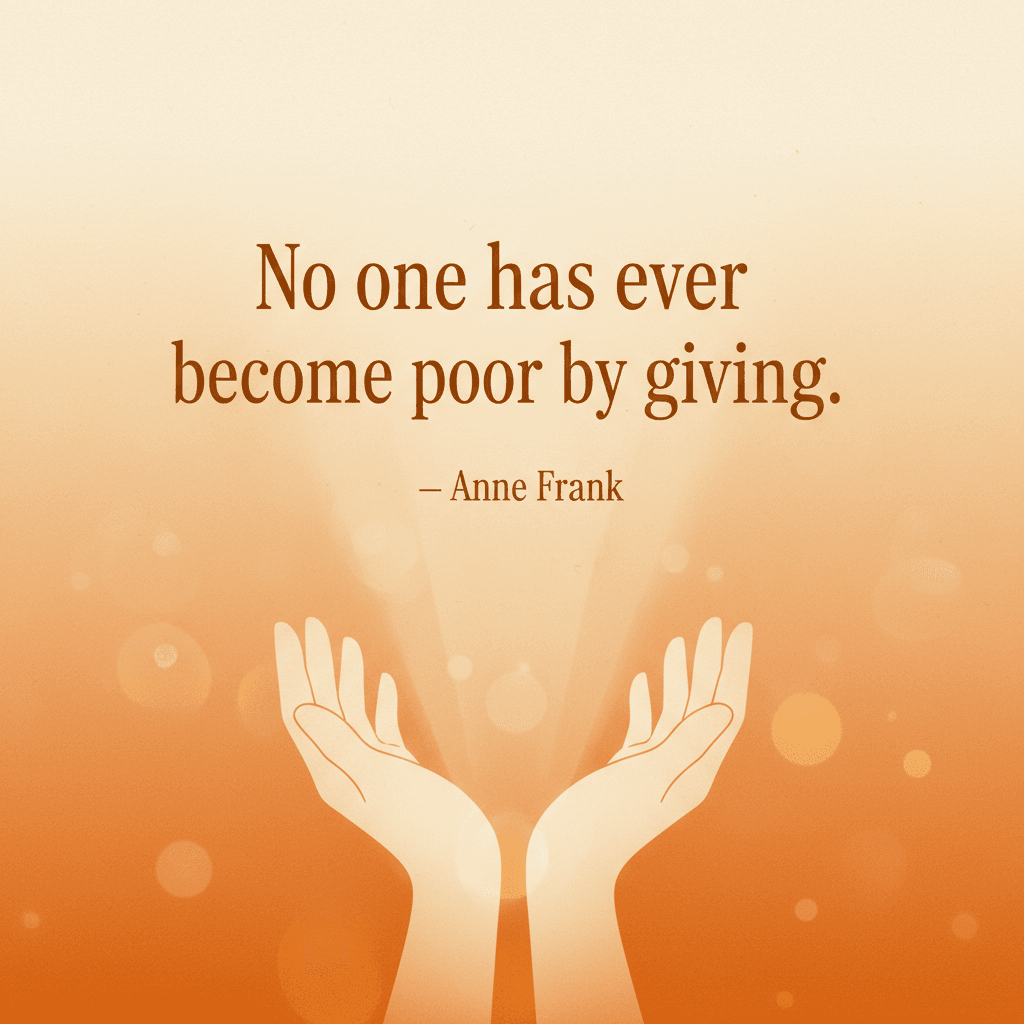
Why Generosity Enriches Rather Than Impoverishes Us
Generosity seeds trust, and trust is compound interest for communities. The reciprocity norm—our tendency to return kindness—helps small gifts cascade through networks (Cialdini, 2001). As neighbors exchange favors and time, they accrue social capital, the mutual obligations and goodwill that make collective action easier (Putnam, Bowling Alone, 2000). Communities rich in social capital weather shocks better, from job loss to natural disasters, because help arrives quickly and without red tape. Thus, giving is not merely altruistic; it is infrastructural, building a safety net that money alone struggles to buy. Once this social lattice is in place, generosity also shows surprising economic effects, expanding our sense of what counts as prosperity. [...]
Created on: 11/10/2025

Carrying a Small Light Through Gathering Doubts
C. R. Snyder’s hope theory (1994) defines hope as goals, pathways, and agency—precisely the structure of moving forward with limited light. When doubts narrow our sense of options, mapping one path and one small action restores agency. Likewise, Peter Gollwitzer’s if–then plans (1999) convert intentions into cues: If I feel overwhelmed, then I will do the next two-minute task. Such micro-commitments lower friction and reignite momentum. Additionally, behavioral activation in clinical psychology recommends action before motivation, trusting that mood will follow motion. In that spirit, the point is not to solve the night but to keep the feet learning the way. With this framework, we can translate the metaphor into concrete practices. [...]
Created on: 11/7/2025