
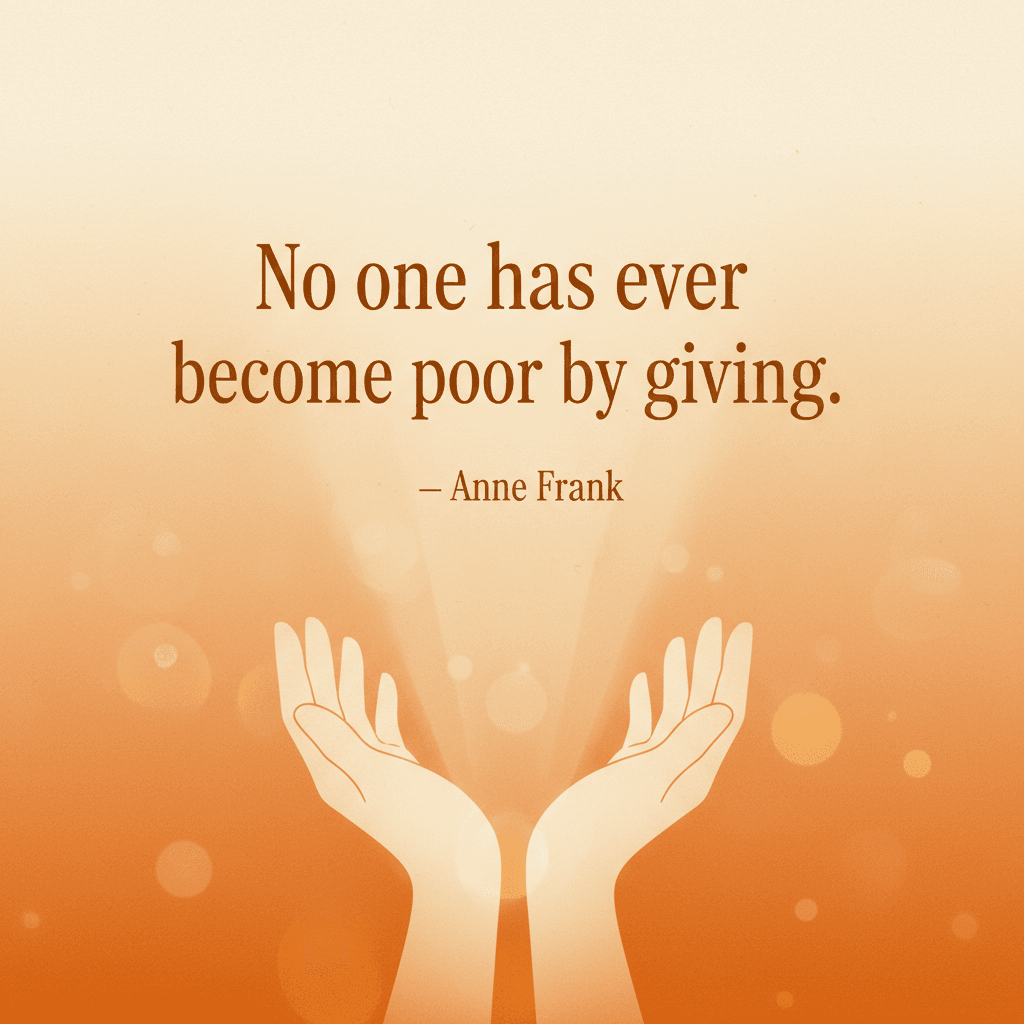
No one has ever become poor by giving. — Anne Frank
—What lingers after this line?
Anne Frank’s Defiant Abundance
Anne Frank’s line, penned amid scarcity and fear, insists that giving does not drain us; it enlarges us. In the annex, her family shared limited food and warmth, modeling a paradox: when material resources are thin, moral wealth can still grow. By reframing wealth as the capacity to care, she widens the ledger beyond coins to include dignity, courage, and solidarity. This reframing sets the stage for understanding how giving alters our inner calculus of value, not just our bank balance. From here, it becomes natural to ask what happens inside us when we give—which turns us toward psychology and the brain’s response to generosity.
The Helper’s High, Explained
Psychologists describe a ‘warm glow’ from giving (Andreoni, 1990), and experiments confirm it: spending on others boosts well-being more than spending on oneself (Dunn, Aknin, and Norton, 2008). Neuroscience echoes this pattern; fMRI studies show that donating activates reward circuits like the ventral striatum (Moll et al., 2006). Beyond momentary uplift, prosocial behavior correlates with reduced stress markers and even lower mortality among sustained helpers (Brown et al., 2003). In short, our bodies seem calibrated to reward generosity, converting outward gifts into inward resilience. Yet these benefits do not occur in isolation; they compound when generosity threads through relationships, which leads us to the social fabric that giving strengthens.
Reciprocity and Social Capital
Generosity seeds trust, and trust is compound interest for communities. The reciprocity norm—our tendency to return kindness—helps small gifts cascade through networks (Cialdini, 2001). As neighbors exchange favors and time, they accrue social capital, the mutual obligations and goodwill that make collective action easier (Putnam, Bowling Alone, 2000). Communities rich in social capital weather shocks better, from job loss to natural disasters, because help arrives quickly and without red tape. Thus, giving is not merely altruistic; it is infrastructural, building a safety net that money alone struggles to buy. Once this social lattice is in place, generosity also shows surprising economic effects, expanding our sense of what counts as prosperity.
Why Generosity Grows the Pie
Contrary to a zero-sum instinct, well-aimed giving can be multiplicative. Small transfers often unlock productivity—microloans through Grameen Bank, for instance, catalyzed entrepreneurship across rural Bangladesh (Yunus, Nobel lecture, 2006). Unconditional cash studies report that recipients invest in assets and earnings rather than squander windfalls (Haushofer and Shapiro, 2016, GiveDirectly). Philanthropy can also ‘crowd in’ private effort by de-risking new ventures or funding public goods that enable commerce. In this way, generosity generates externalities—benefits that spill over—so the community grows wealthier together. Cultures have long intuited this dynamic, which is why many traditions formalize giving as a disciplined practice rather than a sporadic impulse.
Traditions that Institutionalize Giving
Across faiths and philosophies, giving is a trained habit: zakat in Islam, tzedakah in Judaism, and dana in Buddhism embed generosity as duty and joy. Maimonides’ Ladder ranks forms of aid, elevating gifts that preserve dignity and independence (Mishneh Torah, c. 1170). Aristotle’s virtue of liberality in the Nicomachean Ethics frames giving as calibrated—neither miserly nor wasteful—so one’s resources align with noble ends. These frameworks suggest that generosity, practiced thoughtfully, sustains both giver and recipient over time. Still, tradition pairs zeal with prudence, which naturally raises a final question: how can we give in ways that are expansive yet sustainable?
Giving Wisely Without Self-Undoing
Sustainable generosity balances heart and habit. Precommitting a modest, predictable portion—money, time, or skills—prevents overextension while preserving momentum (e.g., the 10% “Give What We Can” pledge). Effective giving favors high-impact uses—cash where choice matters, jobs where dignity grows, and relationships where loneliness recedes—so gifts multiply rather than merely transfer. Practical guards include a generosity budget, seasonal reviews, and mutual-aid circles that distribute load. In this design, no one becomes poorer, because the act of giving enlarges agency, strengthens networks, and nudges resources toward their highest use. Returning to Anne Frank, her claim proves less wish than strategy: practiced well, generosity leaves our accounts—material, social, and moral—richer than before.
One-minute reflection
What feeling does this quote bring up for you?
Related Quotes
6 selectedAct generously; you never know how your kindness will ripple out into the world. — Anne Lamott
Anne Lamott
This quote emphasizes the transformative power of generosity, suggesting that even a small act of kindness can have far-reaching consequences that are often invisible to the giver.
Read full interpretation →The things that you do for yourself are gone when you are gone, but the things that you do for others remain as your legacy. — Kalu K. Ndukwe Kalu
Kalu K. Ndukwe Kalu
At its heart, Kalu K. Ndukwe Kalu’s quote redirects attention from personal gain to shared impact.
Read full interpretation →You don't have to be a billionaire to believe you can make a difference. Give your time, give your love, or simply give a smile. — Steve Goodier
Steve Goodier
At its core, Steve Goodier’s quote challenges the idea that influence belongs only to the wealthy or powerful. By placing time, love, and even a smile alongside money, he broadens generosity into something almost anyone...
Read full interpretation →Takers must have no limits, because givers never do. — Iyanla Vanzant
Iyanla Vanzant
At first glance, Iyanla Vanzant’s line sounds almost humorous, yet its irony cuts deeply. If givers continue offering time, energy, money, or emotional labor without pause, then takers are effectively trained to expect a...
Read full interpretation →The most important aspect of gratitude is that it spurs action—that it compels us to go outside ourselves to express our gratitude in a way that makes a difference in someone else's life. — Rebecca Solnit
Rebecca Solnit
Rebecca Solnit shifts gratitude away from being a private sentiment and turns it into a moral impulse. In her view, thankfulness matters most not when it remains an inward glow, but when it pushes us outward toward other...
Read full interpretation →In the ordinary life, we hardly realize that we receive a great deal more than we give, and that it is only with gratitude that life becomes rich. — Dietrich Bonhoeffer
Dietrich Bonhoeffer
Bonhoeffer begins with a quiet but unsettling observation: most of us move through ordinary life without noticing how much we constantly receive. From language and education to food, care, and companionship, our days are...
Read full interpretation →More From Author
More from Anne Frank →Keep a quiet hope alive and let it guide the brave choices you make. — Anne Frank
Anne Frank’s line begins with a surprising premise: hope can be quiet. Instead of the loud optimism that denies fear or hardship, she points to a steadier inner posture—something you keep alive privately, even when circu...
Read full interpretation →If doubt knocks, invite determination to answer the door — Anne Frank
Anne Frank’s line turns an abstract struggle into a vivid scene: doubt becomes an unexpected visitor, and the self becomes a home with agency over who gets attention. By imagining doubt “knocking,” the quote admits that...
Read full interpretation →Everyone has inside of him a piece of good news. — Anne Frank
Anne Frank’s line begins with a quiet insistence: no matter what a person shows on the outside, something hopeful exists within them. By calling it “good news,” she frames human goodness not as a vague ideal but as a dis...
Read full interpretation →Keep your spirit written on paper; dreams sharpen into designs there. — Anne Frank
Anne Frank’s line begins with an intimate instruction: keep your spirit on paper. In other words, writing can hold what feels too shifting to carry solely in the mind—hopes, grief, curiosity, and resolve.
Read full interpretation →