Laozi
Historical details about Laozi are scarce and debated. He is traditionally credited as the author of the Dao De Jing, a foundational Daoist text; this quote emphasizes the Dao as an inexhaustible, creative source.
Quotes by Laozi
Quotes: 15

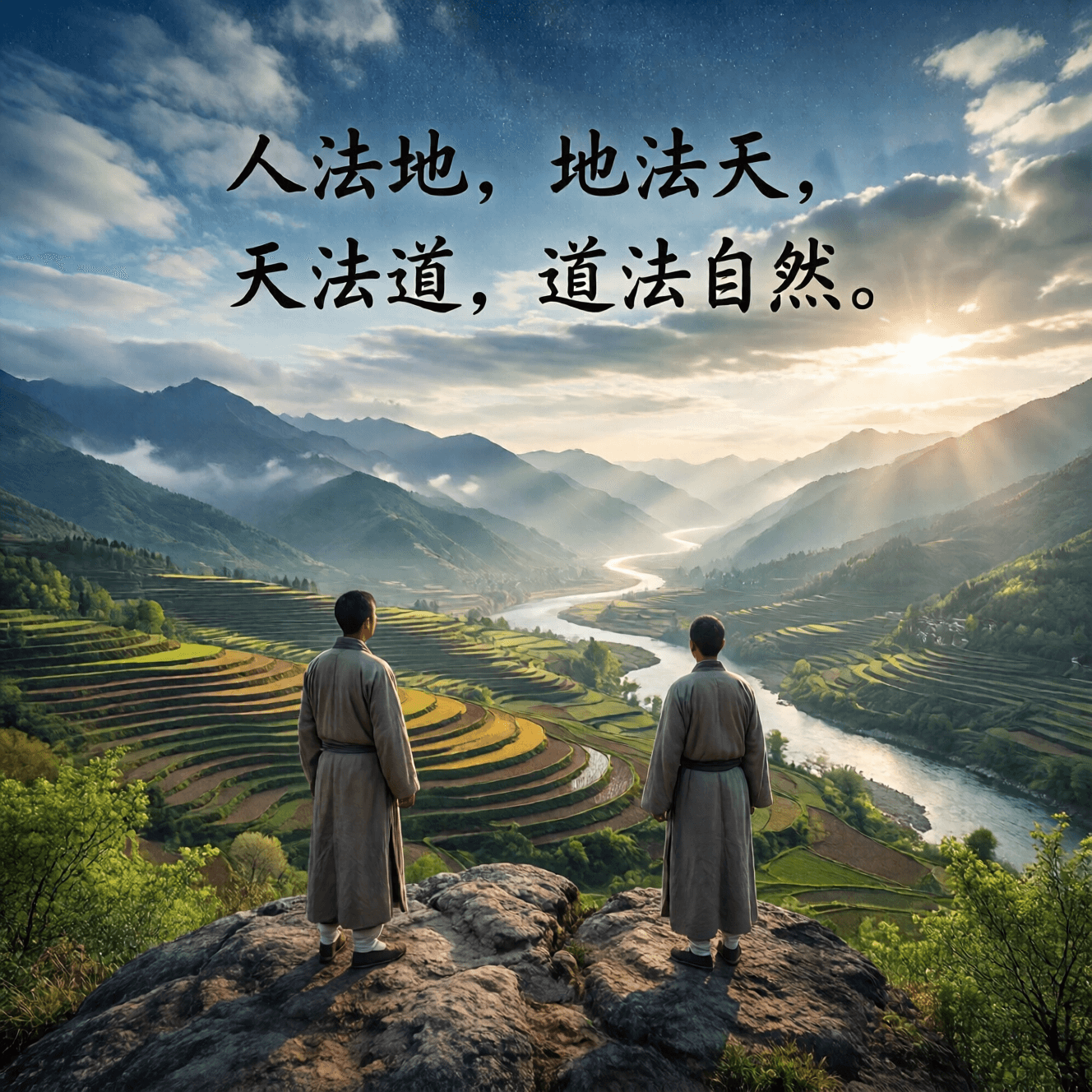
Following Nature’s Order from Humans to Dao
Having established observable patterns, Laozi then points to their source: Heaven follows the Dao. Here the Dao is not merely “rules” or “laws,” but the generative way things arise, change, and return—an underlying coherence that gives Heaven its regularity without being a controlling deity. In the Daodejing, the Dao is famously elusive, described more as an ever-present process than an object one can possess. Accordingly, Heaven’s order is not ultimate; it is an expression. This shift keeps the reader from idolizing mere predictability or treating the cosmos like a machine. The regular cycles of Heaven are meaningful because they echo the Dao’s deeper movement—quiet, continuous, and not dependent on human recognition. From here, Laozi can make his most paradoxical claim about what the Dao itself “follows.” [...]
Created on: 2/7/2026

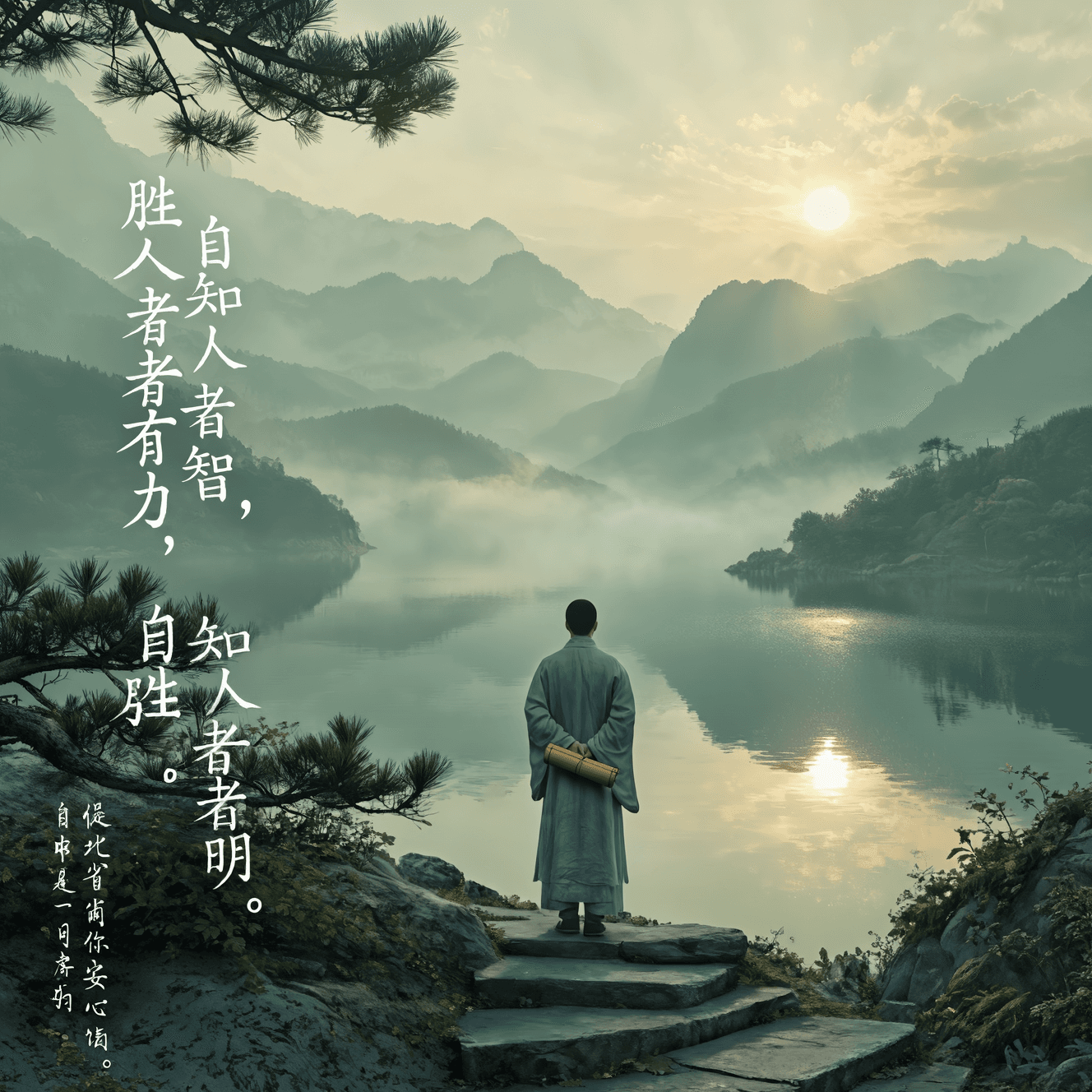
From Wisdom to Enlightenment Through Self-Mastery
Taken together, the quote traces a coherent progression: the more attention stays outward, the more success looks like cleverness and conquest; the more attention turns inward, the more success becomes clarity and restraint. In that sense, wisdom and strength are not dismissed—they are re-situated as early stages that mature into enlightenment and true power. Finally, Laozi’s pairing suggests a practical ethic for daily life: learn people, but study yourself more; compete when necessary, but practice the quieter discipline of self-control. Through that transition from outer mastery to inner freedom, the person becomes both effective and unshakable. [...]
Created on: 1/30/2026

Honor, Humility, and the World’s Valley
A valley does not dominate; it gathers. Water runs downhill, not because the valley is weak, but because it is positioned to receive. Laozi often uses water as a model of the Dao: adaptive, persistent, and effective without self-advertisement. In this light, “be the valley of the world” points to a kind of strength that comes from making space for others. This has social consequences. The “valley” person listens more than they broadcast, can hold conflicting views without forcing immediate victory, and becomes trustworthy because they are not fighting to be seen as superior. What looks like lowliness becomes a quiet form of leadership. [...]
Created on: 1/30/2026

Nature’s Impermanence and the Wisdom of Restraint
From personal emotion, the teaching extends naturally to leadership. Leaders who fill every silence with directives may create motion, but not necessarily alignment; their constant pressure can resemble torrential rain—impressive, loud, and ultimately exhausting. By contrast, Laozi’s ideal ruler in the Tao Te Ching governs with minimal interference, allowing people to find their own balance. This does not mean passivity; it means proportion. Clear, timely words often carry more authority than endless speeches. Like a brief change in weather that refreshes rather than floods, concise guidance can support stability without turning governance into a perpetual storm. [...]
Created on: 1/30/2026

Laozi on the Unfathomable Depth of Sages
When Laozi calls these scholars “mysterious,” he is also pointing to a limit in language and analysis. In the Dao De Jing’s opening, “The Dao that can be spoken is not the constant Dao,” implying that ultimate reality slips beyond verbal capture; this makes the sage’s insight hard to translate into neat explanations. As a result, the mystery is not mere secrecy but an honest reflection of complexity. The wise person may use paradox, silence, or indirect teaching because the subject—the Way, change, harmony—cannot be reduced without distortion. [...]
Created on: 1/19/2026

Antiquity as a Guide for Today’s Way
The quote’s pivot—mastering “what exists today” by anchoring in the past—implies that the present is best understood as an unfolding, not an isolated moment. When we chase only current events, we often confuse surface change for fundamental change. By contrast, when we ask how today’s structures began, we gain leverage over them: we can see which parts are essential and which are mere habit. This is why origin-stories matter in practice. A leader trying to fix a broken workplace culture, for instance, frequently gets further by learning how its norms were first rewarded than by issuing new slogans. Laozi’s method is diagnostic: trace the stream upstream to understand the water you are standing in. [...]
Created on: 12/17/2025

Equanimity Amid Favor, Disgrace, and Trouble
To “value” great trouble as you value your own body does not mean courting misery or romanticizing suffering. Rather, it points to an intimate attention: treat hardship as something that belongs to your experience, not as an alien curse. Just as you respond to bodily pain with care—adjusting, resting, seeking balance—you can respond to trouble with curiosity and appropriate action instead of panic and self-pity. This shift matters because rejection of trouble often adds a second wound: shame, resentment, or frantic control. By holding trouble close enough to learn from it, you reduce the extra suffering created by resistance. [...]
Created on: 12/17/2025