
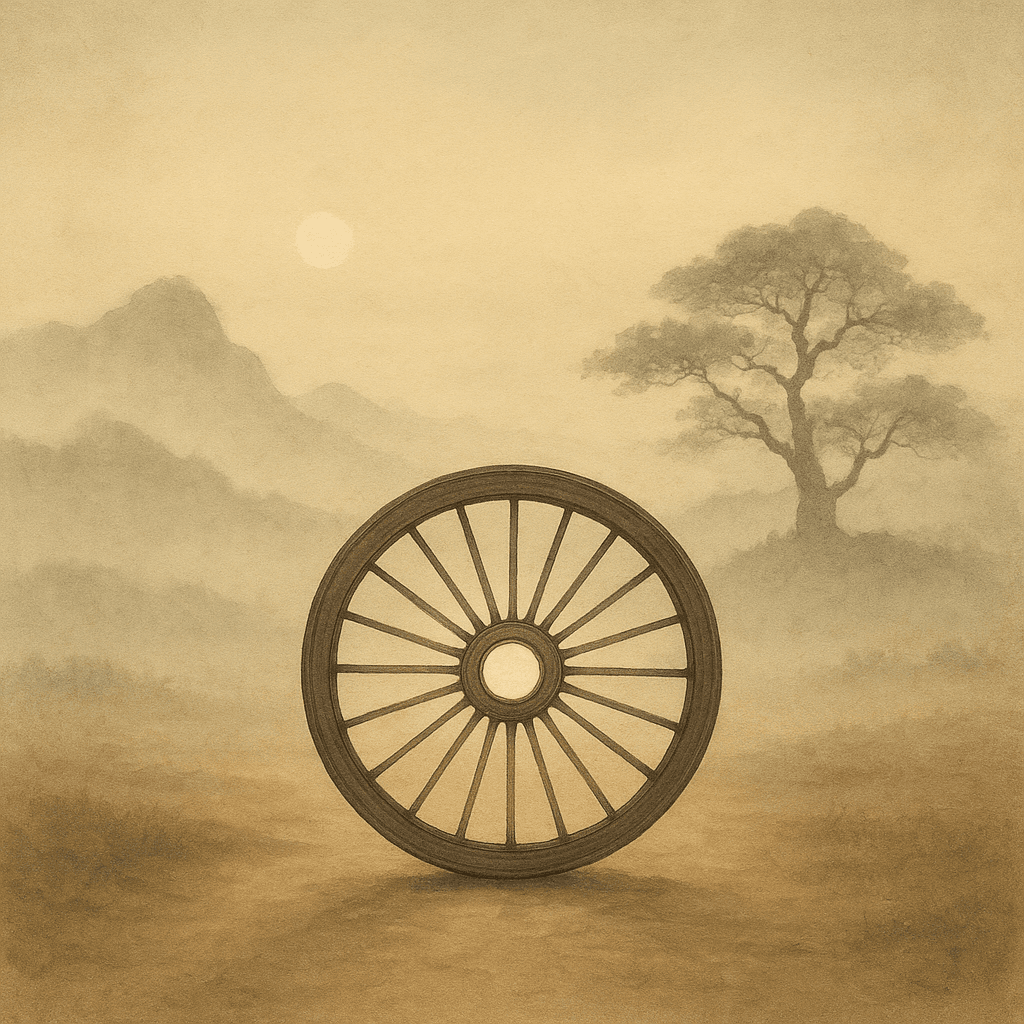
Thirty spokes share a single hub; because of its emptiness, the cart is useful. – Laozi
—What lingers after this line?
The Paradox at the Heart of the Wheel
Laozi’s image is disarmingly simple: thirty solid spokes converge on a hub whose value lies in its emptiness. The cart moves not because of the wood alone, but because of the open space that allows an axle to turn. From the outset, the verse invites us to notice a paradox: what seems like “nothing” quietly makes everything functional. By drawing attention to this overlooked void, Laozi reframes how we understand usefulness, shifting focus from material substance to the invisible conditions that make action possible.
Emptiness as the Source of Function
Extending this insight, the hub’s emptiness becomes a metaphor for all forms of utility. A cup holds water not because of the clay, but because the clay surrounds an empty volume; a room shelters us because walls frame open space. In the *Daodejing* (chap. 11), Laozi repeats this pattern to suggest that absence is not mere lack, but a positive capacity. Through this lens, emptiness is transformed from deficiency into potential, the silent partner without which form cannot truly serve its purpose.
The Daoist Revaluation of ‘Nothing’
From here, Laozi’s image broadens into a core Daoist theme: wu, or non-being. Rather than glorifying only what is visible and tangible, Daoist thought insists that non-being and being interdepend. Just as the hub’s cavity completes the spokes, the unseen ground of reality—the Dao—gives meaning and coherence to the world of things. This reverses common assumptions that celebrate accumulation and solidity, suggesting instead that the highest power often resides in what cannot be grasped, possessed, or even clearly named.
Inner Emptiness and Human Life
Linked to practice, the metaphor speaks directly to how we shape our inner lives. An overfilled mind, crammed with rigid opinions and constant noise, resembles a wheel with no room for an axle—impressive in appearance but unable to turn. By cultivating inner emptiness—mental stillness, emotional spaciousness, and ego-lightness—we become more responsive and adaptable. Classical commentators on the *Daodejing* often equate this emptiness with clarity: when we are not jammed by preconception, new insight and creativity can move through us as freely as an axle through a well-crafted hub.
Designing with Space, Not Just Substance
Moreover, Laozi’s insight has concrete implications for how we design our tools, systems, and communities. Good architecture values light, flow, and openness as much as structural materials; thoughtful conversation allows pauses, silence, and listening, not only speech. Even in technology and organizational design, room for error, reflection, and change functions as the “empty hub” that keeps complex structures from seizing up. Thus the ancient image of thirty spokes converging becomes a timeless design principle: genuine effectiveness arises when we honor the spaces in between, not just the visible parts we can count and touch.
Living Lightly in a World of Excess
Finally, in a culture often driven by accumulation—more data, more possessions, more commitments—Laozi’s cart invites us to step back. Instead of asking only what we can add, we might ask what we can remove to restore movement. Clearing a schedule creates time for genuine presence; letting go of status symbols creates room for authentic relationships. By recognizing emptiness as an active, life-giving force, we begin to see that true usefulness, and perhaps true freedom, emerge less from what we cling to than from the space we are willing to leave open.
One-minute reflection
Why might this line matter today, not tomorrow?
Related Quotes
6 selectedThe Dao is empty; when used, it is never filled. Deep, it seems to be the source of the myriad things. - Laozi
Laozi
At the outset, Laozi declares a puzzle: “The Dao is empty; when used, it is never filled,” suggesting a capacity that is void yet inexhaustible (Daodejing, ch. 4).
Read full interpretation →Those who were good at being scholars in ancient times were subtle, profound, mysterious, and all-pervading—so deep that they could not be understood. -- Laozi
Laozi
Laozi opens by describing exemplary ancient scholars as “subtle, profound, mysterious, and all-pervading,” a sequence that deliberately resists any easy definition. Rather than praising cleverness or fame, he emphasizes...
Read full interpretation →Be startled by favor and disgrace; value great trouble as you value your own body. - Laozi
Laozi
Laozi’s line from the Taoist tradition, often associated with the Tao Te Ching, jolts ordinary priorities: instead of chasing honor and fleeing hardship, we are told to be “startled” by both favor and disgrace, and to tr...
Read full interpretation →Hold fast to the way of antiquity to master what exists today. To be able to know the beginnings of antiquity is called the guiding thread of the Way. - Laozi
Laozi
Laozi’s counsel begins with a simple but demanding practice: “hold fast” to antiquity, not as nostalgia, but as orientation. The phrase suggests continuity—an insistence that what is oldest can still point the direction...
Read full interpretation →The valley spirit never dies; it is called the mysterious female. The gate of the mysterious female is called the root of Heaven and Earth. Unceasing, as if it were there; use it, and it never fails. - Laozi
Laozi
Laozi evokes the “valley spirit” to name a power that endures by being low, open, and receptive. In valleys, waters gather; by yielding, they become inexhaustibly nourished.
Read full interpretation →Heaven and earth endure. The reason heaven and earth can be long and lasting is that they do not live for themselves; therefore they can long endure. - Laozi
Laozi
Laozi observes that heaven and earth last because they do not live for themselves, a paradox at the heart of Daoist thought. In Daodejing, chapter 7, the cosmos endures precisely by not grasping, not claiming, and not ce...
Read full interpretation →More From Author
More from Laozi →Few words accord with nature; therefore a whirlwind does not last all morning, and a sudden rain does not last all day. -- Laozi
Laozi begins with a simple observation: even nature’s fiercest displays are temporary. A whirlwind burns itself out, and a sudden downpour cannot sustain its intensity for long.
Read full interpretation →Humans follow Earth, Earth follows Heaven, Heaven follows the Dao, and the Dao follows what is natural. -- Laozi
Laozi sketches a chain of influence that moves upward from human life to the widest patterns of reality: humans take cues from Earth, Earth from Heaven, Heaven from the Dao, and the Dao from what is natural. Rather than...
Read full interpretation →Those who know others are wise; those who know themselves are enlightened. Those who defeat others have strength; those who defeat themselves are strong. -- Laozi
Laozi opens by placing “knowing others” and “knowing oneself” side by side, as if they were neighboring skills that lead to very different destinations. Understanding other people—reading motives, predicting reactions, n...
Read full interpretation →Few words accord with nature; thus a whirlwind does not last all morning, and a torrential rain does not last all day. -- Laozi
Laozi begins with ordinary observations—wind and rain—to make an uncommonly durable point: extremes, however overwhelming they feel, are brief by nature. A whirlwind cannot sustain itself through the morning, and a downp...
Read full interpretation →