
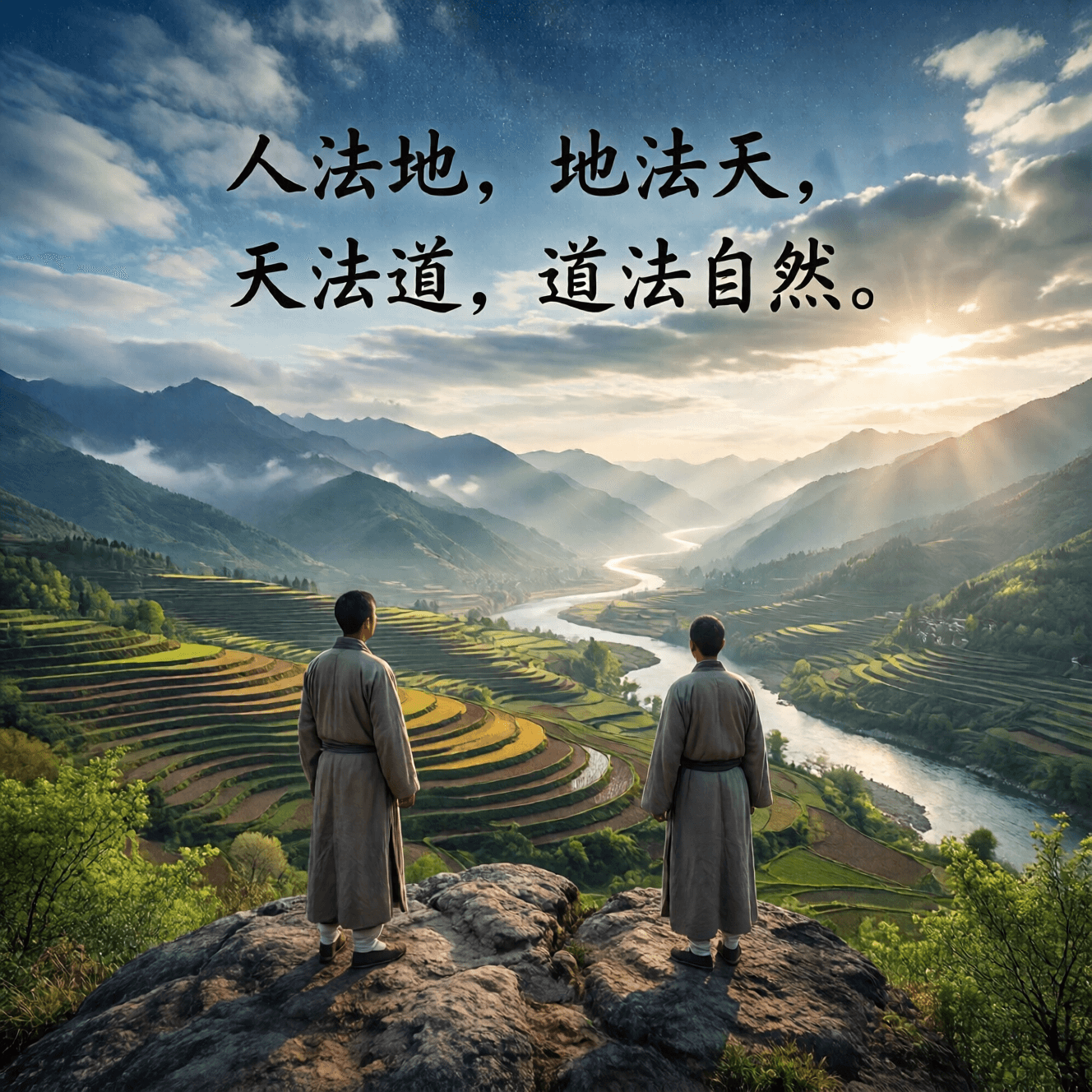
Humans follow Earth, Earth follows Heaven, Heaven follows the Dao, and the Dao follows what is natural. -- Laozi
—What lingers after this line?
A Ladder of Alignment
Laozi sketches a chain of influence that moves upward from human life to the widest patterns of reality: humans take cues from Earth, Earth from Heaven, Heaven from the Dao, and the Dao from what is natural. Rather than a strict hierarchy of domination, it reads like a ladder of alignment—each level learning how to move in step with something broader and less self-centered. In this way, the quote begins with ordinary human concerns—how we live, build, plan, and govern—but immediately points beyond them. From the outset, the message is also corrective: when people ignore the rhythms above them, they fall into artificial strain. By contrast, when each level “follows” appropriately, life becomes less forced and more coherent, as if the world’s parts are fitting back into their proper proportions.
Humans Following Earth
The first relationship is practical and intimate: humans follow Earth. This suggests that human flourishing depends on attending to the ground-level realities of place, season, and limitation—soil that can be exhausted, water that can be polluted, bodies that need rest, and communities that require sustenance. Laozi’s point is not simply “be ecological” in a modern sense, but that wise human action starts by observing what the Earth allows and encourages. Consequently, many everyday failures look like refusals to follow Earth: planting without regard for climate, building as if floods and droughts do not exist, or working as if sleep were optional. By returning to Earth’s constraints and gifts, human choices become less grandiose and more durable, preparing the mind to see the larger patterns Laozi calls Heaven.
Earth Following Heaven
Next, Laozi says Earth follows Heaven—an ancient shorthand for the overarching order of cycles: day and night, weather, celestial motions, and the seasonal turning that shapes life on the ground. Earth’s landscapes and ecosystems respond continually to these larger regularities, and human beings can’t fully understand Earth without noticing what moves above it. In this sense, “Heaven” names the dependable, impersonal rhythms that no single person can bargain with. This transition widens the reader’s perspective. If humans must respect Earth’s concrete realities, they must also respect the wider forces that Earth itself answers to. The quote subtly trains humility: the world is not arranged around human preference, and even the ground beneath our feet is participating in a larger cadence that sets the tempo for growth, decay, and renewal.
Heaven Following the Dao
Having established observable patterns, Laozi then points to their source: Heaven follows the Dao. Here the Dao is not merely “rules” or “laws,” but the generative way things arise, change, and return—an underlying coherence that gives Heaven its regularity without being a controlling deity. In the Daodejing, the Dao is famously elusive, described more as an ever-present process than an object one can possess. Accordingly, Heaven’s order is not ultimate; it is an expression. This shift keeps the reader from idolizing mere predictability or treating the cosmos like a machine. The regular cycles of Heaven are meaningful because they echo the Dao’s deeper movement—quiet, continuous, and not dependent on human recognition. From here, Laozi can make his most paradoxical claim about what the Dao itself “follows.”
The Dao Following What Is Natural
The final line—“the Dao follows what is natural” (ziran, often rendered “self-so” or “so of itself”)—seems to turn the whole chain inside out. If the Dao is the deepest principle, how can it follow anything? Laozi’s point is that the Dao is not a commanding will imposing designs; it is the spontaneous unfolding of reality as it is. To say the Dao “follows” the natural is to deny that ultimate order is artificial, coercive, or contrived. This closes the circle: the highest guidance is not an external blueprint but an allowance for things to be themselves. As a result, the more one seeks to control and over-define life, the more one departs from the Dao’s character. The deepest “law” is not force but fittingness—action that arises from the situation without strain.
Ethics and Governance as Wu-Wei
Because the chain begins with humans, Laozi’s cosmology is also a moral and political lesson. If the Dao’s signature is naturalness, then human leadership and personal conduct should mirror that quality through wu-wei—often translated as “non-action,” but better understood as non-forcing. This does not mean passivity; it means acting in a way that works with conditions rather than against them, like steering with a current instead of trying to stop the river. In the Daodejing (c. 4th–3rd century BC), rulers are repeatedly urged to govern lightly, creating space for people’s lives to organize themselves. Moving from cosmic order to social order, the quote implies that harmony is achieved less by aggressive control and more by attentive alignment—first to Earth’s realities, then to Heaven’s rhythms, and ultimately to the natural spontaneity at the heart of the Dao.
One-minute reflection
What does this quote ask you to notice today?
Related Quotes
6 selectedNature does not hurry, yet everything is accomplished. — Lao Tzu
Lao Tzu
Lao Tzu’s line reframes success as something compatible with calm. Instead of praising speed, it points to a different kind of effectiveness—one that unfolds without strain, panic, or constant forcing.
Read full interpretation →Nature does not hurry, yet everything is accomplished. — Lao Tzu
Lao Tzu
Lao Tzu’s line points to a simple but demanding truth: completion does not require haste. In nature, processes unfold at their own pace—seeds germinate when conditions are right, rivers carve canyons over ages, and seaso...
Read full interpretation →Nature does not hurry, yet everything is accomplished. — Lao Tzu
Lao Tzu
Lao Tzu’s line, often attributed to the Taoist tradition associated with the Tao Te Ching (c. 4th–3rd century BC), opens by questioning a familiar habit: treating speed as proof of seriousness.
Read full interpretation →Nature does not hurry, yet everything is accomplished. — Lao Tzu
Lao Tzu
Lao Tzu’s line challenges the assumption that speed equals success. By pointing to nature—seed to tree, cloud to rain—he highlights a world where outcomes arrive without frantic pushing.
Read full interpretation →Nature does not hurry, yet everything is accomplished. — Lao Tzu
Lao Tzu
Lao Tzu’s line points to a paradox that Taoist philosophy treats as ordinary: effectiveness doesn’t require strain. In the *Tao Te Ching* (traditionally dated around the 4th–3rd century BC), the Tao is portrayed as the u...
Read full interpretation →Nature does not hurry, yet everything is accomplished. — Lao Tzu
Lao Tzu
Lao Tzu’s line points to a paradox we notice the moment we step outside: forests grow, rivers carve valleys, and seasons turn without any visible rush. Nature rarely looks frantic, yet outcomes arrive with astonishing re...
Read full interpretation →More From Author
More from Laozi →Few words accord with nature; therefore a whirlwind does not last all morning, and a sudden rain does not last all day. -- Laozi
Laozi begins with a simple observation: even nature’s fiercest displays are temporary. A whirlwind burns itself out, and a sudden downpour cannot sustain its intensity for long.
Read full interpretation →Those who know others are wise; those who know themselves are enlightened. Those who defeat others have strength; those who defeat themselves are strong. -- Laozi
Laozi opens by placing “knowing others” and “knowing oneself” side by side, as if they were neighboring skills that lead to very different destinations. Understanding other people—reading motives, predicting reactions, n...
Read full interpretation →Few words accord with nature; thus a whirlwind does not last all morning, and a torrential rain does not last all day. -- Laozi
Laozi begins with ordinary observations—wind and rain—to make an uncommonly durable point: extremes, however overwhelming they feel, are brief by nature. A whirlwind cannot sustain itself through the morning, and a downp...
Read full interpretation →Know its honor, keep its disgrace, and be the valley of the world. -- Laozi
Laozi’s line—“Know its honor, keep its disgrace, and be the valley of the world”—unfolds like a short spiritual method. First, it asks for clear recognition of “honor,” meaning the visible standards of success, status, a...
Read full interpretation →