
Authors
Marie Curie
Marie Skłodowska Curie (1867–1934) was a Polish-born physicist and chemist who pioneered research on radioactivity, discovered the elements polonium and radium, and won Nobel Prizes in Physics (1903) and Chemistry (1911). She conducted much of her research in Paris, founded radiological institutes, and was the first woman to receive a Nobel Prize.
Quotes: 33
Quotes by Marie Curie

Planting Ideas Through Action That Creates Change
Marie Curie’s metaphor treats ideas not as static thoughts but as living seeds—small, vulnerable, and full of latent potential. A seed contains an entire future, yet it remains invisible until it meets the right conditio...
Created on: 3/8/2026

Progress Measured by Bridges, Not Avoided Walls
The quote asks for a different yardstick: instead of treating success as the absence of conflict, it frames progress as the presence of connection. Avoiding “walls” can look like prudence—staying silent, steering clear o...
Created on: 1/11/2026

Worth Is Measured by Compassion, Not Trophies
Marie Curie’s line asks us to swap a familiar scoreboard for a quieter one. Instead of counting trophies—awards, titles, status symbols—she points to compassion as the real unit of measure, because it reflects how our li...
Created on: 12/29/2025
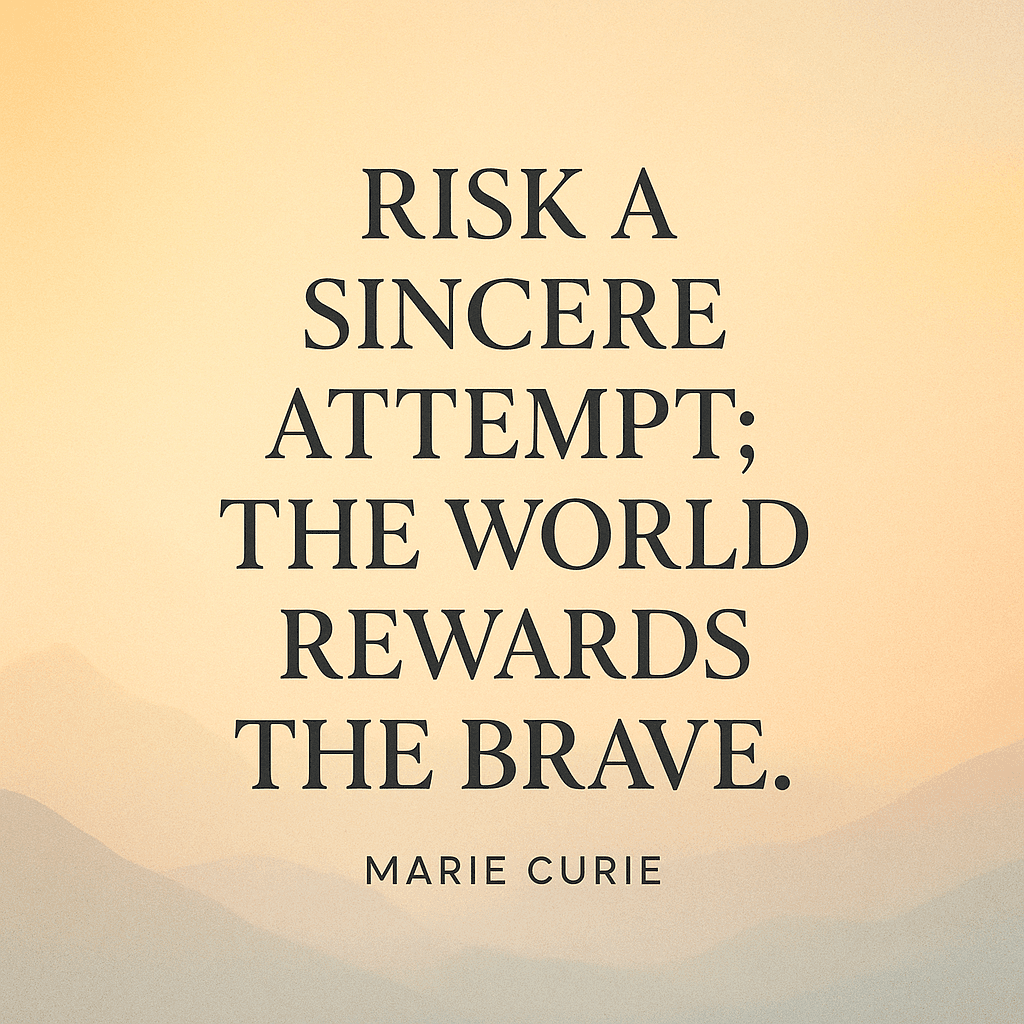
Risk, Sincerity, and the Courage to Attempt
Marie Curie’s exhortation to “risk a sincere attempt” begins with a challenge to our habitual caution. Rather than waiting for perfect conditions or guaranteed success, she urges us to act with genuine intent, even when...
Created on: 12/8/2025

Turning Every Attempt Into a Living Experiment
Marie Curie’s insight invites a fundamental shift in how we view our own efforts. Instead of treating each attempt as a pass-or-fail judgment, she frames it as a small experiment—one step in a longer process of discovery...
Created on: 12/6/2025

How One Honest Effort Can Change Tomorrow
Marie Curie’s statement, “A single honest effort reshapes the shape of tomorrow,” highlights how even one sincere attempt can alter the future’s trajectory. Rather than measuring impact by scale or grandeur, she points t...
Created on: 11/27/2025

Let Meaningful Work Transform Ordinary Everyday Moments
Marie Curie’s insight suggests that meaningful work does not merely fill our schedule; it shapes our sense of purpose. Instead of viewing labor as a separate sphere from life, she implies that what we love doing continuo...
Created on: 11/21/2025