
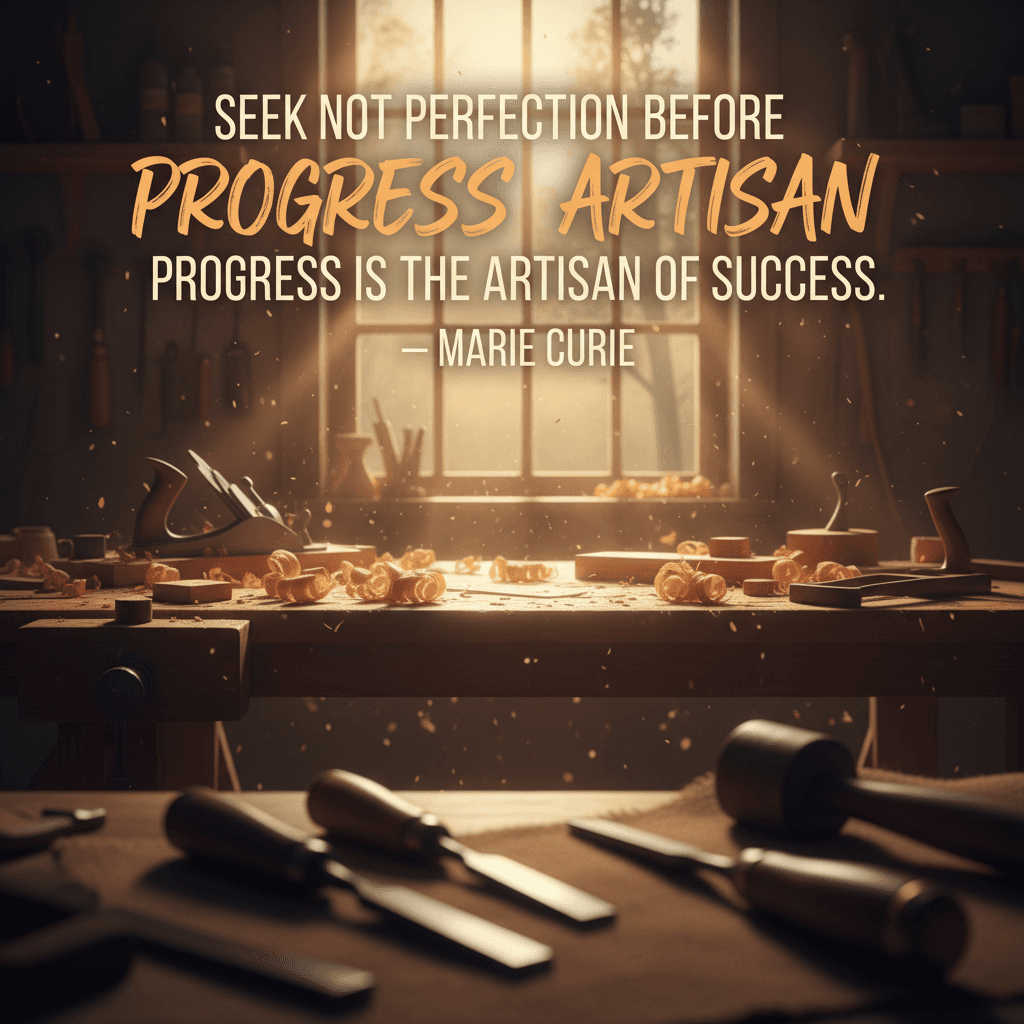
Seek not perfection before beginning; progress is the artisan of success. — Marie Curie
—What lingers after this line?
Begin Before You’re Ready
At the outset, the aphorism—often attributed to Marie Curie—warns against letting the ideal stall the initial step. When we delay action until conditions are flawless, we trade momentum for mirages; by contrast, beginnings create information, surfacing constraints and possibilities that planning alone cannot reveal. Thus the apparent risk of starting imperfectly is actually a hedge against the larger risk of never starting at all.
Progress as a Master Craftsman
Building on this, the line “progress is the artisan of success” reframes achievement as craft rather than coup. Like a woodworker revealing grain through successive passes, progress shapes rough intentions into fit-for-purpose results. Each iteration exposes the next cut, and mistakes become material to be carved, not proof of incompetence. In this view, success is not found; it is fashioned—tool-mark by tool-mark—through steady refinement.
Curie’s Patient Experiments
Consider Curie’s own laboratories, where patience trumped polish. In a drafty shed, Marie and Pierre Curie boiled and re-crystallized tons of pitchblende to isolate radium, enduring burns and monotony to extract faint flashes of blue-green light; Eve Curie’s biography, Madame Curie (1937), vividly recounts the cauldrons and iron stirring rods. The process embodied her later observation, “I was taught that the way of progress was neither swift nor easy.” Slow advances, not perfect plans, yielded a breakthrough.
Iteration at the Heart of Science
Extending this logic, the scientific method institutionalizes imperfect starts and corrective feedback. The Wright brothers’ 1901 wind-tunnel experiments revised faulty lift data and informed the 1902 glider, culminating in the 1903 Flyer; their paper “Some Aeronautical Experiments” (1901) shows how small measurements steered big leaps. By designing tests that expose errors early, they let progress do the sculpting, turning uncertainty into guidance.
Mindset: Embracing Imperfect Starts
In the present day, psychology offers a complementary lens. Carol Dweck’s Mindset (2006) distinguishes a fixed mindset, which hunts for flawless performance, from a growth mindset, which treats ability as improvable. Studies show that learners who expect improvement persist longer and learn more, because feedback becomes fuel, not a verdict. This aligns with Curie’s ethos: imperfect beginnings invite the practice that competence requires.
Putting the Principle to Work
Consequently, putting the principle to work means operationalizing progress. Start with a Minimum Viable Step—one action that produces real feedback—then time-box refinement, define a simple success metric, and close the loop. A writer drafts 200 words daily before editing; a team releases a small feature to 50 users, echoing Eric Ries’s “minimum viable product” in The Lean Startup (2011). Over time, these modest cycles compound, and success arrives looking suspiciously handmade.
Recommended Reading
As an Amazon Associate, we earn from qualifying purchases.
One-minute reflection
What feeling does this quote bring up for you?
Related Quotes
6 selectedThink progress, not perfection. — Ryan Holiday
Ryan Holiday
Ryan Holiday’s line cuts through a common self-deception: the belief that we must be flawless before we begin. In practice, “perfection” often becomes a socially acceptable excuse for delay—endless planning, tweaking, an...
Read full interpretation →Progress, not perfection, is what we should be asking of ourselves. — Julia Cameron
Julia Cameron
This quote encourages individuals to prioritize continuous improvement over an unattainable standard of perfection. Growth and learning happen gradually through effort and persistence.
Read full interpretation →Seek progress, not perfection—movement conquers inertia. — Bell Hooks
bell hooks
Bell Hooks' exhortation to favor progress over perfection highlights a common struggle: the debilitating grip of perfectionism. When individuals aim for flawlessness, they often find themselves paralyzed, reluctant to ta...
Read full interpretation →Persistence is more important than perfection. — Margaret Atwood
Margaret Atwood
Margaret Atwood’s assertion challenges the conventional pursuit of flawlessness, redirecting our focus toward steady, persistent effort. In many domains, society often equates perfection with accomplishment, yet Atwood’s...
Read full interpretation →Progress is born from the courage to be imperfect. — John C. Maxwell
John C. Maxwell
Many individuals hesitate to begin new ventures or adopt innovative ideas because they fear making mistakes or appearing flawed. This reluctance often leads to stagnation, both personally and collectively.
Read full interpretation →The subtle art of progress is to keep moving when you feel like stopping. — Marie Forleo
Marie Forleo
Marie Forleo’s statement underscores a vital nuance in personal development: true progress emerges not in moments of ease, but precisely when motivation wanes. The 'subtle art' she refers to is less about grand gestures...
Read full interpretation →More From Author
More from Marie Curie →Plant ideas like seeds and tend them with action until forests of change grow — Marie Curie
Marie Curie’s metaphor treats ideas not as static thoughts but as living seeds—small, vulnerable, and full of latent potential. A seed contains an entire future, yet it remains invisible until it meets the right conditio...
Read full interpretation →Measure progress by the bridges you build, not by the walls you avoid. — Marie Curie
The quote asks for a different yardstick: instead of treating success as the absence of conflict, it frames progress as the presence of connection. Avoiding “walls” can look like prudence—staying silent, steering clear o...
Read full interpretation →Measure your worth by the compassion you practice, not by the trophies you collect. — Marie Curie
Marie Curie’s line asks us to swap a familiar scoreboard for a quieter one. Instead of counting trophies—awards, titles, status symbols—she points to compassion as the real unit of measure, because it reflects how our li...
Read full interpretation →Risk a sincere attempt; the world rewards the brave. — Marie Curie
Marie Curie’s exhortation to “risk a sincere attempt” begins with a challenge to our habitual caution. Rather than waiting for perfect conditions or guaranteed success, she urges us to act with genuine intent, even when...
Read full interpretation →