
Authors
Seamus Heaney
Seamus Heaney (1939–2013) was an Irish poet, playwright, and translator who won the 1995 Nobel Prize in Literature. His work explored rural Ulster life, history, and the ethics of language; the quote emphasizes focused will and attentive perception.
Quotes: 16
Quotes by Seamus Heaney

Choosing Bold Joy Over Better Judgment
Heaney’s line hinges on a sharp contradiction: to “walk on air” is to do what gravity says you cannot, and to do it “against your better judgement” is to move despite the mind’s careful warnings. From the outset, the quo...
Created on: 12/30/2025

Transforming the Ordinary Into Enduring Stories
Seamus Heaney’s line, “Turn the ordinary into a story worth taking further,” urges us to reconsider what we dismiss as mundane. Rather than waiting for dramatic events, he suggests that meaning emerges when we treat ever...
Created on: 11/24/2025

From Small Kindness to Warming Human Communities
Seamus Heaney’s image of a “small fire of kindness” invites us to see gentle acts as sources of unexpected power. Just as a single match alters the darkness around it, a quiet gesture—a thoughtful word, a seat offered on...
Created on: 11/21/2025
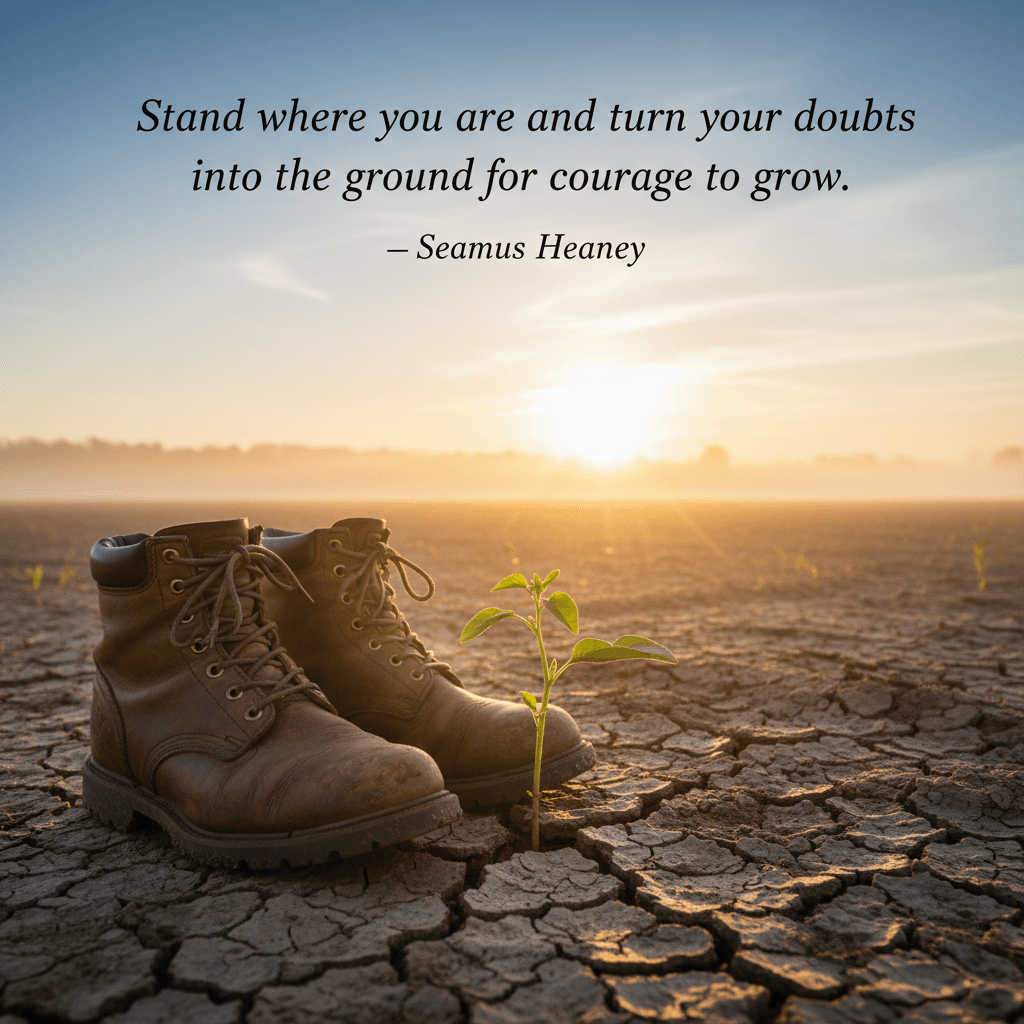
Rooting Doubt to Grow Everyday Courage
Heaney’s imperative to “stand where you are” reframes courage as composure before motion. Instead of scrambling for escape or certainty, he invites a pause that gathers scattered attention back into the body—feet planted...
Created on: 11/5/2025

Small Habits Carve Life’s Lasting Inner Landscapes
Seamus Heaney’s line invites us to see routine as terrain. His poems return to earth, craft, and the shaping touch—consider Digging from Death of a Naturalist (1966), where the pen becomes a spade and steady strokes repl...
Created on: 11/4/2025

Enduring Winter to Claim Any Possible Summer
Heaney’s line divides life into seasons: a harsh, contracting winter and a liberating, expansive summer. Winter stands for deprivation, fear, and constriction; summer signals ripeness, mobility, and choice.
Created on: 8/10/2025
In the Rhythm of Life, We Discover the Dance of Purpose - Seamus Heaney
This quote suggests that life has a natural rhythm, much like music or dance. By embracing this rhythm, we find our true purpose and direction.
Created on: 2/19/2025