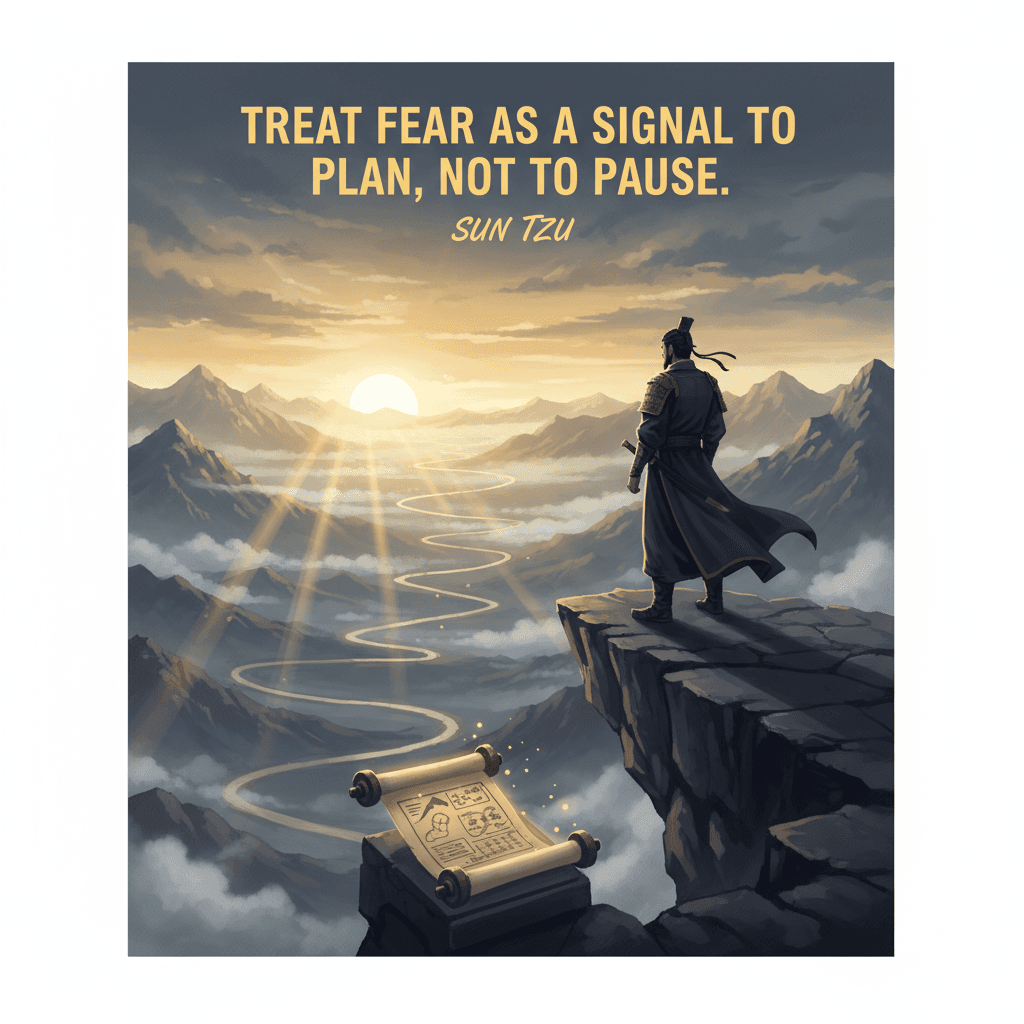
Sun Tzu
Sun Tzu is traditionally credited as an ancient Chinese military strategist and the author attributed to The Art of War. Reliable biographical details are scarce; his attributed work emphasizes strategy, leadership, and the theme of courage reflected in the quote.
Quotes by Sun Tzu
Quotes: 34

Success Means Building, Not Merely Avoiding Risk
Finally, the quote offers a simple metric you can use daily: ask what you added, not just what you escaped. Instead of ending a week satisfied that nothing went wrong, you might ask what moved forward—one draft written, one difficult conversation held, one system simplified, one habit installed. Over months, this becomes a compounding strategy: small constructed gains outpace flawless inaction. In that sense, Sun Tzu’s lesson is both strategic and personal: safety is not a finish line. The enduring measure of success is the structure you leave standing after the uncertainty passes. [...]
Created on: 12/15/2025

Turning Fear Into Foresight and Strategic Action
Finally, treating fear as a signal to plan gradually reshapes our character. Courage here is not the absence of fear, but the decision to let fear trigger preparation rather than withdrawal. Repeatedly responding to anxiety with thoughtful planning builds a track record of survivable challenges and learned lessons. As with veteran commanders in Sun Tzu’s world, this history of well-prepared responses reduces the intensity of future fears. Over time, we come to trust that when fear appears, it will not imprison us; instead, it will cue a disciplined process that moves us forward. [...]
Created on: 12/6/2025

The Power Of A Single Well-Timed Move
When the right action finally arrives, its impact can cascade far beyond its immediate effect. A surprise maneuver on the battlefield can break morale; similarly, a well-timed public statement or product launch can shift narratives, redefine expectations, and force rivals into reactive postures. In this way, Sun Tzu’s insight underscores that transformative change often emerges from singular, focused decisions that redirect the flow of events rather than from a gradual accumulation of minor, unfocused efforts. [...]
Created on: 12/5/2025

Moving Mountains By Mastering Simple Repeated Actions
Ultimately, Sun Tzu’s insight points toward building systems rather than relying on bursts of willpower. A system is a repeatable set of simple actions aligned with a larger purpose: a daily writing routine for a book, a training schedule for a marathon, or a savings plan for financial freedom. By committing to the system, we stop wrestling with the entire mountain and instead focus on the next stone. Over time, the landscape changes—not through force, but through consistent, well-designed simplicity. [...]
Created on: 11/21/2025

When Courageous Questions Outshine Easy Answers
Ultimately, Sun Tzu’s insight suggests that wisdom is less about collecting final answers and more about remaining in a state of thoughtful, continuous inquiry. Answers are milestones, not destinations. A brave question opens a door to deeper layers of reality—about strategy, ethics, or self-knowledge—that any single answer cannot fully capture. By cultivating the habit of asking bold, uncomfortable questions, individuals and societies keep that door open, allowing new insights, revised plans, and better decisions to emerge over time. [...]
Created on: 11/20/2025

Uniting Strategy and Resolve for Decisive Action
Yet, Sun Tzu does not advocate reckless aggression; his broader work praises careful calculation and understanding terrain before battle. The quote therefore suggests a balance: think rigorously, then stop thinking and move. This balance appears in modern strategy as well, from Eisenhower’s D‑Day planning—which combined exhaustive preparation with a firm launch decision—to entrepreneurial ‘build–measure–learn’ cycles that favor quick, committed experiments over endless theorizing. In every case, strategy finds its true meaning only when resolve closes the gap between intention and action. [...]
Created on: 11/19/2025

Marrying Imagination and Discipline at Daybreak
Finally, sustained discipline requires feedback. Sun Tzu’s counsel to “know the enemy and know yourself” (ch. 3) points to continuous appraisal: compare plan to reality, then adjust. The after-action review, formalized in the U.S. Army in the 1980s, institutionalizes this loop by asking what was intended, what occurred, and what to change next time. Carried into daily life, a five-minute review closes the imagination–action circuit, preventing drift and cultivating humility. In this rhythm—envision, execute, examine—the next dawn inherits sharper insight, ensuring that creativity remains bold while discipline stays wise. [...]
Created on: 11/17/2025