
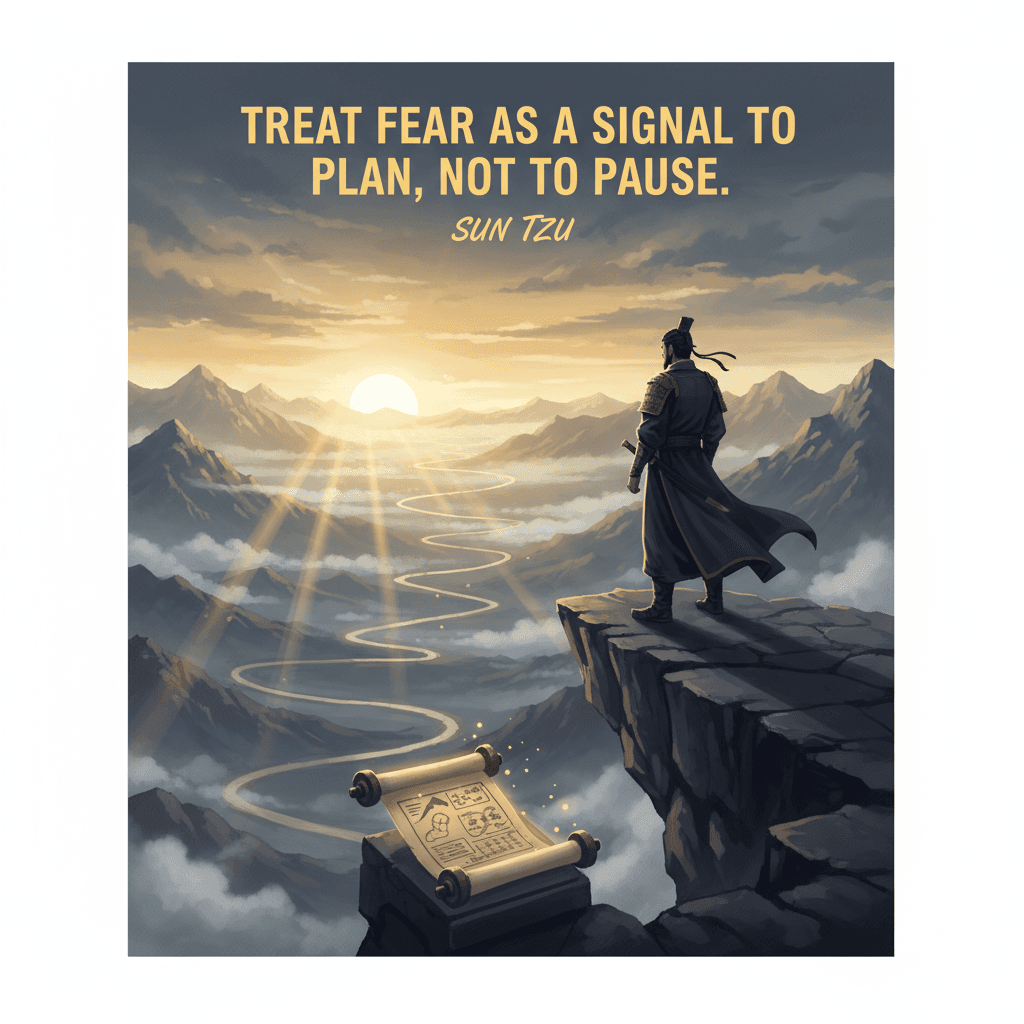
Treat fear as a signal to plan, not to pause. — Sun Tzu
—What lingers after this line?
Reframing Fear as Strategic Information
Sun Tzu’s counsel asks us to reinterpret fear not as a stop sign but as a dashboard warning light. Instead of freezing when danger appears, he suggests treating the anxious jolt as data about risk, weakness, or uncertainty. This shift in perspective converts a purely emotional reaction into a strategic resource. By doing so, fear stops being an enemy to suppress and becomes a messenger that highlights where we must think more carefully. In this way, the emotion that once stalled us now becomes the starting point for deliberate, intelligent planning.
Sun Tzu’s Art of War and Preparation
In *The Art of War* (c. 5th century BCE), Sun Tzu repeatedly emphasizes that victory belongs to those who calculate, prepare, and foresee. He notes that a general wins not through brute courage alone but by assessing terrain, timing, and the enemy’s intentions. Fear naturally arises in the face of unknowns and potential defeat; however, Sun Tzu would have us respond by sharpening our analysis. Rather than retreat in panic, the wise commander uses apprehension to probe vulnerabilities, strengthen supply lines, and refine tactics, transforming dread into disciplined readiness.
From Fight-or-Flight to Think-and-Plan
Biologically, fear primes us for fight, flight, or freeze, yet Sun Tzu implicitly proposes a fourth option: think. When tension rises, the mind can either narrow into panic or widen into strategy. Choosing the latter means asking: What exactly am I afraid of? What scenarios could unfold? What contingencies can I put in place now? This process redirects raw adrenaline into structured problem-solving. Over time, the habit of pausing not in paralysis but in analysis builds a calmer confidence, because each fearful moment has been systematically translated into concrete plans.
Practical Applications in Modern Life
Although rooted in warfare, the principle applies across everyday domains. A fear of financial instability can prompt budgeting, skill-building, or diversifying income rather than avoidance of bank statements. Nervousness before a key presentation can lead to rehearsals, feedback sessions, and backup materials instead of last-minute cancellations. Entrepreneurs facing market uncertainty can run scenario analyses and stress tests, echoing Sun Tzu’s insistence on preparation. In each case, fear is acknowledged but immediately harnessed to design next steps, turning potential obstacles into prompts for strategic action.
Cultivating Courage Through Planned Response
Finally, treating fear as a signal to plan gradually reshapes our character. Courage here is not the absence of fear, but the decision to let fear trigger preparation rather than withdrawal. Repeatedly responding to anxiety with thoughtful planning builds a track record of survivable challenges and learned lessons. As with veteran commanders in Sun Tzu’s world, this history of well-prepared responses reduces the intensity of future fears. Over time, we come to trust that when fear appears, it will not imprison us; instead, it will cue a disciplined process that moves us forward.
One-minute reflection
Why might this line matter today, not tomorrow?
Related Quotes
6 selectedMeasure each move by purpose, and victory becomes a natural result. — Sun Tzu
Sun Tzu
Sun Tzu’s line reframes victory as an outcome of disciplined intent rather than a lucky break or a last-minute burst of effort. When every move is measured by purpose, actions stop being reactive and start forming a cohe...
Read full interpretation →Study your obstacles like maps — each one marks a path forward. — Sun Tzu
Sun Tzu
Though the phrasing is modern, the maxim echoes Sun Tzu’s method in The Art of War (5th century BCE): treat impediments as information. A wall, looked at closely, is a contour line; it tells you where the ground rises an...
Read full interpretation →Victorious warriors win first and then go to war, while defeated warriors go to war first and then seek to win. — Sun Tzu
Sun Tzu
Sun Tzu’s line captures a quiet truth: victory is largely decided before swords cross. To win first is to shape conditions so decisively—through intelligence, positioning, and timing—that the ensuing clash merely confirm...
Read full interpretation →Strategy often beats sweat. Your direction matters more than your speed. — James Clear
James Clear
James Clear’s line compresses a hard-earned lesson into two sentences: effort alone isn’t the deciding factor; alignment is. “Strategy often beats sweat” argues that a thoughtful plan can outperform raw exertion, while “...
Read full interpretation →First, have a definite, clear practical ideal; a goal, an objective. Second, have the necessary means to achieve your ends; wisdom, money, materials, and methods. Third, adjust all your means to that end. — Aristotle
Aristotle
Aristotle emphasizes the importance of having a clear and practical goal. Before making any progress, it's essential to know exactly what you want to achieve.
Read full interpretation →As long as you have courage and a plan, you will be all right. — Winston S. Churchill
Winston S. Churchill
This quote emphasizes the importance of courage when facing challenges. Courage provides the mental and emotional strength necessary to overcome difficulties and remain focused on your goals.
Read full interpretation →More From Author
More from Sun Tzu →There are not more than five musical notes, yet their combinations give rise to more melodies than can ever be heard. — Sun Tzu
Sun Tzu’s remark begins with a disarmingly small inventory: just a handful of musical notes. Yet the point is not about music alone—it is about strategy’s habit of hiding abundance inside simplicity.
Read full interpretation →Find the bridge between intent and action, and cross it deliberately. — Sun Tzu
The quote frames a familiar human problem: intention often feels like progress, yet it can remain safely abstract unless it becomes action. By naming a “bridge,” it implies there is a real gap—made of doubt, distraction,...
Read full interpretation →Measure each move by purpose, and victory becomes a natural result. — Sun Tzu
Sun Tzu’s line reframes victory as an outcome of disciplined intent rather than a lucky break or a last-minute burst of effort. When every move is measured by purpose, actions stop being reactive and start forming a cohe...
Read full interpretation →Measure success by what you build, not by what you avoid. — Sun Tzu
Sun Tzu’s line shifts the definition of success away from a defensive mindset and toward tangible creation. Rather than treating life like a minefield where the goal is simply to survive unscathed, it argues that the tru...
Read full interpretation →