
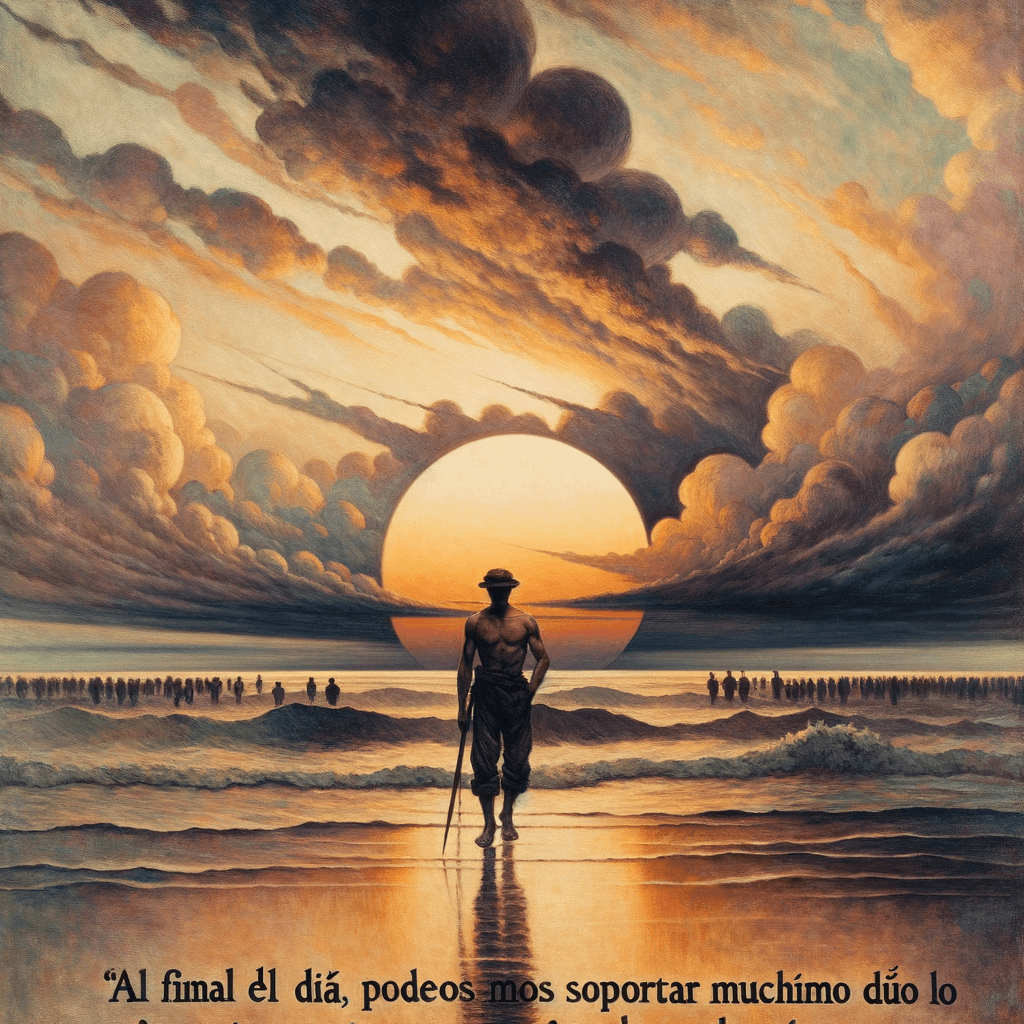
At the end of the day, we can endure much more than we think we can. - Frida Kahlo
—What lingers after this line?
Resilience of the Human Spirit
This quote highlights the incredible resilience and strength inherent in each person. It suggests that individuals have the capacity to withstand and overcome challenges that they may initially perceive as insurmountable.
Underestimating One's Own Strength
People often underestimate their own abilities to cope with difficult situations. Frida Kahlo's words serve as a reminder that we possess more inner strength and endurance than we give ourselves credit for.
Personal Experience
Frida Kahlo herself endured tremendous physical and emotional pain throughout her life, including chronic health issues and personal hardships. Her statement reflects her personal journey and the strength she found within herself.
Encouragement and Hope
The quote offers encouragement and hope to those facing tough circumstances. It reassures them that, despite how challenging a situation may appear, they have the ability to endure and come out stronger.
Psychological and Emotional Growth
Endurance through hardships often leads to personal growth and emotional development. This quote underscores the process of gaining wisdom, resilience, and inner strength through life's trials.
Historical Context
Frida Kahlo was a Mexican painter known for her impactful and raw depictions of pain and suffering. Her life and art were significantly influenced by her own battles with illness and hardship, which gives her words profound authenticity and depth.
One-minute reflection
What's one small action this suggests?
Related Quotes
6 selectedA mind grows by staying with difficulty long enough for the experience to change it. — Mary Catherine Bateson
Mary Catherine Bateson
Mary Catherine Bateson’s observation begins with a quiet but demanding truth: the mind does not grow merely by encountering difficulty, but by remaining with it. Challenge becomes transformative only when we resist the u...
Read full interpretation →When you are friends with your storm, you dance, instead of getting blown away. — Michael Bassey Johnson
Michael Bassey Johnson
Michael Bassey Johnson’s line begins with a striking reversal: the storm is not merely an enemy to survive, but a force one can learn to understand. In this sense, the storm may represent grief, fear, conflict, uncertain...
Read full interpretation →The strongest person controls the self, not others. — Seneca
Seneca
Seneca’s statement turns the usual idea of power inside out. Instead of praising the person who dominates rivals, commands attention, or bends others to their will, he locates real strength in self-command.
Read full interpretation →Just because your light flickers does not mean it is about to go out. — Yohancé Salimu
Yohancé Salimu
At first glance, Yohancé Salimu’s line separates appearance from reality. A flicker suggests instability, fatigue, or interruption, yet it does not automatically signal extinction.
Read full interpretation →When something in your life dies—whether it be a job, a hobby, or a dream—I encourage you not to focus on what could have been but instead to look for the new life and the new opportunities that result. — Ryan Hall
Ryan Hall
Ryan Hall frames loss as a kind of death, and that metaphor immediately broadens the quote beyond grief in the literal sense. A job can end, a cherished hobby can fade, and a long-held dream can collapse; yet in each cas...
Read full interpretation →Dreams are made of sturdy stuff. — William Carlos Williams
William Carlos Williams
At first glance, William Carlos Williams’s line reverses a familiar assumption: dreams are often treated as airy, fleeting, and insubstantial, yet he insists they are made of “sturdy stuff.” In that compact phrase, he gi...
Read full interpretation →More From Author
More from Frida Kahlo →I paint flowers so they will not die. — Frida Kahlo
Frida Kahlo’s line reads like a gentle spell: by painting flowers, she resists the most ordinary tragedy—things fading despite our care. A bouquet wilts, a season ends, a beloved moment slips away; the canvas, however, o...
Read full interpretation →I tried to drown my sorrows, but the bastards learned how to swim. — Frida Kahlo
Frida Kahlo’s line opens with the familiar promise of escape—“I tried to drown my sorrows”—and then snaps into a punchline that refuses sentimentality. The sudden insult, “the bastards,” is more than comic shock; it’s a...
Read full interpretation →I used to think I was the strangest person in the world, but there must be someone just like me who feels bizarre and flawed. — Frida Kahlo
Frida Kahlo’s reflection begins in a familiar loneliness: the belief that one’s inner life is uniquely strange, even irredeemably flawed. That kind of self-story can make ordinary differences feel like permanent exile.
Read full interpretation →Embrace risk as the price of progress; comfort keeps the clock of your life frozen. — Frida Kahlo
Frida Kahlo’s line frames progress as a purchase: you pay for it with risk. In that sense, “embrace” is not a motivational flourish but an instruction to stop treating uncertainty as an error and start treating it as a t...
Read full interpretation →