
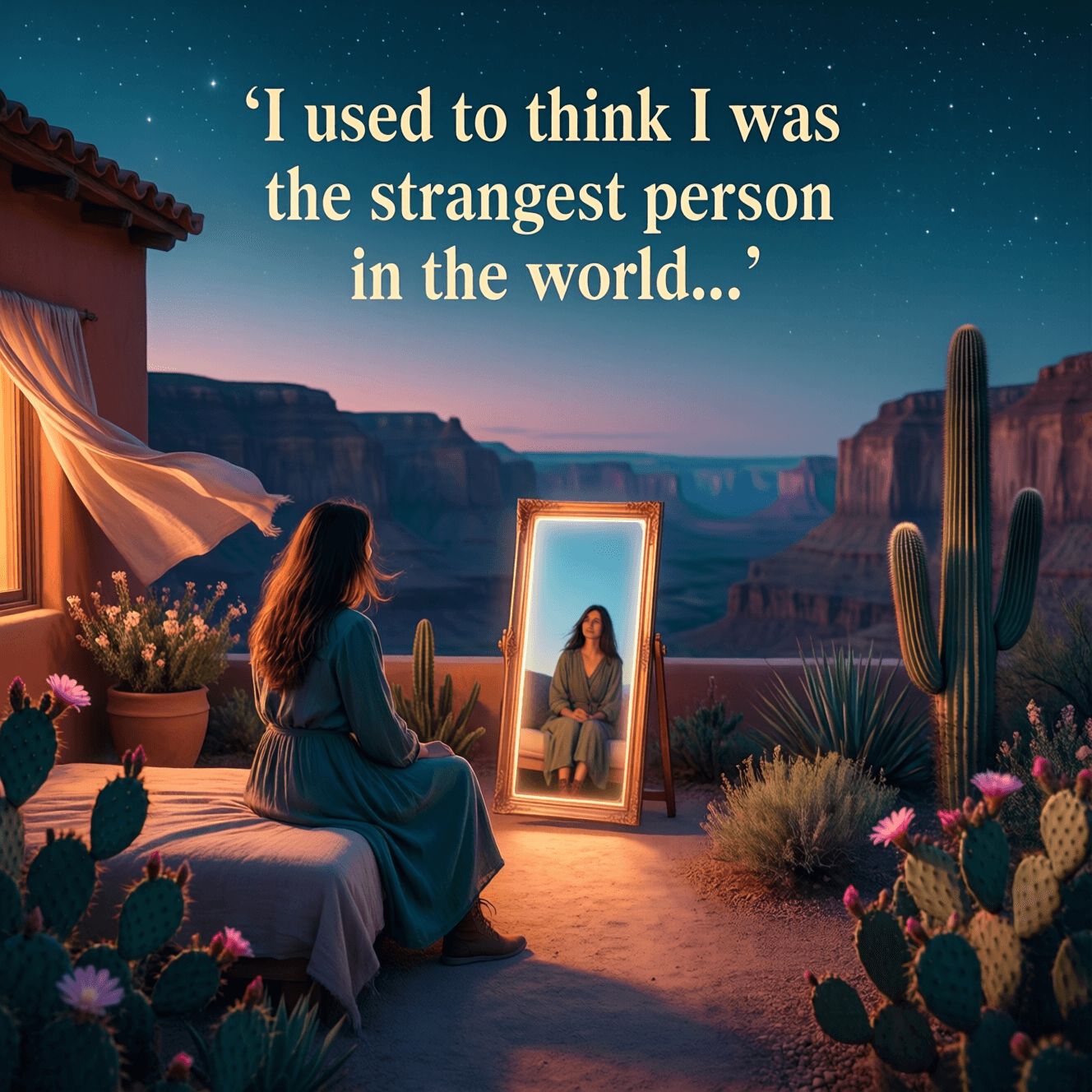
I used to think I was the strangest person in the world, but there must be someone just like me who feels bizarre and flawed. — Frida Kahlo
—What lingers after this line?
From Isolation to a Quiet Hope
Frida Kahlo’s reflection begins in a familiar loneliness: the belief that one’s inner life is uniquely strange, even irredeemably flawed. That kind of self-story can make ordinary differences feel like permanent exile. Yet within the sentence, the mood shifts from despair to possibility as she imagines, almost stubbornly, that someone else must exist who feels the same way. This turn matters because it replaces a closed world—“only me”—with an open one—“someone like me.” Even before any proof appears, the mere idea of a counterpart loosens the grip of isolation and makes room for connection.
The Universal Need to Be Recognized
Moving from that initial hope, the quote points to a basic human hunger: recognition without correction. Kahlo isn’t asking to be fixed; she’s yearning to be understood as she is, bizarre edges included. In that sense, her words echo a broader truth about belonging: people often don’t need perfect acceptance from everyone, just truthful recognition from someone. Literature repeatedly returns to this motif of the “other self” who makes life bearable; Mary Shelley’s *Frankenstein* (1818) dramatizes how devastating it is to be denied companionship, suggesting that being seen can be as vital as being safe.
Why We Overestimate Our Uniqueness
Then comes an important psychological undertone: when we’re ashamed or in pain, we tend to assume our experience is unprecedented. This is close to what cognitive therapy calls the spotlight effect and personalization—believing our flaws are more visible and more damning than they really are. Kahlo’s line gently challenges that distortion by introducing statistical and emotional probability: if I exist, someone like me likely exists too. In everyday life, this often shows up when a person hides a trait—chronic illness, sexuality, grief, neurodivergence—only to discover later that others nearby were carrying similar secrets. The shock isn’t that others suffer, but that silence made it seem impossible.
Art as a Bridge Between Private Worlds
Because Kahlo was an artist, her insight also implies a method: if you cannot find your counterpart, you can call them into the open through expression. Art externalizes what feels unspeakable and invites response from strangers who recognize themselves in it. Kahlo’s own paintings, filled with bodily pain and symbolic self-portraiture, function like messages in a bottle—deeply personal, yet aimed at an unknown receiver. This is why a diary, a song, or a canvas can feel like companionship across time. The creator admits, “This is what it’s like inside me,” and the viewer replies, “Me too,” sometimes without ever meeting.
Imperfection as a Site of Belonging
Next, the quote reframes “flawed” not as a verdict but as a common condition. If flaws are universal, then they can become a basis for solidarity rather than separation. Kahlo’s imagined twin isn’t flawless; she’s specifically someone who feels “bizarre and flawed,” which suggests that connection doesn’t require polishing oneself into acceptability. Philosophical traditions have long treated human brokenness as shared ground; Marcus Aurelius’ *Meditations* (c. 170–180) repeatedly reminds the reader that others are struggling too, and that compassion becomes easier when we remember our mutual limits.
Turning the Thought Into a Practice
Finally, Kahlo’s sentence can be read as a practical instruction: when you feel uniquely strange, assume there is a hidden community of similar minds and begin acting as if it’s real. That might mean seeking spaces where honesty is the norm—support groups, creative circles, thoughtful friendships—or simply sharing one true detail with a trusted person and seeing what returns. The point isn’t to erase individuality but to soften its sting. By holding onto the likelihood of a “someone just like me,” the self becomes less of a solitary puzzle and more of a recognizable human variation—worthy of contact, not concealment.
One-minute reflection
Why might this line matter today, not tomorrow?
Related Quotes
6 selectedHome is the place where one finally allows the armor to drop and the spirit to breathe. — Maya Angelou
Maya Angelou
At its core, Maya Angelou’s reflection defines home not merely as a structure but as a sanctuary of emotional safety. The image of letting “the armor drop” suggests that daily life often requires protection—composure, re...
Read full interpretation →What shames us, what we most fear to tell, does not set us apart from others; it binds us together if only we can take the risk to speak it. — Brené Brown
Brené Brown
At first glance, Brené Brown’s insight appears paradoxical: the very experiences we hide for fear of rejection are often the ones that make us most recognizable to others. Shame convinces people that their pain, failures...
Read full interpretation →The hardest thing about loving someone deeply is letting them see your vulnerabilities. — Catherine Gilbert Murdock
Catherine Gilbert Murdock
At first glance, Murdock’s insight seems to define love as an act of devotion toward another person. Yet the quote quickly turns inward: the hardest part is not simply feeling deeply, but allowing that feeling to expose...
Read full interpretation →To love at all is to be vulnerable. Love anything and your heart will be wrung and possibly broken. If you want to make sure of keeping it intact, you must give it to no one. — C.S. Lewis
C.S. Lewis
C.S. Lewis begins with a stark truth: to love anything at all is to accept vulnerability.
Read full interpretation →Let yourself be gutted. Let it open you. Start there. — Cheryl Strayed
Cheryl Strayed
At first glance, Cheryl Strayed’s words sound brutal, yet their force lies in invitation rather than destruction. To be “gutted” is to be stripped of pretense, certainty, and emotional armor; however, Strayed immediately...
Read full interpretation →To be tough is to be fragile; to be tender is to be truly fierce. — Farhana Qazi
Farhana Qazi
Farhana Qazi’s quote turns conventional ideas of power upside down. At first glance, toughness appears protective, even admirable; however, she suggests that rigid hardness often hides insecurity, fear, or emotional brit...
Read full interpretation →More From Author
More from Frida Kahlo →I paint flowers so they will not die. — Frida Kahlo
Frida Kahlo’s line reads like a gentle spell: by painting flowers, she resists the most ordinary tragedy—things fading despite our care. A bouquet wilts, a season ends, a beloved moment slips away; the canvas, however, o...
Read full interpretation →I tried to drown my sorrows, but the bastards learned how to swim. — Frida Kahlo
Frida Kahlo’s line opens with the familiar promise of escape—“I tried to drown my sorrows”—and then snaps into a punchline that refuses sentimentality. The sudden insult, “the bastards,” is more than comic shock; it’s a...
Read full interpretation →Embrace risk as the price of progress; comfort keeps the clock of your life frozen. — Frida Kahlo
Frida Kahlo’s line frames progress as a purchase: you pay for it with risk. In that sense, “embrace” is not a motivational flourish but an instruction to stop treating uncertainty as an error and start treating it as a t...
Read full interpretation →Stand where your heart points, even if your feet tremble — Frida Kahlo
Frida Kahlo’s line frames the heart as a compass: not a sentimental impulse, but an inner conviction that points toward what feels most true. “Stand where your heart points” implies choosing a position—an identity, a rel...
Read full interpretation →