
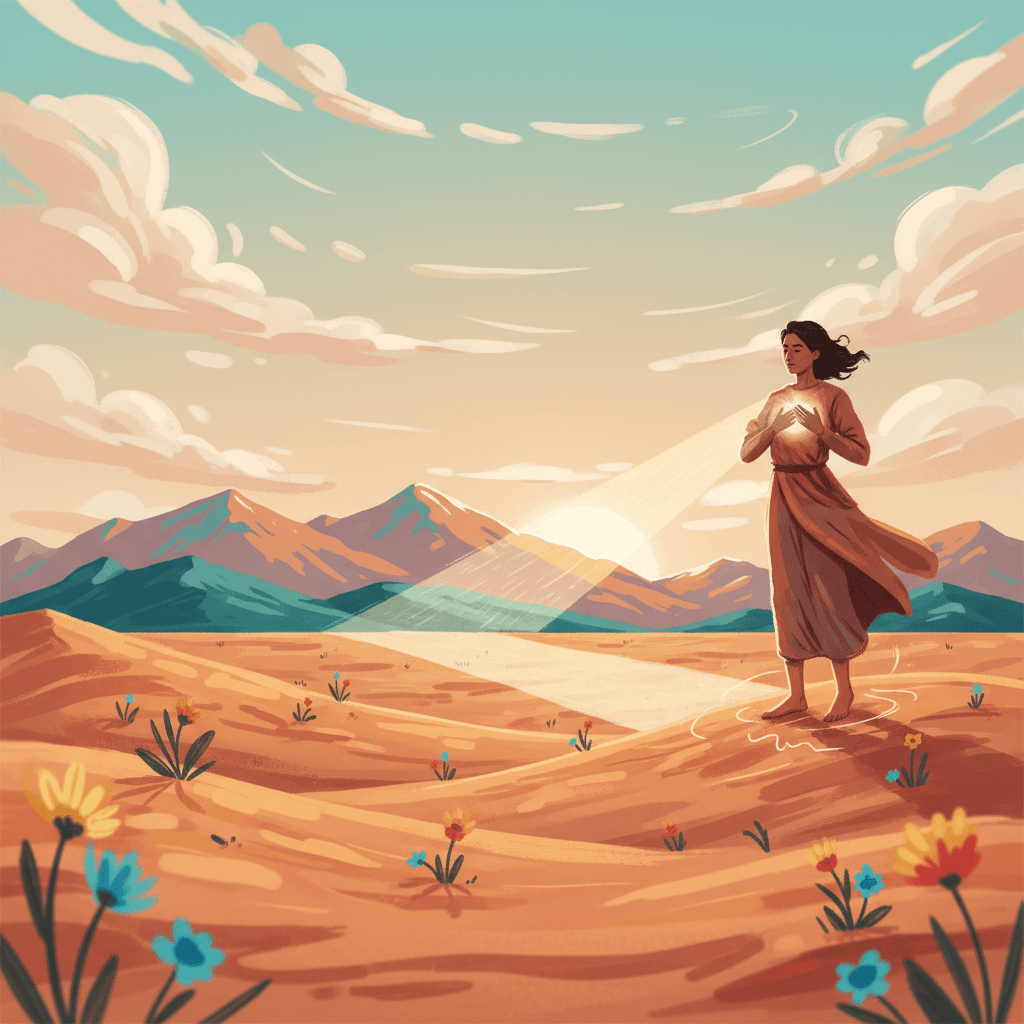
Stand where your heart points, even if your feet tremble — Frida Kahlo
—What lingers after this line?
A Map Drawn by Inner Conviction
Frida Kahlo’s line frames the heart as a compass: not a sentimental impulse, but an inner conviction that points toward what feels most true. “Stand where your heart points” implies choosing a position—an identity, a relationship, a creative path—and inhabiting it openly rather than hovering at the edge of commitment. Yet the phrase also acknowledges that clarity does not erase difficulty. The heart may point somewhere socially inconvenient or personally costly, and Kahlo’s imperative suggests that authenticity becomes real only when it is embodied as a stance, not merely held as a private belief.
Trembling Feet and the Reality of Fear
The second half—“even if your feet tremble”—adds psychological honesty: courage is not the absence of fear but action alongside it. The body’s trembling represents what happens when the nervous system anticipates risk, whether that risk is rejection, failure, or isolation. In that way, Kahlo is not romanticizing bravery as a heroic performance. Instead, she presents a more accessible model: you can be uncertain, anxious, and still choose the truer direction. The trembling becomes evidence that the choice matters, not a sign that you should turn back.
Frida Kahlo’s Life as Subtext
Although the quote stands on its own, it resonates with Kahlo’s larger story as an artist who transformed pain into self-definition. After a catastrophic bus accident in 1925, she endured lifelong medical complications and repeated surgeries, yet built an artistic voice that refused to look away from the body’s reality. As a result, “standing” here can be read literally and metaphorically: perseverance through physical limitation, and persistence in self-expression despite scrutiny. Her self-portraits—often confronting injury, identity, and desire—function like visual declarations of where her heart pointed, even under conditions that would make anyone tremble.
Integrity as a Daily Practice
Moving from biography to everyday life, Kahlo’s message becomes a practical ethic: align your actions with your values in small, repeatable ways. Standing where your heart points can look like setting a boundary, telling an uncomfortable truth, applying for the work you want, or refusing to shrink your ambitions to keep others comfortable. Importantly, this is less about one dramatic leap and more about sustained integrity. Each time you act in accord with your deeper commitments, you reinforce a steadier posture—so the body may still tremble, but the self becomes harder to dislodge.
When the Heart Points Toward Love and Belonging
The quote also speaks to relational courage: being honest about who you love, what you need, or what you can no longer tolerate. In many lives, the heart points toward a frank conversation, a reconciliation, or sometimes a necessary departure. Here trembling is especially familiar because relationships involve vulnerability and unpredictability. Kahlo’s phrasing implies that dignity comes from choosing sincerity over performance. Even when the outcome is uncertain, standing in the truth of your feelings can be a form of self-respect that outlasts the moment’s fear.
Choosing Without Romanticizing Impulse
Finally, the quote invites a careful distinction: following the heart is not the same as obeying every fleeting desire. A heart that “points” suggests direction over time—an enduring sense of meaning—rather than a passing urge. So the courage Kahlo advocates is best paired with reflection: test whether the direction is consistent with your values and long-term well-being. Once it is, the trembling no longer disqualifies the choice; it simply accompanies it. In that closing insight, the quote becomes both permission and challenge: be afraid, but be true.
One-minute reflection
What feeling does this quote bring up for you?
Related Quotes
6 selectedYou do not have to be fearless to be brave. You only need to be present enough to take the next deliberate action. — Pema Chödrön
Pema Chödrön
At first glance, Pema Chödrön’s quote gently overturns a common misconception: that bravery belongs only to people untouched by fear. Instead, she presents courage as something far more accessible.
Read full interpretation →Dare to begin where fear says to stop; the first step redraws the map — Paulo Coelho
Paulo Coelho
Paulo Coelho’s line treats fear less as a warning and more as a border we mistakenly accept as permanent. When fear says “stop,” it often isn’t pointing to actual danger; it’s signaling uncertainty, inexperience, or the...
Read full interpretation →To be courageous is to act with the heart. — Molière
Molière
Molière’s line suggests that courage is not merely the absence of fear, but the decision to move despite it. By connecting courage with the heart, he frames bravery as an emotional and moral act rather than a simple disp...
Read full interpretation →The best people possess a feeling for beauty, the courage to take risks, the discipline to tell the truth, the capacity for sacrifice. — Ernest Hemingway
Ernest Hemingway
Hemingway’s line presents goodness not as politeness or success, but as a demanding inner code. The “best people” are those who combine sensitivity, bravery, honesty, and self-denial—qualities that do not always coexist...
Read full interpretation →If you are not willing to look stupid, nothing great is ever going to happen to you. — Julia Cameron
Julia Cameron
Julia Cameron’s remark begins with a hard truth: many people do not fail because they lack talent, but because they fear embarrassment. In that sense, ‘looking stupid’ becomes shorthand for being seen trying, stumbling,...
Read full interpretation →You don't have to bully yourself out of feeling fear. You just have to move while it's still there. — Annie Wright
Annie Wright
At its core, Annie Wright’s quote challenges the common belief that courage begins only after fear has disappeared. Instead, it reframes fear as something that can accompany action rather than prevent it.
Read full interpretation →More From Author
More from Frida Kahlo →I paint flowers so they will not die. — Frida Kahlo
Frida Kahlo’s line reads like a gentle spell: by painting flowers, she resists the most ordinary tragedy—things fading despite our care. A bouquet wilts, a season ends, a beloved moment slips away; the canvas, however, o...
Read full interpretation →I tried to drown my sorrows, but the bastards learned how to swim. — Frida Kahlo
Frida Kahlo’s line opens with the familiar promise of escape—“I tried to drown my sorrows”—and then snaps into a punchline that refuses sentimentality. The sudden insult, “the bastards,” is more than comic shock; it’s a...
Read full interpretation →I used to think I was the strangest person in the world, but there must be someone just like me who feels bizarre and flawed. — Frida Kahlo
Frida Kahlo’s reflection begins in a familiar loneliness: the belief that one’s inner life is uniquely strange, even irredeemably flawed. That kind of self-story can make ordinary differences feel like permanent exile.
Read full interpretation →Embrace risk as the price of progress; comfort keeps the clock of your life frozen. — Frida Kahlo
Frida Kahlo’s line frames progress as a purchase: you pay for it with risk. In that sense, “embrace” is not a motivational flourish but an instruction to stop treating uncertainty as an error and start treating it as a t...
Read full interpretation →