
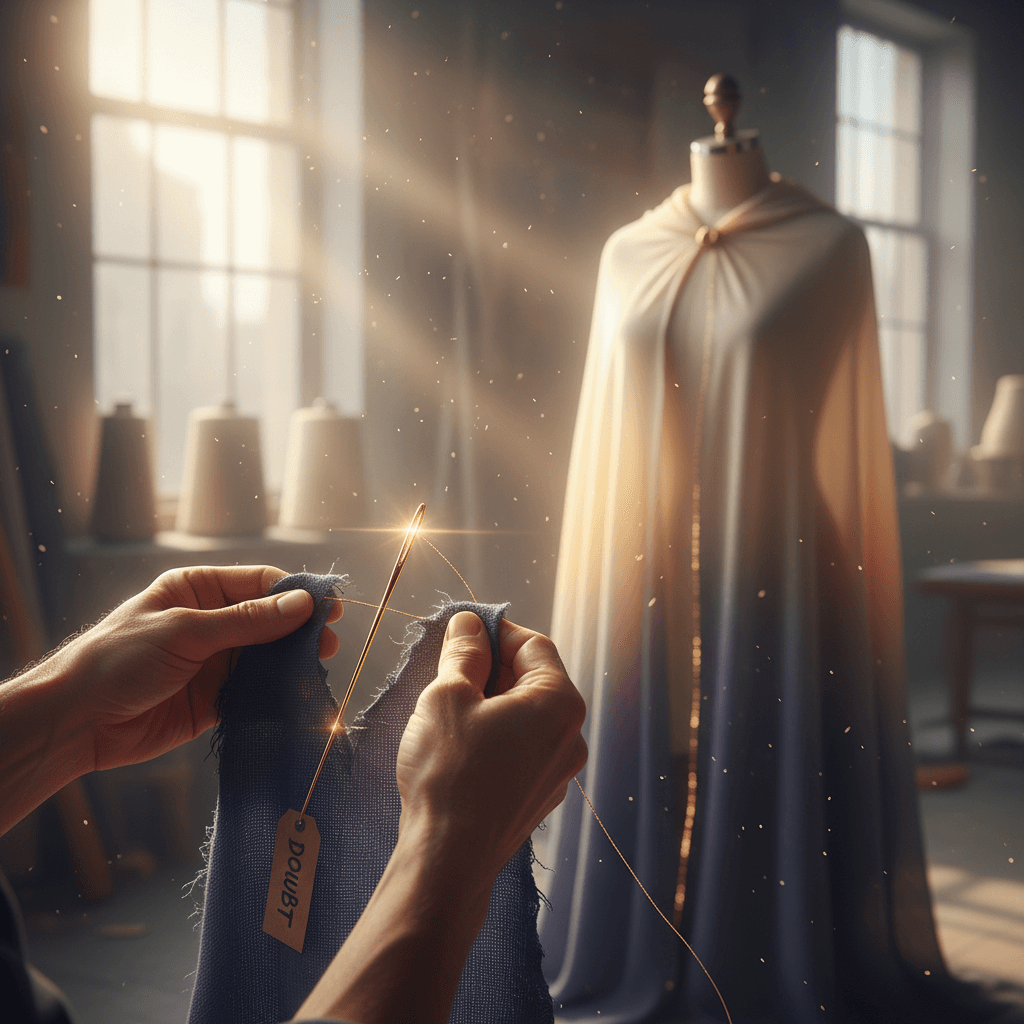
Courage stitches the torn edges of doubt into a garment of hope — Maya Angelou
—What lingers after this line?
A Metaphor of Repair and Renewal
Maya Angelou’s line frames courage not as a flashy triumph but as a quiet craft: stitching. By choosing the language of mending, she implies that doubt is not an enemy to be eliminated; it is a tear in the fabric of the self that can be repaired. The image of a “garment” also suggests something lived in daily—hope is not merely an idea we admire, but a practical covering we carry into the world. This metaphor sets a grounded tone from the start: courage is the act that makes hope usable. Rather than pretending we never fray, Angelou points to the dignity of repair, where vulnerability becomes the very place transformation begins.
Doubt as a Common Human Fracture
To understand why courage matters, Angelou first makes room for doubt as a normal condition. Doubt appears when goals exceed certainty—when you apply for the job you might not get, speak up in a room that might dismiss you, or grieve a change you can’t control. In that sense, doubt is evidence that you are attempting something real, not a sign that you are unfit. From here, the quotation subtly shifts the question: the issue is not whether doubt exists, but what we do with its torn edges. If doubt can be acknowledged without surrendering to it, then the possibility of repair—courage—becomes the next logical step.
Courage as a Repeated Practice
Angelou’s “stitches” imply repetition, patience, and incremental progress. One stitch rarely holds a rip; many small passes of thread create strength over time. Likewise, courage often looks like a sequence of manageable actions—making the phone call, rewriting the page, showing up again—rather than a single heroic leap. This view aligns with the practical wisdom that bravery is built, not bestowed. Much as Aristotle’s Nicomachean Ethics (4th century BC) treats virtue as habituated action, Angelou’s metaphor suggests that courage is a skill you practice until it becomes part of how you live with uncertainty.
Hope as Something You Can Wear
The end of the metaphor—“a garment of hope”—matters because garments do more than decorate; they protect, warm, and present us to others. Hope, in Angelou’s framing, is not naïve optimism but a functional layer that helps you endure exposure to disappointment and keep moving. It is the difference between being raw to the world and being able to face it. Seen this way, hope is the outcome of courageous repair. Once doubt is stitched rather than left to widen, hope becomes something you can put on in the morning and carry into difficult conversations, long projects, and uncertain seasons.
The Quiet Heroism of Self-Compassion
Stitching torn fabric requires a steady hand and gentleness; ripping at it only makes the hole larger. Similarly, courage often depends on self-compassion—the willingness to treat your own fear with care instead of contempt. In practice, this might mean admitting “I’m not sure” while still taking the next step, or letting yourself learn publicly without needing perfection. This gentleness doesn’t weaken the message; it deepens it. Angelou implies that courage includes how we hold ourselves during doubt, because repair is most possible when we stop punishing the tear and start working with it.
From Inner Mending to Collective Strength
Finally, Angelou’s metaphor can expand beyond the individual. Communities also experience doubt—about justice, safety, and the future—and courage can be the collective act of stitching: organizing, telling the truth, voting, mentoring, and rebuilding trust after harm. In that sense, hope becomes a shared garment, something a society wears when it chooses repair over resignation. Angelou’s broader body of work, including I Know Why the Caged Bird Sings (1969), often insists that survival and dignity are not passive states but achieved through resilience. This line fits that arc: courage is the thread that turns frayed experience into something strong enough to live in.
One-minute reflection
Where does this idea show up in your life right now?
Related Quotes
6 selectedStepping onto a brand-new path is difficult, but not more difficult than remaining in a situation which is not nurturing. — Maya Angelou
Maya Angelou
Maya Angelou frames change as hard, but she refuses to let that difficulty dominate the decision. By comparing “a brand-new path” with “remaining in a situation which is not nurturing,” she shifts the question from comfo...
Read full interpretation →Plant courage in small moments; over time it becomes the landscape of your life — Maya Angelou
Maya Angelou
Maya Angelou’s image of planting courage in small moments reframes bravery as a series of quiet choices rather than a single heroic act. Instead of waiting for a grand test of character, she suggests that every ordinary...
Read full interpretation →Stand up to your doubts with the dignity of someone who remembers why they began. — Maya Angelou
Maya Angelou
Maya Angelou’s words urge us to meet doubt not by shrinking, but by standing up. Doubts—about our abilities, choices, or worth—often invite us to bow our heads in shame or to abandon our efforts altogether.
Read full interpretation →Turn hesitation into rehearsal; practice is the beacon that guides your first brave move. — Maya Angelou
Maya Angelou
Maya Angelou’s line starts from an honest place: hesitation. Before any meaningful endeavor—speaking up, changing careers, or sharing art—most people confront a quiet pause filled with doubt.
Read full interpretation →To be courageous is to act with the heart. — Molière
Molière
Molière’s line suggests that courage is not merely the absence of fear, but the decision to move despite it. By connecting courage with the heart, he frames bravery as an emotional and moral act rather than a simple disp...
Read full interpretation →The best people possess a feeling for beauty, the courage to take risks, the discipline to tell the truth, the capacity for sacrifice. — Ernest Hemingway
Ernest Hemingway
Hemingway’s line presents goodness not as politeness or success, but as a demanding inner code. The “best people” are those who combine sensitivity, bravery, honesty, and self-denial—qualities that do not always coexist...
Read full interpretation →More From Author
More from Maya Angelou →We need joy as we need air. We need love as we need water. We need each other as we need the earth we share. — Maya Angelou
Maya Angelou’s words turn emotional needs into elemental ones, placing joy beside air, love beside water, and human connection beside the earth itself. By doing so, she refuses to treat happiness, affection, and communit...
Read full interpretation →The only way to exist in a world that feels increasingly cold is to be the warmth you wish to receive from others. — Maya Angelou
At its core, Maya Angelou’s line reframes loneliness as a call to action rather than a verdict on the world. If life feels impersonal, distant, or harsh, she suggests that waiting passively for kindness may only deepen t...
Read full interpretation →Home is the place where one finally allows the armor to drop and the spirit to breathe. — Maya Angelou
At its core, Maya Angelou’s reflection defines home not merely as a structure but as a sanctuary of emotional safety. The image of letting “the armor drop” suggests that daily life often requires protection—composure, re...
Read full interpretation →The true value of our journey is found in the people who walk beside us, turning simple moments into our most enduring milestones. — Maya Angelou
At its heart, this reflection suggests that life is not valued only by destinations reached, but by the companions who share the road. Maya Angelou’s thought reframes success away from solitary achievement and toward rel...
Read full interpretation →