
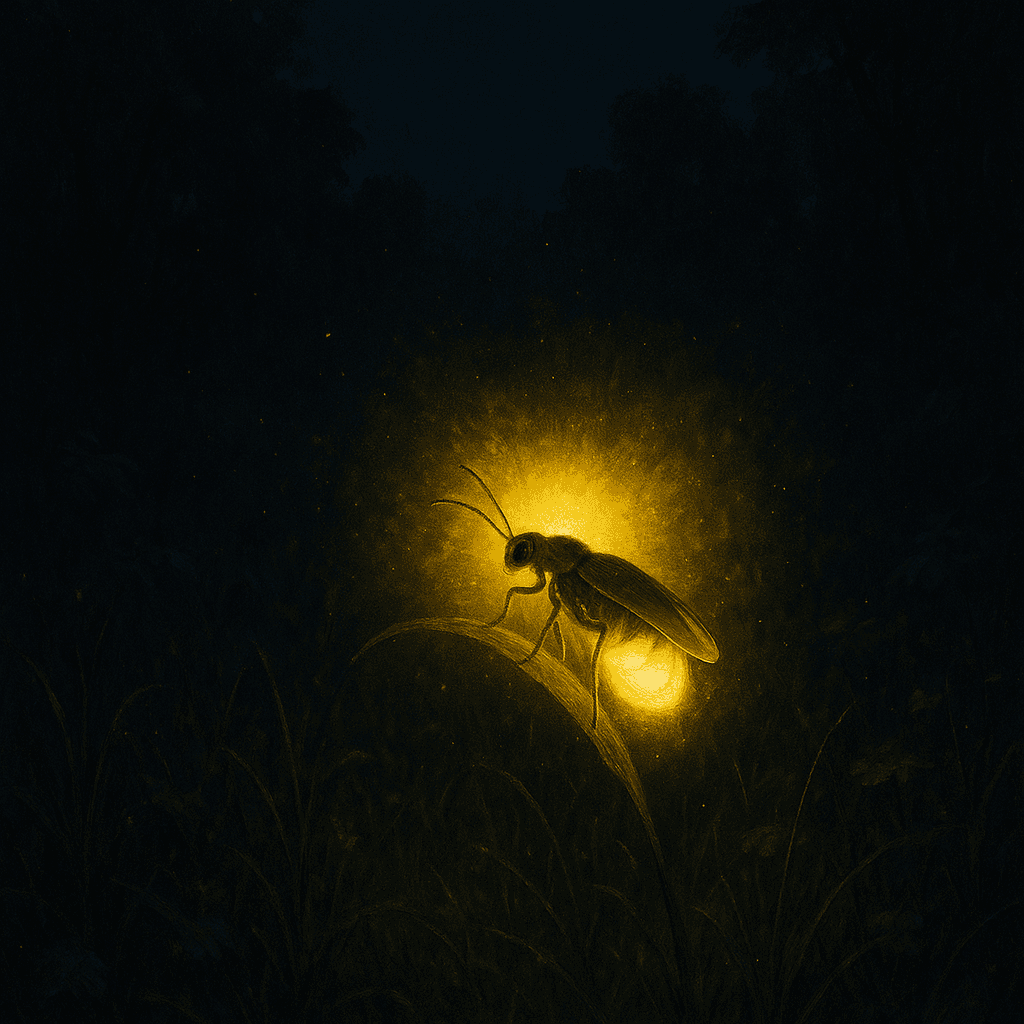
Glow fiercely like a firefly in the darkest night. — John Green
—What lingers after this line?
The Symbolism of the Firefly’s Glow
John Green’s evocative metaphor places the firefly—a creature best known for lighting up the darkness—at the heart of his message. The tiny insect, whose bioluminescence cuts through the night, becomes a symbol of hope, resilience, and individuality. Its glow is all the more striking amid deep shadows, suggesting that personal light and positivity gain meaning when set against adversity.
Resilience Revealed Through Darkness
Following the metaphor, the ‘darkest night’ references those periods of uncertainty, grief, or struggle that touch every life. Like the firefly, individuals are often called to shine brightest when circumstances are at their gloomiest. This theme echoes Viktor Frankl’s reflections in 'Man’s Search for Meaning' (1946), where he describes how purpose and hope can sustain the spirit during humanity’s darkest moments.
Inspiration Drawn from Small Acts of Light
Building on this, it is important to remember that, just as a firefly’s glow seems modest but can fill a field with wonder, even the smallest acts of kindness or courage have the power to illuminate another’s darkness. Stories abound of people offering empathy, laughter, or support in times of need, transforming bleak situations into moments of connection—much like fireflies gathering in the night.
Celebrating Uniqueness and Authenticity
Furthermore, fireflies glow not through imitation but from their innate biology, reminding us to honor our authentic selves. John Green’s quote emphasizes the virtue of embracing one’s unique gifts and character. Oscar Wilde famously quipped, 'Be yourself; everyone else is already taken,' reinforcing the idea that inner light shines brightest when it is genuine.
Encouraging Hopeful Action in Challenging Times
Ultimately, this metaphor urges active engagement rather than passive endurance: to 'glow fiercely' is to face adversity not just with endurance, but with spirited presence and intention. As transitions from night to dawn are brought about by the gradual presence of light, so too can collective courage and compassion bring hope to troubled times—just as countless fireflies transform a nightscape into a scene of wonder.
Recommended Reading
As an Amazon Associate, we earn from qualifying purchases.
One-minute reflection
What does this quote ask you to notice today?
Related Quotes
6 selectedThe light in me sees the light in you. — Marianne Williamson
Marianne Williamson
At its heart, Marianne Williamson’s line suggests that human connection begins with recognition rather than judgment. To say “the light in me sees the light in you” is to describe a meeting beneath personality, status, o...
Read full interpretation →It does not matter what you bear, but how you bear it. — Seneca
Seneca
At its heart, Seneca’s remark shifts attention away from suffering itself and toward character. Misfortune, pain, and limitation are often beyond human control, yet our response remains a moral choice.
Read full interpretation →Peace is not freedom from the storm, but peace amid the storm. — Martin Luther King Jr.
Martin Luther King Jr.
Martin Luther King Jr.’s words redefine peace as something deeper than comfort or calm surroundings. Rather than imagining peace as the total absence of conflict, pain, or uncertainty, he presents it as an inner steadine...
Read full interpretation →Yield and overcome, bend and be straight. — Lao Tzu
Lao Tzu
At first glance, Lao Tzu’s line seems contradictory: how can yielding lead to overcoming, or bending result in straightness? Yet this paradox lies at the heart of Taoist thought.
Read full interpretation →Glow fiercely like a firefly in the darkest night. — John Green
John Green
John Green’s evocative imagery encourages us to radiate our inner light even in the bleakest times, much like a firefly’s glow in the dark. A single firefly’s bioluminescence can pierce through the night, symbolizing hop...
Read full interpretation →A blazing fire makes flame and brightness out of everything that is thrown into it. — Marcus Aurelius
Marcus Aurelius
Marcus Aurelius compresses a central Stoic lesson into a vivid image: a strong fire does not merely endure what is cast into it, but transforms it into more flame and light. In that sense, adversity is not just something...
Read full interpretation →More From Author
More from John Green →There is hope, even when your brain tells you there isn't. — John Green
John Green’s line begins by acknowledging a familiar conflict: the mind can deliver convincing arguments for despair, yet hope can still exist alongside them. Rather than treating hope as a naïve feeling, he frames it as...
Read full interpretation →What's the point of being alive if you don't at least try to do something remarkable? — John Green
This quote questions the significance of life and urges individuals to seek a meaningful existence. It suggests that simply living is not enough; one must strive to achieve something noteworthy.
Read full interpretation →Those who do not understand true pain can never understand true joy. — John Green
This quote conveys that pain and joy are deeply connected experiences. Without going through significant sorrow or hardship, it may be impossible to fully appreciate moments of profound happiness.
Read full interpretation →In the face of impossible odds, people who love adventure will always find a way. — John Green
This quote highlights the power of resilience and determination. Those who have a passion for adventure are not easily discouraged by challenges; instead, they use obstacles as motivation to push forward.
Read full interpretation →