
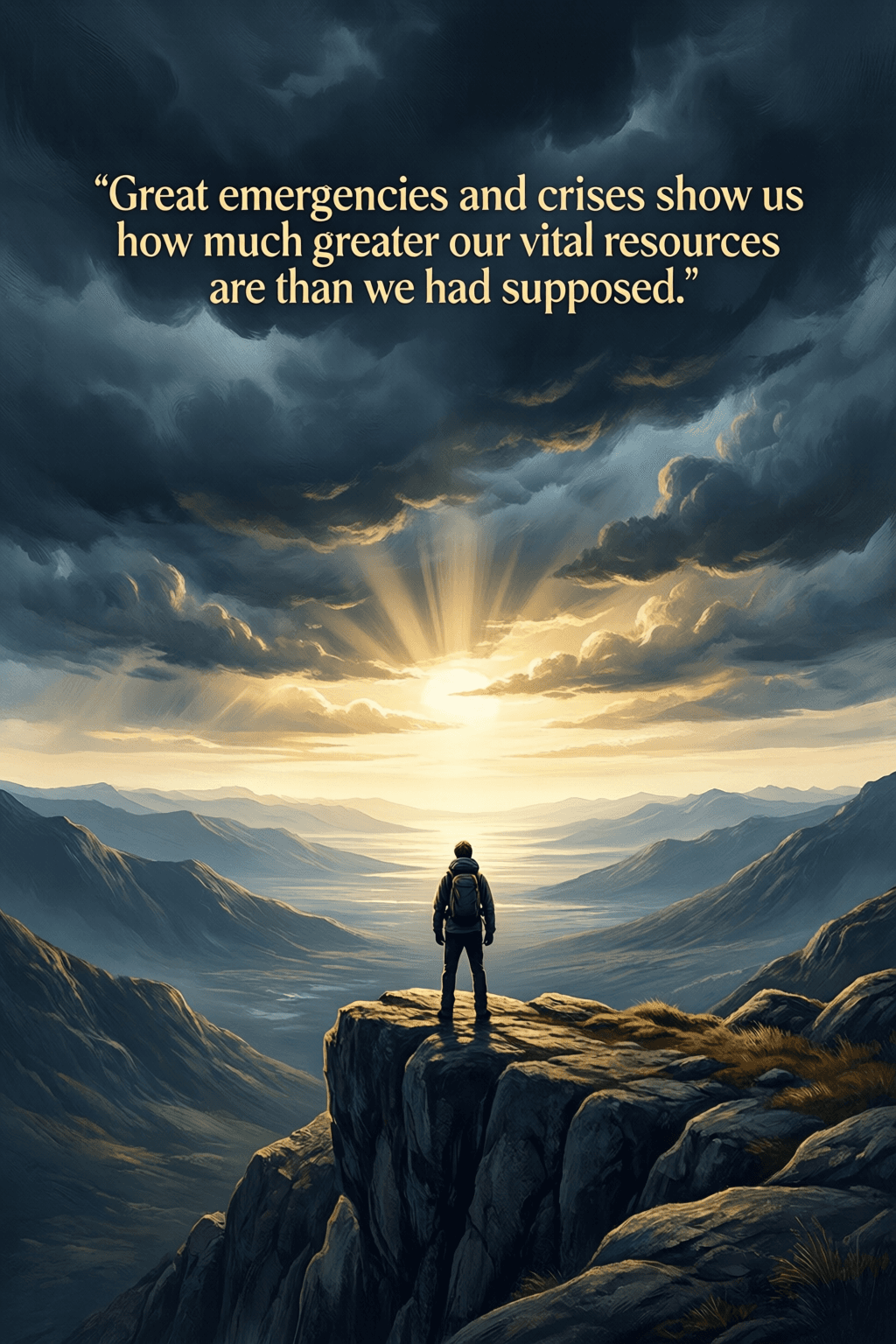
Great emergencies and crises show us how much greater our vital resources are than we had supposed. — William James
—What lingers after this line?
The Hidden Reserve Within
William James suggests that ordinary life can conceal our deepest capacities. In routine conditions, people often act within familiar limits, assuming those limits define their true strength. Yet when a crisis arrives, something startling happens: energy, courage, and clarity emerge from places we did not know existed. In this way, the quote is less about disaster itself than about revelation. James, in works such as The Energies of Men (1907), repeatedly explored the idea that human beings live below their full power. Emergencies strip away hesitation, and in doing so, they expose a hidden reserve that comfort rarely calls forth.
Why Pressure Can Awaken Power
From this starting point, the quote also explains why extreme pressure sometimes produces extraordinary performance. A person who feels average in daily life may become decisive in an accident, a war, or a family emergency because necessity narrows attention and silences trivial doubts. What seemed impossible suddenly becomes required, and therefore achievable. Modern psychology supports this intuition through research on stress responses. While chronic stress can be damaging, acute stress can sharpen focus and mobilize the body for action. Thus, James’s insight remains persuasive: under urgent conditions, human beings often discover that their practical and emotional resources are far larger than they had imagined.
Historical Moments of Unexpected Endurance
Seen historically, James’s claim appears again and again in moments of collective hardship. During the London Blitz of 1940–41, for example, civilians endured bombardment with a steadiness that surprised even officials who had predicted mass panic. Diaries and government reports from the period show that ordinary people developed routines, mutual aid, and courage under conditions that once seemed unbearable. Likewise, memoirs from natural disasters often recount neighbors becoming rescuers, organizers, and caretakers almost overnight. These examples deepen James’s point: crises do not magically create character from nothing, but they do summon dormant capacities into visible action.
Personal Transformation Through Adversity
At a personal level, the quote speaks to the strange aftermath of hardship. Many people look back on illness, bereavement, or financial collapse and say not that they wanted the experience, but that it revealed what they were capable of enduring. In the moment, they felt frightened; afterward, they recognized resilience they could not previously have claimed. This idea resembles what later psychologists called post-traumatic growth, discussed by Richard Tedeschi and Lawrence Calhoun (1995). Not every crisis leads to growth, of course, yet some individuals emerge with a stronger sense of purpose, deeper relationships, or greater confidence. James’s observation captures the beginning of that transformation.
The Difference Between Strength and Invulnerability
However, James’s statement should not be mistaken for a romantic celebration of suffering. To say that crises reveal vital resources is not to say that pain is good or that everyone must endure hardship alone. In fact, true resilience often includes asking for help, adapting expectations, and accepting vulnerability rather than denying it. This distinction matters because hidden strength is not the same as invulnerability. A firefighter who acts bravely may still be terrified; a grieving parent may continue functioning while deeply wounded. James’s wisdom is therefore humane rather than heroic in a simplistic sense: human beings are stronger than they assume, even when that strength coexists with fear and fragility.
A Practical Lesson for Ordinary Life
Finally, the quote invites a practical shift in how we live before crisis arrives. If emergencies reveal unused resources, then perhaps daily life should be shaped by greater trust in our latent abilities. We need not wait for catastrophe to test them; disciplined effort, service, and deliberate challenges can gradually widen the boundaries of what we think possible. In that sense, James offers both comfort and instruction. Comfort, because apparent weakness may be incomplete self-knowledge; instruction, because the self is larger than habit suggests. When difficulty comes, his words remind us that we may meet it not only with dread, but with powers still waiting to be discovered.
One-minute reflection
What does this quote ask you to notice today?
Related Quotes
6 selectedDon't fight the challenges. Just find a new way to stand. — Germany Kent
Germany Kent
Germany Kent’s words begin with a quiet reversal of instinct: instead of treating every challenge as an enemy to defeat, she invites us to reconsider our posture toward difficulty. The emphasis is not on surrender, but o...
Read full interpretation →Optimist: someone who figures that taking a step backward after taking a step forward is not a disaster, it's more like a cha-cha. — Robert Brault
Robert Brault
Robert Brault’s line begins with a witty redefinition: an optimist is not someone who denies backward motion, but someone who interprets it differently. Instead of treating a setback as proof of failure, the optimist see...
Read full interpretation →A mind grows by staying with difficulty long enough for the experience to change it. — Mary Catherine Bateson
Mary Catherine Bateson
Mary Catherine Bateson’s observation begins with a quiet but demanding truth: the mind does not grow merely by encountering difficulty, but by remaining with it. Challenge becomes transformative only when we resist the u...
Read full interpretation →When you are friends with your storm, you dance, instead of getting blown away. — Michael Bassey Johnson
Michael Bassey Johnson
Michael Bassey Johnson’s line begins with a striking reversal: the storm is not merely an enemy to survive, but a force one can learn to understand. In this sense, the storm may represent grief, fear, conflict, uncertain...
Read full interpretation →Just because your light flickers does not mean it is about to go out. — Yohancé Salimu
Yohancé Salimu
At first glance, Yohancé Salimu’s line separates appearance from reality. A flicker suggests instability, fatigue, or interruption, yet it does not automatically signal extinction.
Read full interpretation →When something in your life dies—whether it be a job, a hobby, or a dream—I encourage you not to focus on what could have been but instead to look for the new life and the new opportunities that result. — Ryan Hall
Ryan Hall
Ryan Hall frames loss as a kind of death, and that metaphor immediately broadens the quote beyond grief in the literal sense. A job can end, a cherished hobby can fade, and a long-held dream can collapse; yet in each cas...
Read full interpretation →More From Author
More from William James →No matter how full a reservoir of maxims one may possess, if one has not taken advantage of every concrete opportunity to act, one's character may remain entirely unaffected. — William James
At first glance, William James draws a sharp line between knowing and becoming. A person may store up countless moral sayings, noble principles, and wise resolutions, yet these remain largely ornamental if they never pas...
Read full interpretation →It is our attitude at the beginning of a difficult task which, more than anything else, will affect its successful outcome. — William James
William James argues that the decisive moment in any hard undertaking arrives before the real work is even underway. In this view, success does not begin with talent, resources, or luck, but with the posture of mind we b...
Read full interpretation →We are like islands in the sea, separate on the surface but connected in the deep. — William James
William James’s metaphor begins with a simple visual truth: islands appear isolated when viewed from above. In the same way, human beings often seem self-contained, bounded by private thoughts, personal histories, and in...
Read full interpretation →The art of being wise is the art of knowing what to overlook. — William James
William James reframes wisdom as subtraction rather than accumulation: to be wise is not merely to notice more, but to decide what deserves notice at all. At first, that can sound like avoidance, yet his point is sharper...
Read full interpretation →