
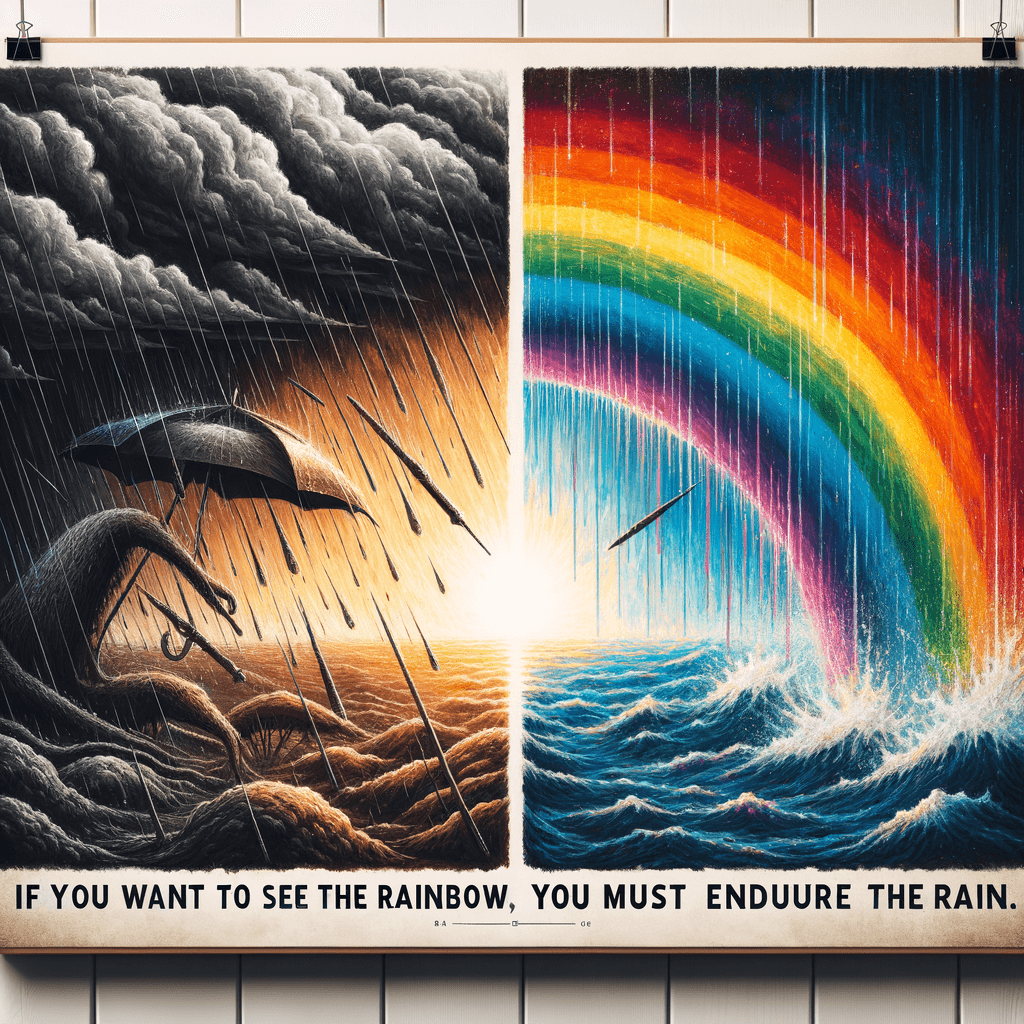
If you want to see the rainbow, you have to endure the rain.
—What lingers after this line?
Endurance and Reward
This quote implies that in order to experience beauty and success (symbolized by the rainbow), one must first endure hardships and challenges (symbolized by the rain).
Perseverance
It emphasizes the importance of perseverance. Great things often require overcoming obstacles and enduring difficult times before reaching the desired outcome.
Natural Cycles
The quote reflects the natural cycle of life, where moments of difficulty are followed by periods of relief and joy. Just as rain is followed by a rainbow, hardships can lead to rewarding experiences.
Optimism and Hope
It offers a message of hope, encouraging individuals to remain optimistic during tough times. Enduring temporary struggles is worth it for the eventual positive outcomes.
Personal Growth
The rain can also symbolize personal growth and learning. Enduring challenges can lead to personal development and understanding, much like how rain nourishes the earth.
One-minute reflection
What does this quote ask you to notice today?
Related Quotes
6 selectedResilience is not an exercise in quiet endurance; it is the courage to seek the visibility and support you deserve. — Unknown
Unknown
The quote challenges a familiar stereotype: that resilience is proven by staying silent, stoic, and self-contained. Instead, it reframes resilience as an active stance—choosing what helps you recover and move forward rat...
Read full interpretation →Resilience is not just enduring the storm; it is learning to harvest the rain to nourish the roots you've already planted. — Elizabeth Edwards
Elizabeth Edwards
At first glance, Elizabeth Edwards rejects the common image of resilience as simple endurance. To ‘endure the storm’ suggests gritting one’s teeth and waiting for suffering to pass, yet her metaphor quickly moves further...
Read full interpretation →Scars are the drag paths of survival—evidence that you moved through the weight. — Unknown
Unknown
The quote reframes scars as proof rather than decoration—physical or emotional marks that testify to what a person has endured. Instead of treating them as flaws to hide, it presents them as records of contact with hards...
Read full interpretation →A soft reset is still a reset. You don’t have to break to begin again. — Unknown
Unknown
The quote reframes reset as something gentler than the dramatic turning points we often romanticize. A “soft reset” suggests small, deliberate recalibrations—changing a habit, adjusting expectations, or stepping back to...
Read full interpretation →Don't fight the challenges. Just find a new way to stand. — Germany Kent
Germany Kent
Germany Kent’s words begin with a quiet reversal of instinct: instead of treating every challenge as an enemy to defeat, she invites us to reconsider our posture toward difficulty. The emphasis is not on surrender, but o...
Read full interpretation →Optimist: someone who figures that taking a step backward after taking a step forward is not a disaster, it's more like a cha-cha. — Robert Brault
Robert Brault
Robert Brault’s line begins with a witty redefinition: an optimist is not someone who denies backward motion, but someone who interprets it differently. Instead of treating a setback as proof of failure, the optimist see...
Read full interpretation →More From Author
More from Unknown →The language is the substrate. The architecture is the contract.
The line sets up a deliberate pairing: language lies beneath everything, while architecture governs everything above it. In other words, what you can express determines what you can build, and what you commit to structur...
Read full interpretation →A scroll is not a break; it is a trap disguised as rest. — Unknown
The quote begins by challenging a familiar story we tell ourselves: that a brief scroll is a harmless pause between tasks. On the surface, it looks like recovery—no effort, no decision, no commitment.
Read full interpretation →Don't let your ice cream melt while you're counting someone else's sprinkles. — Unknown
The quote uses ice cream as a simple stand-in for life’s fleeting pleasures: what you have is delicious, but it won’t last forever if you ignore it. Meanwhile, “counting someone else’s sprinkles” captures the habit of mo...
Read full interpretation →If your absence doesn't affect them, your presence never mattered. — Unknown
The quote frames absence as a revealing experiment: remove yourself, and the reaction—concern, curiosity, indifference—becomes a kind of data. If nothing changes when you’re gone, it suggests your role was never integrat...
Read full interpretation →