
Quote of the day
Why Habits Outlast Inspiration in Creative Work
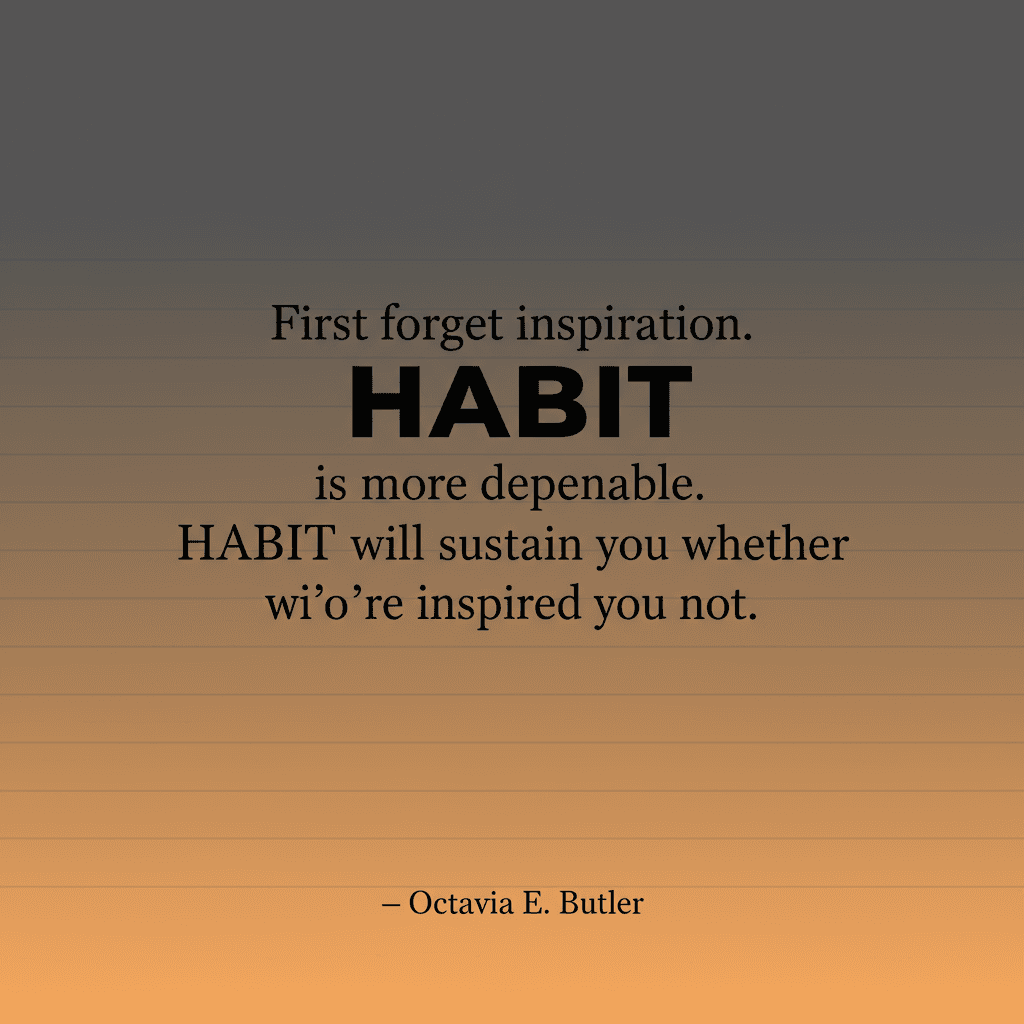
First forget inspiration. Habit is more dependable. Habit will sustain you whether you're inspired or not. — Octavia E. Butler
— Octavia E. Butler
Interpretation
Read full interpretation →At the outset, Butler’s injunction to forget inspiration reframes creativity as logistics rather than lightning. Inspiration is volatile; deadlines and doldrums arrive on schedule.
Read full interpretation →
Replacing the Muse with a Method
At the outset, Butler’s injunction to forget inspiration reframes creativity as logistics rather than lightning. Inspiration is volatile; deadlines and doldrums arrive on schedule. Habit, by contrast, reduces work to repeatable moves, lowering the psychological cost of starting. Once the first small action is underway—opening the document, setting a 25-minute timer—momentum replaces mood. Thus the paradox emerges: disciplined routine is not the enemy of creativity but its infrastructure, the scaffolding that holds when the spark flickers. Her own life exemplifies this claim, and it invites us to treat steadiness as a creative technology.
Butler’s Routine as Living Evidence
In Butler’s own life, the claim was practical. Interviews and her essay Positive Obsession (in Bloodchild and Other Stories, 1995) describe years of pre-dawn drafting before temp jobs. Her archived journals at The Huntington Library circle the mantra “I shall be a bestselling writer” across pages—an act of rehearsal as much as hope. Habitual early sessions produced pages through periods when Kindred stalled and the Parable novels were repeatedly revised. Because the hour was fixed, the work could proceed regardless of mood; because the practice was simple—sit, write, revise—it proved portable across seasons of doubt.
What Neuroscience and Psychology Reveal
Beyond anecdote, neuroscience and psychology show why habit sustains effort. Studies from Ann Graybiel’s lab at MIT (c. 2005) observed chunking in the basal ganglia as behaviors become automatic, shifting control from deliberative systems to efficient motor loops. Charles Duhigg’s The Power of Habit (2012) popularized the cue-routine-reward cycle, while Peter Gollwitzer’s implementation intentions (1999) demonstrated that if-then plans (“If it’s 6 a.m., then I draft 200 words”) dramatically raise follow-through. In this light, habit is not stoic heroism; it is cognitive economy, freeing scarce attention for the hard problems inside the work.
Designing Habits That Actually Stick
Practically speaking, durable habits are designed, not willed. Start with a tiny, non-negotiable minimum—one paragraph or a five-minute sketch—then attach it to a stable cue like a commute or a pre-coffee moment. Reduce friction by staging tools the night before and by constraining options (one project, one place). Name the plan: “At 7:00, at the desk, I outline.” Research on temptation bundling (Milkman et al., 2014) shows pairing effort with a treat—music, a special tea—can lock the loop. As Mason Currey’s Daily Rituals (2013) illustrates with Toni Morrison and Maya Angelou, steadiness beats sporadic sprints.
Weathering Dry Spells and Setbacks
When inspiration thins or setbacks arrive, habit becomes a safety net. Teresa Amabile’s The Progress Principle (2011) shows small, visible wins create disproportionate motivation—so keep a simple tally of sessions or a “done” list. Protect streaks with a humane rule: never miss twice. On chaotic days, execute the minimum and leave a breadcrumb note for tomorrow; this preserves momentum and cuts re-entry cost. Over time, these modest continuities compound into mastery precisely because they operate during the uninspired middle, not the euphoric start.
From Myth to Craft: A Sustainable Ethic
In the end, Butler’s advice asks us to trade the myth of the muse for the ethic of craft. Flaubert reputedly urged, “Be regular and orderly in your life so that you may be violent and original in your work” (c. 1852); the sentiment rhymes with Butler’s. Athletes, scientists, and coders alike ship results by showing up on schedule, not by awaiting a mood. Habit, then, is creative insurance: it carries you through weather. And once you’re moving, inspiration—capricious as it is—often remembers where to find you.
One-minute reflection
What does this quote ask you to notice today?