
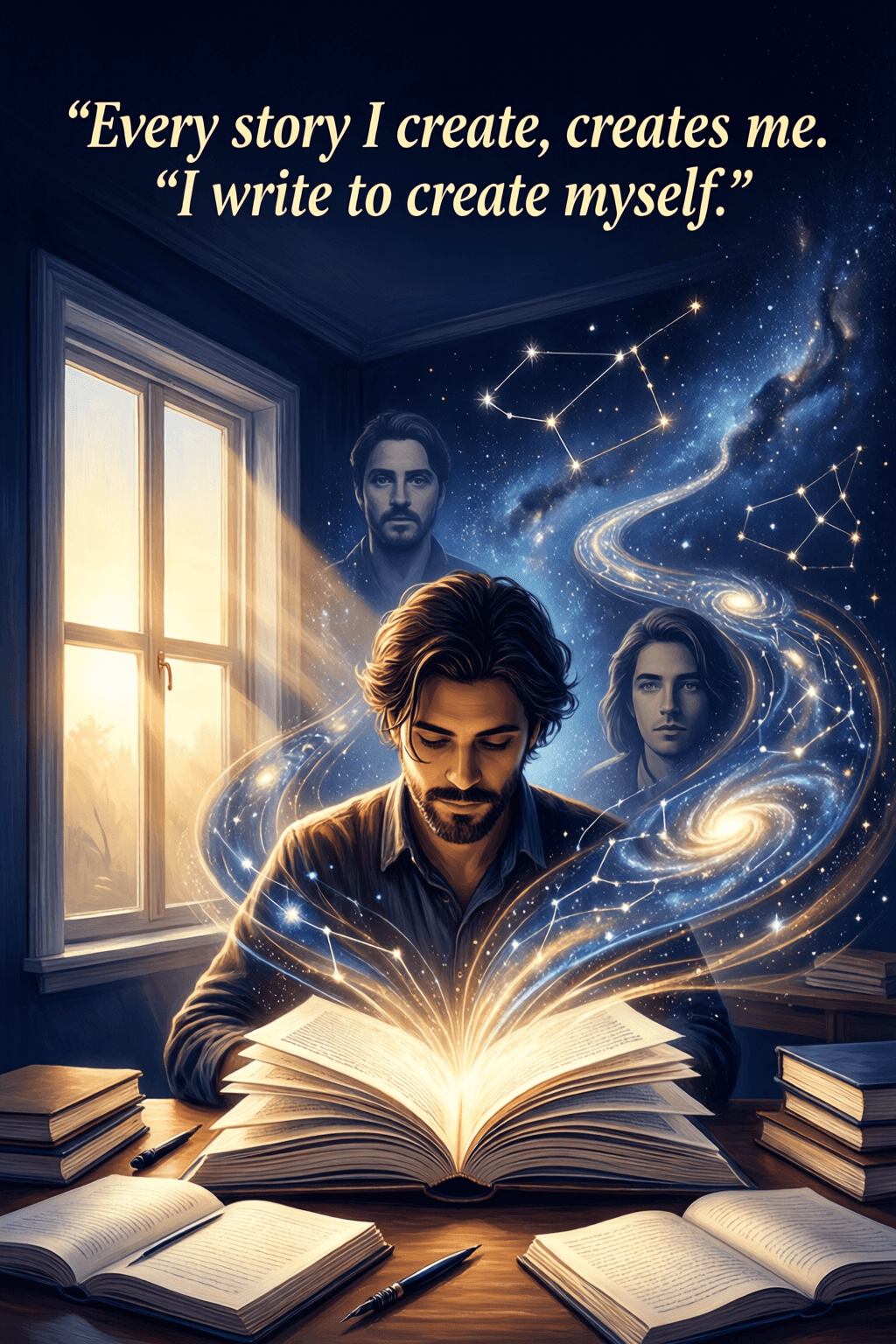
Every story I create, creates me. I write to create myself. — Octavia E. Butler
—What lingers after this line?
The Self Shaped Through Narrative
At first glance, Octavia E. Butler’s remark turns writing into more than expression; it becomes a process of becoming. When she says that every story she creates also creates her, she suggests that identity is not fixed in advance but formed through repeated acts of imagination, choice, and revision. In this way, storytelling is not merely a mirror of the self but one of its workshops. This idea feels especially powerful because stories require authors to test values, fears, and possibilities. As a result, each narrative becomes a kind of rehearsal for personhood, allowing the writer to discover who they are by deciding what their characters will endure, resist, and transform.
Why Butler’s Words Carry Special Weight
That insight deepens when placed beside Butler’s own life and work. Octavia E. Butler, best known for novels such as Kindred (1979) and Parable of the Sower (1993), wrote speculative fiction that confronted hierarchy, survival, power, and adaptation. Her protagonists are rarely passive; instead, they are shaped by brutal circumstances and forced to invent themselves within unstable worlds. Consequently, her quote reads not as a decorative reflection but as an artistic creed. Butler’s fiction shows that creating imagined futures can also forge inner resilience in the present. The worlds she built were intellectually daring, yet they also reveal a writer continually defining her own voice against social and literary constraints.
Creation as Discovery and Discipline
From there, Butler’s statement also points to the discipline hidden inside creativity. Writers often begin with the hope of producing a finished story, yet the act of writing demands patience, honesty, and endurance. Draft after draft, the writer confronts confusion and limitation, and in doing so becomes someone more attentive and more deliberate than before. In that sense, self-creation is not mystical alone; it is practical. Joan Didion expressed a related idea in “Why I Write” (1976), where writing becomes a way of finding out what one thinks. Butler pushes this further: writing does not only clarify thought, it actively forms the person capable of thinking, imagining, and persisting.
Fiction as a Space for Possible Selves
Moreover, stories allow a writer to inhabit possibilities unavailable in ordinary life. Through characters, settings, and conflicts, one can try on different moral choices, emotional responses, and futures. This imaginative movement expands the self, because each invented world asks the author to negotiate unfamiliar realities and, in turn, revise their own assumptions. Here Butler’s line echoes broader literary traditions. Virginia Woolf’s A Room of One’s Own (1929) argues that writing enables women to claim intellectual existence in cultures that deny it. Similarly, Butler implies that to write is to assert one’s authority to exist fully. The page becomes a site where identity is not granted by others but authored from within.
The Mutual Making of Writer and Work
As the quote unfolds, it becomes clear that Butler is describing a reciprocal relationship: the writer makes the story, and the story makes the writer back. This reciprocity explains why certain works feel life-altering not only for readers but for their creators. A sustained project can change a writer’s habits of thought, emotional vocabulary, and sense of purpose. Toni Morrison once said in interviews collected around The Source of Self-Regard (2019) that if there is a book one wants to read but it has not been written, then one must write it. Butler’s statement complements that view by adding a personal dimension: in writing the missing book, the author may also be writing the missing self.
A Broader Lesson Beyond Literature
Finally, Butler’s insight reaches beyond professional authorship. Even for those who never publish, journaling, memoir, fiction, or private reflection can become tools for self-construction. Language helps people order experience, give shape to pain, and imagine change; therefore, writing can be both an artistic act and a method of survival. Taken together, Butler’s words offer a profound vision of human agency. We are shaped by what we make, especially when what we make is meaning. Her quote endures because it reminds us that creation is never external alone: every serious act of storytelling leaves its mark on the story’s maker.
One-minute reflection
What does this quote ask you to notice today?
Related Quotes
6 selectedTell stories with your work; let creation sing the possibilities you imagine. — Alice Walker
Alice Walker
Alice Walker’s invitation to “tell stories with your work” suggests that every act of creation—whether writing, painting, coding, or organizing a community event—can carry a narrative. Rather than treating work as a seri...
Read full interpretation →It is not the voice that commands the story: it is the ear. — Italo Calvino
Italo Calvino
At first glance, Calvino’s line overturns a common assumption about storytelling. We often praise the speaker, the narrator, or the authorial voice as the force that leads a tale forward.
Read full interpretation →If you have nothing at all to create, then perhaps you create yourself. — Kurt Vonnegut
Kurt Vonnegut
At first glance, Vonnegut’s line sounds stark, even lonely: if the world offers no ready-made purpose, one must become the work itself. Yet the statement quickly turns from despair to possibility.
Read full interpretation →The deepest secret is that life is not a process of discovery, but a process of creation. — Neale Donald Walsch
Neale Donald Walsch
At its core, Neale Donald Walsch’s statement overturns a familiar assumption: that life arrives with a fixed essence waiting to be uncovered. Instead, he proposes that meaning, identity, and purpose are actively made thr...
Read full interpretation →Our stories are medicine for the present and lessons for the future. — Chag Lowry
Chag Lowry
Chag Lowry’s line begins by treating story not as entertainment but as care: something administered in the middle of real conditions. In the present, people reach for narratives to name what hurts, what’s changing, and w...
Read full interpretation →Begin each chapter with kindness and your story will find readers — Jane Austen
Jane Austen
Jane Austen’s advice treats a chapter opening as more than a technical necessity; it’s an invitation. To “begin…with kindness” implies that the first sentences should feel like a door held open rather than a test the rea...
Read full interpretation →More From Author
More from Octavia E. Butler →First forget inspiration. Habit is more dependable. Habit will sustain you whether you're inspired or not. — Octavia E. Butler
At the outset, Butler’s injunction to forget inspiration reframes creativity as logistics rather than lightning. Inspiration is volatile; deadlines and doldrums arrive on schedule.
Read full interpretation →Boldness in pursuit breathes life into dreams. — Octavia E. Butler
Octavia E. Butler’s statement underscores the transformative nature of boldness when chasing our aspirations.
Read full interpretation →All that you touch you change. All that you change changes you. — Octavia E. Butler
Octavia E. Butler condenses a worldview into two sentences: “All that you touch you change.
Read full interpretation →All that you touch you change. All that you change changes you. The only lasting truth is change. — Octavia E. Butler
Octavia E. Butler frames these lines as the core teaching of Earthseed in Parable of the Sower (1993), where Lauren Olamina compiles The Books of the Living.
Read full interpretation →