
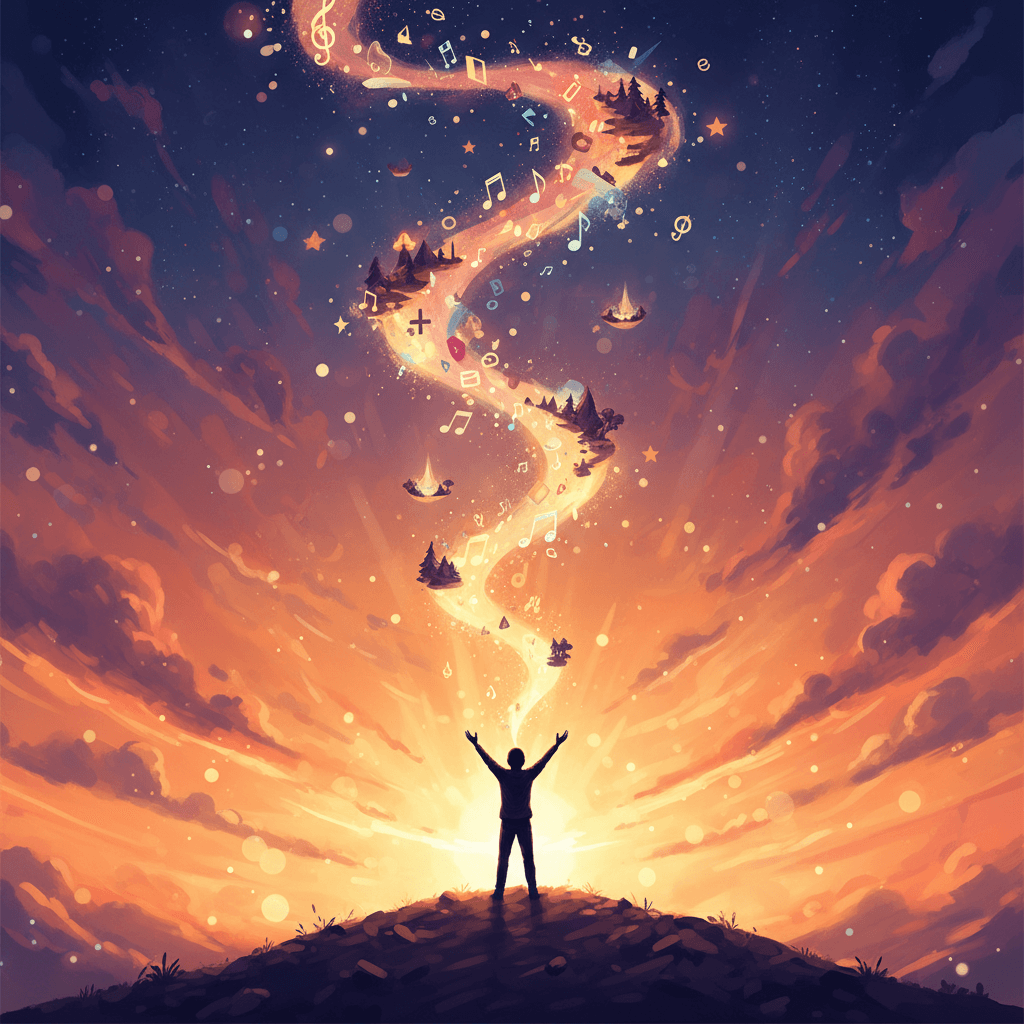
Tell stories with your work; let creation sing the possibilities you imagine. — Alice Walker
—What lingers after this line?
Creation as a Vehicle for Story
Alice Walker’s invitation to “tell stories with your work” suggests that every act of creation—whether writing, painting, coding, or organizing a community event—can carry a narrative. Rather than treating work as a series of tasks, she frames it as a living testimony to what we care about and who we hope to become. This perspective echoes Toni Morrison’s insistence that writers create the books they want to read; in both cases, work becomes a story we need to tell the world and ourselves.
From Silent Labor to Singing Possibilities
Moving from this foundation, Walker’s image of creation that “sing[s] the possibilities” pushes us beyond silent, purely functional labor. Instead of hiding our dreams behind finished products, she urges us to let them resonate through the work itself. Just as spirituals encoded hope and resistance within their melodies, everyday creations can hold subtle songs of change—imagining fairer workplaces, kinder technologies, or more inclusive communities. The work is not only done; it also hums with what might yet be.
Imagination as Radical Practice
Extending this idea, imagination becomes a radical practice rather than a childish escape. In her novel *The Color Purple* (1982), Walker herself imagines a Black woman’s journey from voicelessness to self-defined freedom, turning fiction into a map of possibility. Similarly, when a designer imagines a city where public spaces welcome disabled residents, or a teacher envisions classrooms centered on student agency, they are quietly reconfiguring what the future could hold. The act of imagining within the work challenges present limits.
Everyday Makers and Quiet Narratives
Furthermore, Walker’s guidance applies not only to celebrated artists but also to everyday makers. A community gardener choosing to plant heirloom seeds is telling a story about memory and resilience; a parent crafting bedtime rituals is narrating safety, love, and continuity. These small narratives, though rarely archived like famous novels, shape cultural expectations in ways that accumulate over time. By recognizing this, ordinary labor is re-seen as a continuous, quiet authorship of shared life.
Responsibility in the Stories We Create
Because our work inevitably tells stories, Walker’s words also imply responsibility: which possibilities are we teaching others to expect? Advertising campaigns, algorithms, and policies all narrate what kinds of people matter and what futures are plausible. When we consciously choose to let our creations sing of dignity, interdependence, and repair, we resist fatalistic tales that say nothing can change. In doing so, our work not only reflects the world as it is but helps compose the world as it might just become.
One-minute reflection
What feeling does this quote bring up for you?
Related Quotes
6 selectedIt is not the voice that commands the story: it is the ear. — Italo Calvino
Italo Calvino
At first glance, Calvino’s line overturns a common assumption about storytelling. We often praise the speaker, the narrator, or the authorial voice as the force that leads a tale forward.
Read full interpretation →There is no must in art because art is free. — Wassily Kandinsky
Wassily Kandinsky
At its core, Kandinsky’s statement rejects the idea that art must obey fixed obligations. By saying there is no ‘must’ in art, he frees creation from rigid formulas, academic demands, and social expectation.
Read full interpretation →Often what the artist expresses is unconscious, but we can learn to decode the story by collaboratively finding the pieces to the puzzle that create new possibilities for innovation. — Ben Okri
Ben Okri
At the heart of Ben Okri’s statement is the idea that art often says more than the artist consciously intends. A poem, painting, or song may carry hidden fears, cultural memories, or emotional truths that emerge without...
Read full interpretation →Every story I create, creates me. I write to create myself. — Octavia E. Butler
Octavia E. Butler
At first glance, Octavia E. Butler’s remark turns writing into more than expression; it becomes a process of becoming.
Read full interpretation →I think that when you create something, you leave a part of yourself in it. — Henri Matisse
Henri Matisse
At its core, Matisse’s reflection suggests that making anything—a painting, a poem, a song, even a room—inevitably transfers something inward into outward form. Creation is not merely the arrangement of materials; rather...
Read full interpretation →There is a deep peace that comes from creating something that didn't exist before. It is your way of telling the universe that you were here, and you felt something. — Maya Angelou
Maya Angelou
At its heart, Maya Angelou’s reflection suggests that creation is not merely productive but restorative. To make something that did not exist before—a poem, a garden, a melody, even a repaired room—is to experience a rar...
Read full interpretation →More From Author
More from Alice Walker →The most beautiful things are those that take time to grow, requiring a commitment to the process rather than a hunger for the end. — Alice Walker
Alice Walker’s reflection shifts beauty away from instant results and toward slow formation. At its heart, the quote suggests that what becomes truly beautiful does so through time, care, and endurance rather than speed...
Read full interpretation →Hard times require furious dancing. Each of us is the proof. — Alice Walker
Alice Walker’s line treats “hard times” not as a cue for silence, but as a summons to movement. The phrase “furious dancing” reads like an intentional contradiction—how can joy or art survive suffering?
Read full interpretation →The most common way people give up their power is by thinking they don't have any. — Alice Walker
Alice Walker’s line points to a paradox: people often lose power not through force, but through a belief that power was never theirs to begin with. That assumption quietly reshapes behavior—choices narrow, risks feel poi...
Read full interpretation →In an age of speed, I began to think nothing is as precious as slowness. — Alice Walker
Alice Walker’s line begins with a modern assumption—life is accelerating—and then performs a quiet reversal: the rarer something becomes, the more it is worth. In an age that prizes quick replies, rapid production, and c...
Read full interpretation →