
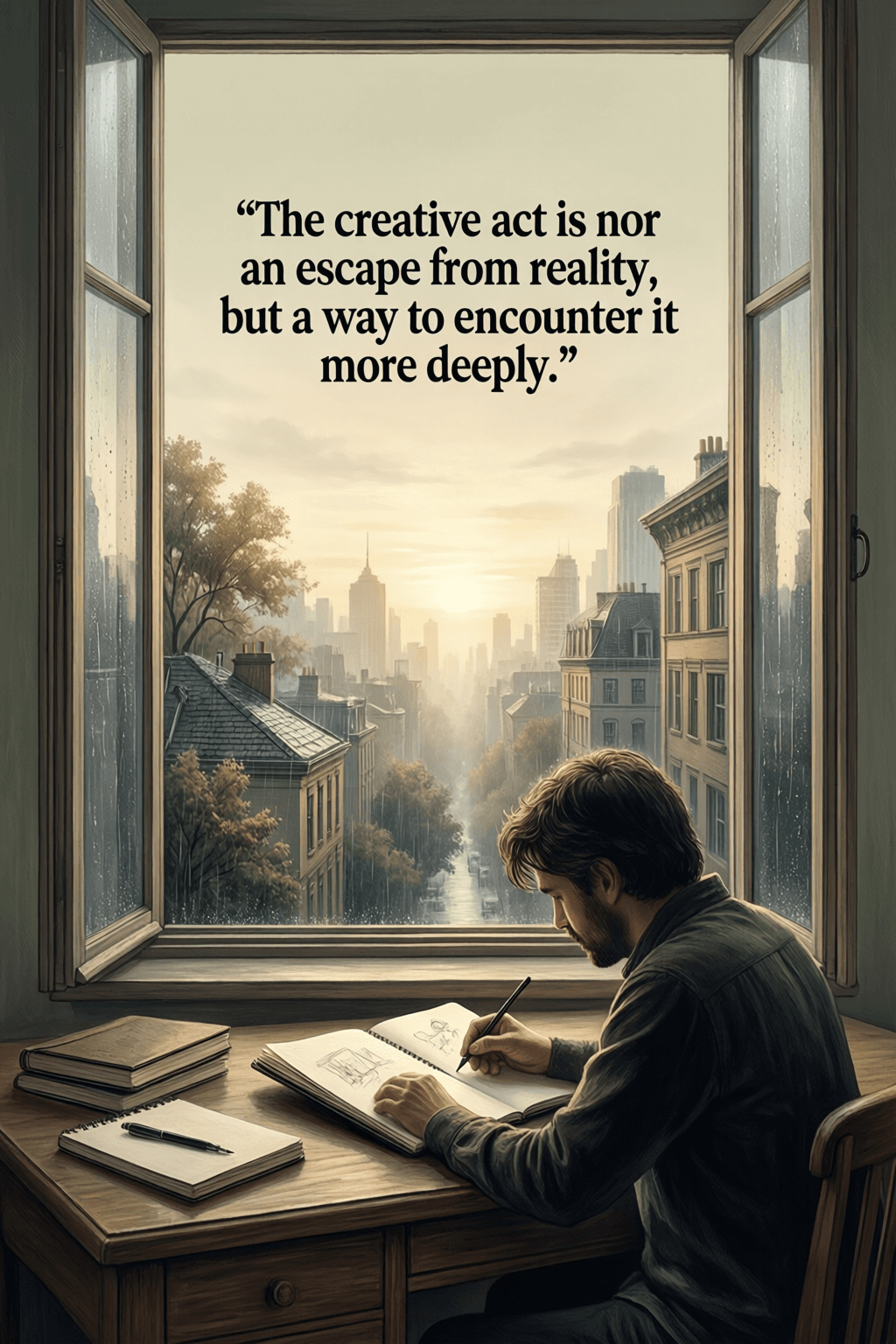
The creative act is not an escape from reality, but a way to encounter it more deeply. — bell hooks
—What lingers after this line?
Beyond Simple Escape
At first glance, creative work can look like withdrawal: a painter disappears into a studio, a writer vanishes into pages, a musician closes the door and listens inward. Yet bell hooks reverses that assumption. She argues that creation is not a retreat from the world but a disciplined return to it, one that allows us to notice textures, contradictions, and feelings that ordinary habits often blur. In this sense, art sharpens perception rather than dulling it. Instead of numbing experience, the creative act gives form to what reality already contains—pain, beauty, conflict, memory, desire. hooks’s insight fits her broader body of work, including *Teaching to Transgress* (1994), where deep attention and critical engagement become ways of living more truthfully.
Attention as a Moral Practice
From there, the quote suggests that creativity begins with attention. To write a poem about grief or photograph a city street honestly, one must look carefully and refuse easy clichés. That careful looking is not merely technical; it is ethical, because it honors the complexity of people and situations instead of reducing them to stereotypes or convenient stories. Simone Weil wrote in *Gravity and Grace* (1947) that absolute attention is a form of prayer, and hooks’s statement moves in a similar direction. The artist does not float above reality; rather, the artist kneels before it. By paying sustained attention, creators discover that reality is richer, harsher, and more interconnected than surface appearances suggest.
Transforming Experience Into Knowledge
Once attention deepens, creativity becomes a way of knowing. A memoirist may not simply report events but uncover what those events meant; likewise, a filmmaker can reveal social tensions that daily routines hide. In this way, the creative act turns lived experience into insight, translating confusion into pattern without flattening its mystery. James Baldwin’s essays, especially in *Notes of a Native Son* (1955), show this process vividly: personal memory becomes a lens for confronting race, family, and national identity. Similarly, hooks implies that creation helps us meet reality at a more profound level because it converts feeling, observation, and reflection into understanding.
Art and the Hidden Structures of Life
Moreover, hooks’s idea points beyond private emotion toward social reality. Creative work can expose the structures that shape everyday life—power, exclusion, longing, labor, and belonging. A novel about one household may illuminate an entire class system; a song about heartbreak may also reveal gender expectations or cultural silence. This is why art so often unsettles audiences. Pablo Picasso’s *Guernica* (1937) did not offer escape from violence; it forced viewers to confront the horror of war through fractured, unforgettable imagery. In the same spirit, hooks reminds us that creativity can strip illusion away, making reality more visible precisely by reimagining how it is presented.
Healing Through Honest Encounter
At the same time, encountering reality more deeply can be healing. Creative expression often allows people to face experiences that are otherwise too chaotic or painful to name. A journal entry after loss, a dance shaped by anger, or a quilt stitched from family memory does not erase suffering; instead, it creates a space in which suffering can be recognized and held. This helps explain why art is central in many therapeutic and communal traditions. The healing does not come from fantasy alone but from truthful engagement. By making experience shareable and tangible, creativity gives individuals and communities a way to move through reality rather than deny it.
Living More Fully in the World
Finally, bell hooks leaves us with a larger vision of what it means to create. The creative act is not reserved for professional artists; it can shape teaching, conversation, parenting, activism, and daily problem-solving. Whenever people respond imaginatively and honestly to the world before them, they are practicing this deeper encounter with reality. Thus the quote becomes both a defense of art and a philosophy of living. Creativity matters because it teaches us to see, feel, and respond more completely. Rather than carrying us away from life, it returns us to life with greater clarity, courage, and presence.
One-minute reflection
Where does this idea show up in your life right now?
Related Quotes
6 selectedThere is no must in art because art is free. — Wassily Kandinsky
Wassily Kandinsky
At its core, Kandinsky’s statement rejects the idea that art must obey fixed obligations. By saying there is no ‘must’ in art, he frees creation from rigid formulas, academic demands, and social expectation.
Read full interpretation →Often what the artist expresses is unconscious, but we can learn to decode the story by collaboratively finding the pieces to the puzzle that create new possibilities for innovation. — Ben Okri
Ben Okri
At the heart of Ben Okri’s statement is the idea that art often says more than the artist consciously intends. A poem, painting, or song may carry hidden fears, cultural memories, or emotional truths that emerge without...
Read full interpretation →I think that when you create something, you leave a part of yourself in it. — Henri Matisse
Henri Matisse
At its core, Matisse’s reflection suggests that making anything—a painting, a poem, a song, even a room—inevitably transfers something inward into outward form. Creation is not merely the arrangement of materials; rather...
Read full interpretation →There is a deep peace that comes from creating something that didn't exist before. It is your way of telling the universe that you were here, and you felt something. — Maya Angelou
Maya Angelou
At its heart, Maya Angelou’s reflection suggests that creation is not merely productive but restorative. To make something that did not exist before—a poem, a garden, a melody, even a repaired room—is to experience a rar...
Read full interpretation →The best use of imagination is creativity. The worst use of imagination is anxiety. — Deepak Chopra
Deepak Chopra
Deepak Chopra frames imagination as a neutral force whose value depends on its direction. In one sense, imagination is the mind’s simulator: it can invent possibilities that do not yet exist, letting us rehearse outcomes...
Read full interpretation →You were not just born to center your entire existence around work and labor. You were born to exist, to dance, to create, to be. — Tricia Hersey
Tricia Hersey
Tricia Hersey’s statement begins by breaking a common spell: the idea that a human life is primarily a productivity machine. By saying we were not born to center our existence on labor, she challenges the quiet assumptio...
Read full interpretation →More From Author
More from bell hooks →The art of living is a constant process of refining one's own sanctuary against the tide of external expectations. — bell hooks
At its core, bell hooks presents living not as a finished achievement but as a continuous act of shaping and reshaping the self. The phrase “constant process” suggests that identity, peace, and integrity are never perman...
Read full interpretation →Quiet confidence is not about what you say, but about the space you hold for yourself when the world gets loud. — bell hooks
At first glance, bell hooks shifts confidence away from performance and toward presence. She suggests that real assurance is not measured by how forcefully someone speaks, but by how steadily they remain grounded when ex...
Read full interpretation →The artist is a witness to the present moment, not a slave to the machine that wants to replace it. — bell hooks
At its core, bell hooks’s statement insists that art begins with presence. To be a witness to the present moment is to attend closely to lived reality—its tensions, beauties, wounds, and contradictions—rather than merely...
Read full interpretation →Deep breathing is a form of resistance against a world that demands you stay perpetually frantic. — Bell hooks
At first glance, bell hooks’s line turns an ordinary bodily act into a moral and political gesture. Deep breathing is not presented as mere relaxation, but as resistance to a culture that rewards haste, anxiety, and cons...
Read full interpretation →