
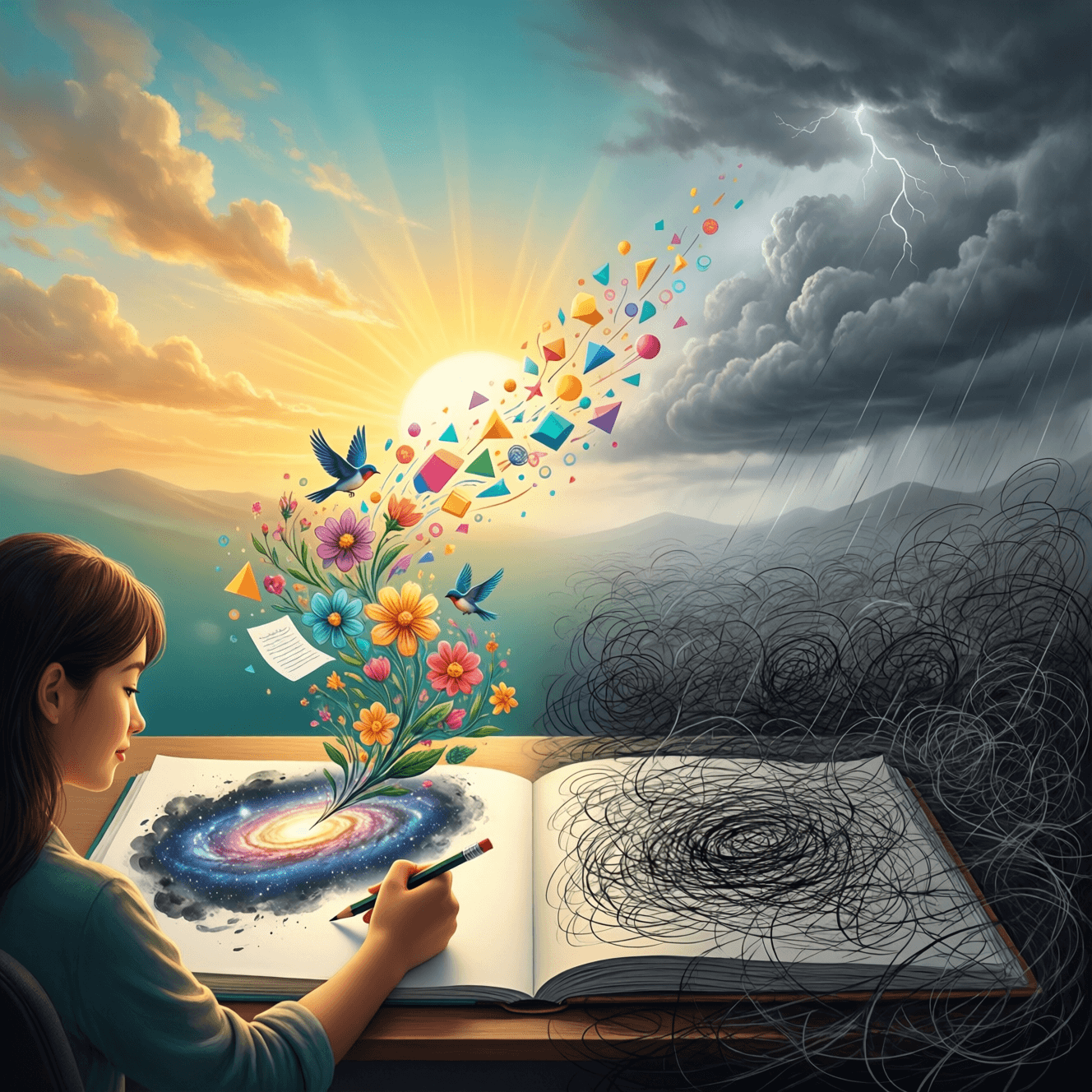
The best use of imagination is creativity. The worst use of imagination is anxiety. — Deepak Chopra
—What lingers after this line?
A Double-Edged Mental Power
Deepak Chopra frames imagination as a neutral force whose value depends on its direction. In one sense, imagination is the mind’s simulator: it can invent possibilities that do not yet exist, letting us rehearse outcomes before acting. Yet that same simulator can turn against us, generating vivid threats and worst-case scenarios that feel urgent and real. From this starting point, the quote nudges us to see imagination less as a trait you either have or lack, and more as a tool you actively aim. The central question becomes not “Do I imagine?” but “Where is my imagining taking me—toward building or bracing?”
Creativity: Imagining Possibility Into Form
When imagination points outward toward making, it becomes creativity: the ability to combine memories, skills, and observations into something new. This is the imagination that drafts a story, prototypes a product, or reframes a problem at work by asking, “What if we tried the opposite?” It doesn’t require constant inspiration so much as permission to explore without immediate judgment. Building on Chopra’s claim, creativity is “best” because it converts mental images into constructive action. Even small acts—sketching a plan on a napkin, brainstorming ten bad ideas to reach one good one—demonstrate how imagining can be a practical engine for progress rather than a private daydream.
Anxiety: Imagination Trapped in Threat Forecasting
The “worst” use arises when imagination becomes a threat generator, repeatedly projecting harm, rejection, or failure. Anxiety often isn’t just fear of what is happening; it’s fear of what might happen, amplified by mental imagery and internal narratives that loop without resolution. In that state, the mind treats possibility as probability and prepares the body for danger that never arrives. Connecting this back to the quote, the problem isn’t imagination itself but the absence of boundaries. Instead of being a creative studio, the mind becomes an emergency newsroom, producing breaking alerts all day—highly detailed, emotionally convincing, and largely unverified.
Why the Same Mechanism Feels So Different
Creativity and anxiety can look like opposites, but they share a mechanism: both involve simulating futures. The difference is the emotional stance and the sense of agency. Creative imagining tends to include options—multiple paths, revisions, experiments—whereas anxious imagining collapses into a single catastrophic storyline, as if no alternative ending is allowed. This distinction clarifies Chopra’s contrast: imagination is healthiest when it stays flexible. Once it becomes rigid and repetitive, it stops serving discovery and starts serving avoidance, narrowing attention until the mind searches for certainty in a world that can’t supply it.
Redirecting Imagination With Practical Habits
If imagination can drift into anxiety, it can also be redirected—often by shifting from prediction to creation. Simple practices help: naming the story (“I’m running a worst-case simulation”), writing down fears to make them concrete, and then adding creative counterweights such as “three other plausible outcomes” or “one small experiment I can run today.” These moves don’t deny risk; they restore choice. From there, imagination becomes actionable again. Instead of asking, “What if everything goes wrong?” you begin asking, “What can I make, test, or learn next?”—a transition that turns mental energy into momentum.
A Healthier Goal: Imagination as Guided Vision
Ultimately, Chopra’s line reads like a reminder that imagination needs a compass. Used well, it is guided vision: the capacity to picture a better arrangement of life and then take steps toward it. Used poorly, it becomes ungoverned rumination: vivid scenes of danger that substitute for solving what can actually be solved. The lasting takeaway is not to eliminate imagination, but to cultivate a relationship with it—one where you can notice when it’s building something and when it’s merely sounding alarms. In that awareness, creativity becomes the default destination and anxiety a detour you can recognize and exit.
One-minute reflection
What does this quote ask you to notice today?
Related Quotes
6 selectedAnxiety is the precursor to creativity, and every great creation is born from anxiety. — T.S. Eliot
T. S. Eliot
At its core, Eliot’s statement frames anxiety not as a purely destructive force but as the restless tension that often precedes invention. Anxiety unsettles the mind, making ordinary answers feel insufficient; in that di...
Read full interpretation →Anxiety is just the imagination working overtime, and most of that overtime is completely unpaid. — Alain de Botton
Alain de Botton
At first glance, Alain de Botton’s remark frames anxiety with disarming humor: the mind behaves like an overworked employee, generating scenarios, rehearsing disasters, and collecting no reward for the effort. By calling...
Read full interpretation →Don't believe every worried thought you have. Worried thoughts are notoriously inaccurate. — Renee Jain
Renee Jain
At its core, Renee Jain’s quote confronts a habit many people barely notice: treating every anxious thought as if it were reliable evidence. Worry often arrives with urgency, and because it feels protective, it can masqu...
Read full interpretation →Your anxiety is not a failure; it is a signal. Stop trying to silence it and start listening to what it is trying to teach you about your boundaries. — Bessel van der Kolk
Bessel van der Kolk
At first glance, anxiety often feels like evidence that something is wrong within us. Yet Bessel van der Kolk reverses that assumption, suggesting that anxiety is not simply a defect to erase but a message to interpret.
Read full interpretation →There is no must in art because art is free. — Wassily Kandinsky
Wassily Kandinsky
At its core, Kandinsky’s statement rejects the idea that art must obey fixed obligations. By saying there is no ‘must’ in art, he frees creation from rigid formulas, academic demands, and social expectation.
Read full interpretation →Often what the artist expresses is unconscious, but we can learn to decode the story by collaboratively finding the pieces to the puzzle that create new possibilities for innovation. — Ben Okri
Ben Okri
At the heart of Ben Okri’s statement is the idea that art often says more than the artist consciously intends. A poem, painting, or song may carry hidden fears, cultural memories, or emotional truths that emerge without...
Read full interpretation →More From Author
More from Deepak Chopra →What keeps life fascinating is the constant creativity of the soul. — Deepak Chopra
At its core, Deepak Chopra’s line suggests that life stays interesting not because the world is fixed and exciting on its own, but because the inner self continually reinterprets it. The phrase “creativity of the soul” p...
Read full interpretation →Healing is the return of the memory of wholeness. — Deepak Chopra
At first glance, Deepak Chopra’s line reframes healing as something larger than the disappearance of pain or illness. To call healing “the return of the memory of wholeness” suggests that wellness is not newly manufactur...
Read full interpretation →Healing is not linear; energy comes and goes like waves, but it always moves forward. — Deepak Chopra
At its heart, Deepak Chopra’s line reframes healing as motion rather than perfection. Instead of imagining recovery as a straight climb upward, he presents it as a tide: energy rises, retreats, and returns.
Read full interpretation →Healthy boundaries allow us to be more fully present in our lives. — Deepak Chopra
At first glance, Deepak Chopra’s statement links two ideas that are often treated separately: limits and mindfulness. Yet the connection is intuitive.
Read full interpretation →