
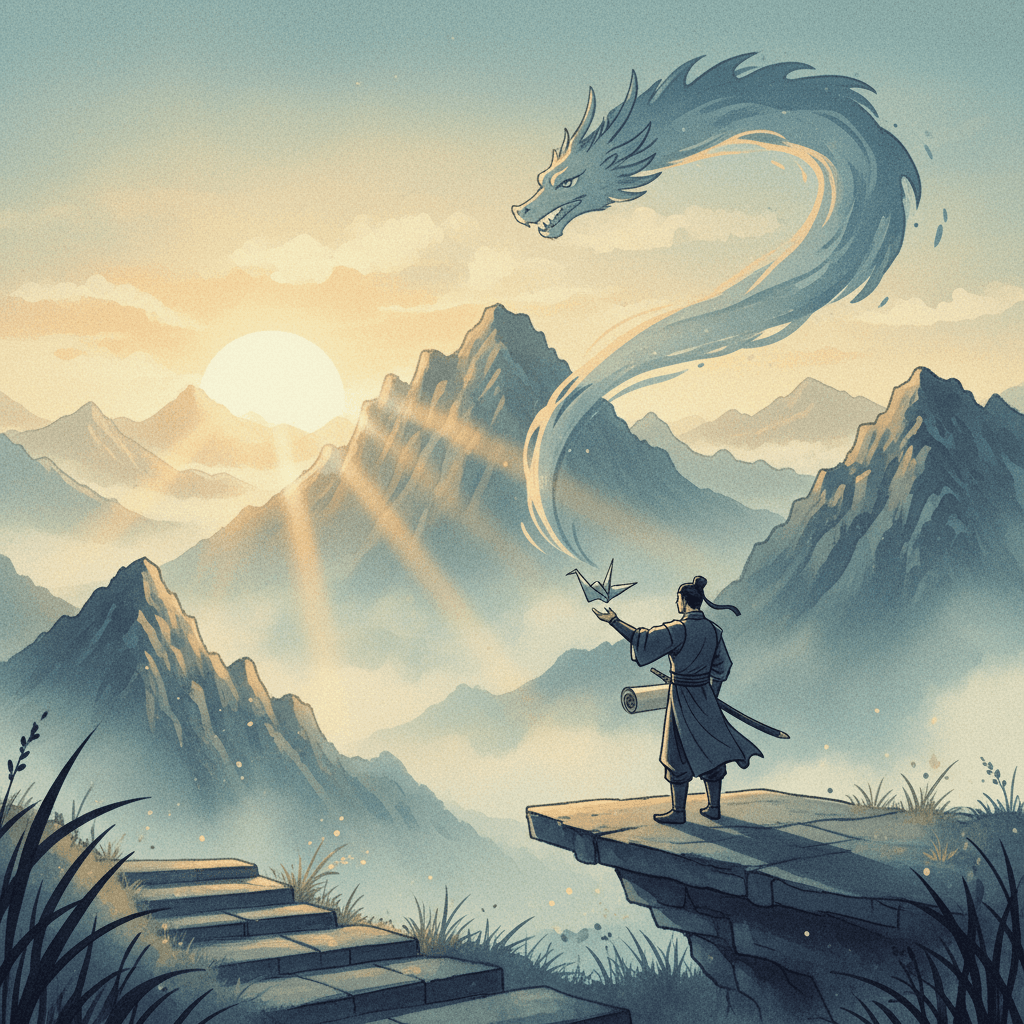
Begin each day by matching imagination with disciplined action. — Sun Tzu
—What lingers after this line?
A Strategic Dawn
To begin, the maxim urges a morning pact between vision and execution. Imagination sets direction—what could be—while discipline choreographs the first steps—what must be done now. Sun Tzu’s The Art of War frames this union: “The general who wins makes many calculations in his temple before the battle is fought” (ch. 1). Likewise, daybreak is our modern “temple,” a quiet interval to visualize outcomes and convert them into moves. Moreover, Sun Tzu adds that “victorious warriors win first and then go to war” (ch. 4), implying that the decisive battle is won in planning. Starting each day this way prevents aimless activity; it channels creativity into deliberate effort so momentum is not left to chance.
From Vision to Viability
Building on that foundation, imagination gains power only when bounded by reality tests. Design thinking embodies this shift: ideas are sketched, then stress-tested through quick prototypes, so fantasy becomes feasible (IDEO’s early prototyping culture is emblematic). Similarly, the lean startup loop—build, measure, learn (Eric Ries, 2011)—translates inspiration into experiments that reveal constraints. Thus, creativity remains expansive yet accountable. By treating each morning idea as a testable hypothesis, we keep ambition intact while inviting data to refine it. In this way, daybreak dreams evolve into viable plans rather than evaporating as ungrounded wishes.
Rituals That Operationalize Ideas
In practice, brief rituals fuse imagination with discipline. Begin with a two-minute “outcome sketch”: write the single result that would make today a win. Then translate it into time-boxed blocks, anchoring them with if–then cues (Peter Gollwitzer’s implementation intentions, 1999): “If it’s 9:00, then I start the proposal for 50 minutes.” Before beginning, run a quick pre-mortem—the Stoic premeditatio malorum found in Seneca’s letters—asking, “What could derail this, and how will I respond?” Finally, set a visible checkpoint (midday) and a five-minute after-action review (day’s end). These micro-rituals honor imagination by specifying its shape and honor discipline by guarding execution time.
Examples Across High-Stakes Work
Consider how pioneers have paired bold vision with method. The Wright brothers combined audacious flight ideas with daily wind-tunnel experiments that quantified lift and control (David McCullough, The Wright Brothers, 2015). Decades later, NASA’s Apollo teams married lunar imagination to relentless simulations and checklists, a rigor chronicled by Christopher Kraft in Flight: My Life in Mission Control (2001). In both cases, mornings often began with briefings, test plans, and contingency mapping—small, disciplined steps staging outsized breakthroughs. Their arc shows that inspiration scales only when a repeatable cadence escorts it from concept to cockpit.
The Psychology of Momentum
Moreover, research explains why the imagination–discipline junction energizes action. Implementation intentions create automaticity, shrinking the gap between intention and behavior (Gollwitzer, 1999). Mental contrasting—imagining the desired future while confronting present obstacles—further boosts follow-through; Oettingen’s WOOP method operationalizes this link (Rethinking Positive Thinking, 2014). Complementing both, Amabile and Kramer’s “progress principle” shows that visible small wins fuel motivation (The Progress Principle, 2011). Thus, when mornings pair vivid outcomes with concrete cues and quick wins, they generate psychological momentum that compounds across the day.
Feedback, Humility, and Adaptation
Finally, sustained discipline requires feedback. Sun Tzu’s counsel to “know the enemy and know yourself” (ch. 3) points to continuous appraisal: compare plan to reality, then adjust. The after-action review, formalized in the U.S. Army in the 1980s, institutionalizes this loop by asking what was intended, what occurred, and what to change next time. Carried into daily life, a five-minute review closes the imagination–action circuit, preventing drift and cultivating humility. In this rhythm—envision, execute, examine—the next dawn inherits sharper insight, ensuring that creativity remains bold while discipline stays wise.
One-minute reflection
What's one small action this suggests?
Related Quotes
6 selectedThe discipline of creation, be it to paint, compose, write, is an effort towards wholeness. — Madeleine L'Engle
Madeleine L’Engle
Madeleine L'Engle’s insight frames creation not as mere self-expression but as a disciplined movement toward inner completeness. To paint, compose, or write is to gather scattered thoughts, emotions, and experiences into...
Read full interpretation →I write when I'm inspired, and I see to it that I'm inspired at nine o'clock every morning. — Peter De Vries
Peter De Vries
Peter De Vries frames his line as a wry paradox: he writes “when” inspiration strikes, yet he also schedules it for nine every morning. The humor lands because it punctures the romantic myth that good work depends on unp...
Read full interpretation →If you wish to be a writer, write. — Epictetus
Epictetus
This quote emphasizes that wanting to be a writer is not enough. To achieve the goal of becoming a writer, one must take action and actually engage in writing.
Read full interpretation →Take a simple idea and take it seriously. — W. H. Auden
W. H. Auden
At first glance, simplicity looks easy; in practice, it is an act of discipline. Auden’s injunction reads less like a quip and more like a work order: identify the essential idea, then spare it from dilution.
Read full interpretation →There are not more than five musical notes, yet their combinations give rise to more melodies than can ever be heard. — Sun Tzu
Sun Tzu
Sun Tzu’s remark begins with a disarmingly small inventory: just a handful of musical notes. Yet the point is not about music alone—it is about strategy’s habit of hiding abundance inside simplicity.
Read full interpretation →Find the bridge between intent and action, and cross it deliberately. — Sun Tzu
Sun Tzu
The quote frames a familiar human problem: intention often feels like progress, yet it can remain safely abstract unless it becomes action. By naming a “bridge,” it implies there is a real gap—made of doubt, distraction,...
Read full interpretation →More From Author
More from Sun Tzu →There are not more than five musical notes, yet their combinations give rise to more melodies than can ever be heard. — Sun Tzu
Sun Tzu’s remark begins with a disarmingly small inventory: just a handful of musical notes. Yet the point is not about music alone—it is about strategy’s habit of hiding abundance inside simplicity.
Read full interpretation →Find the bridge between intent and action, and cross it deliberately. — Sun Tzu
The quote frames a familiar human problem: intention often feels like progress, yet it can remain safely abstract unless it becomes action. By naming a “bridge,” it implies there is a real gap—made of doubt, distraction,...
Read full interpretation →Measure each move by purpose, and victory becomes a natural result. — Sun Tzu
Sun Tzu’s line reframes victory as an outcome of disciplined intent rather than a lucky break or a last-minute burst of effort. When every move is measured by purpose, actions stop being reactive and start forming a cohe...
Read full interpretation →Measure success by what you build, not by what you avoid. — Sun Tzu
Sun Tzu’s line shifts the definition of success away from a defensive mindset and toward tangible creation. Rather than treating life like a minefield where the goal is simply to survive unscathed, it argues that the tru...
Read full interpretation →