
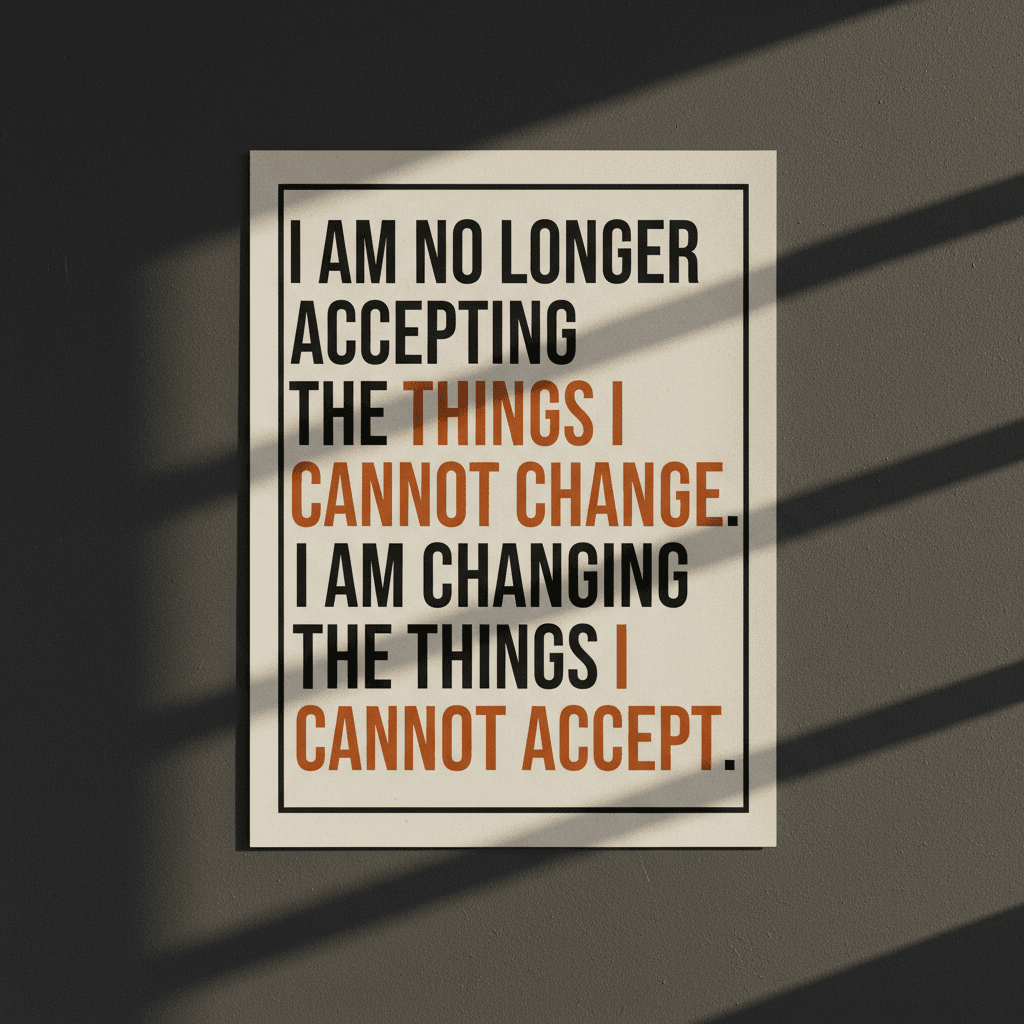
I am no longer accepting the things I cannot change. I am changing the things I cannot accept. — Angela Y. Davis
—What lingers after this line?
Inverting Resignation Into Resolve
Davis’s line pivots on a deliberate reversal. Where the Serenity Prayer asks for serenity to accept what cannot be changed (Niebuhr, c. 1930s), she replaces resignation with agency. The result reframes discomfort not as a private burden to endure but as a public mandate to act. In this way, the quote becomes less a quip than a strategy. It instructs us to scrutinize which limits are truly fixed and which are socially constructed—and therefore moveable. The move from acceptance to intervention is the hinge on which her broader political philosophy turns.
A Life Rooted in Movement Struggle
This resolve is not abstract. Davis’s own history—arrested in 1970, acquitted in 1972 amid a global “Free Angela” campaign—illustrates how collective pressure can transform what authorities present as inevitable. Her An Autobiography (1974) recounts how solidarity networks, legal advocacy, and international attention altered the terrain of possibility. Moreover, Davis’s academic work never drifted far from organizing. Trained by critical theorists like Herbert Marcuse, she brings analysis to the street and the classroom alike, showing that ideas become forceful when they circulate through movements.
Reframing the Boundaries of the Possible
Building on that experience, Davis urges a redefinition of what society deems tolerable. Women, Race & Class (1981) exposes how racism and sexism interlock, implying that any politics content to “accept” partial justice simply reproduces hierarchy. Likewise, Are Prisons Obsolete? (2003) challenges the “common sense” inevitability of cages. Thus, the quote functions as a diagnostic tool: if a condition persists only because we have normalized it, then the task is not stoic acceptance but political redesign. Naming the unacceptable becomes the first step in undoing it.
From “I” to “We”: Collective Power
Crucially, the statement’s first-person voice invites a collective echo. History shows how shared refusal makes change: the Montgomery bus boycott (1955–56) converted private indignation into coordinated economic pressure, while ACT UP (founded 1987) turned grief into policy shifts on HIV/AIDS through direct action. In this light, “I am changing” signals the start of a broader “we are organizing.” The unacceptable is rarely altered by solitary will; rather, movements translate individual conviction into structures capable of shifting institutions.
The Abolitionist Lens in Practice
Davis’s abolitionism offers a concrete program for change. Instead of accepting mass incarceration as public safety, she and peers like Ruth Wilson Gilmore argue for investments that prevent harm—housing, healthcare, education—and for alternatives like restorative justice (see Gilmore’s Golden Gulag, 2007). Pilot efforts in violence interruption and bail reform illustrate how reframing problems yields new solutions. Accordingly, to “change the things we cannot accept” is to redesign systems at their roots, not merely renovate their surfaces. Abolition is less a demolition than a blueprint for life-affirming institutions.
Courage, Care, and Sustainable Resistance
Finally, the quote calls for courage paired with care. Audre Lorde’s “The Transformation of Silence into Language and Action” (1977) reminds us that speaking and acting carry risks, yet the cost of silence is greater. Sustainable change requires communities that protect one another while pressing forward. Thus, the arc from refusal to reconstruction is both ethical and practical. By tending to people as we transform policy, we ensure that the world we are building already embodies the values we refuse to live without.
One-minute reflection
Why might this line matter today, not tomorrow?
Related Quotes
6 selectedYou cannot command things, but you can command yourself. — Michael D. Pollock
Michael D. Pollock
At first glance, Michael D. Pollock’s line draws a sharp boundary between the outer world and the inner one.
Read full interpretation →A boundary is not a wall; it is a door with a lock that you control. — Annie Wright
Annie Wright
At first glance, Annie Wright’s quote corrects a common misunderstanding: people often treat boundaries as acts of distance or punishment, when in fact they are tools of intentional relationship. A wall shuts everyone ou...
Read full interpretation →When you feel like you are at a dead end, remember that you are at a place where you can choose a different path. — Haemin Sunim
Haemin Sunim
At first glance, a dead end feels like failure, as though movement itself has been denied. Yet Haemin Sunim’s insight gently reverses that impression: what seems like a wall may actually be a point of decision.
Read full interpretation →The boundaries of your life are merely a creation of the self. — Robin Sharma
Robin Sharma
Robin Sharma’s line reframes “boundaries” as something less like a fence in the world and more like a frame in the mind. What we often call limits—who we are, what we can do, what we deserve—can be stories we repeat unti...
Read full interpretation →You are the author of your own story. You don't need permission to begin. — Ctrl+Alt+Write
Ctrl+Alt+Write
The quote opens with a bracing premise: your life is not merely something that happens to you, but something you shape. By calling you “the author,” it reframes identity from a fixed description into an ongoing draft—rev...
Read full interpretation →Suffering is universal. But victimhood is optional. — Edith Eger
Edith Eger
Edith Eger’s line begins by naming what no life escapes: suffering arrives through loss, illness, disappointment, and injustice, often without warning or consent. By calling it universal, she removes the illusion that pa...
Read full interpretation →More From Author
More from Angela Y. Davis →