#Social Justice
Quotes tagged #Social Justice
Quotes: 12

Cultivating Justice Through Daily, Persistent Acts
Finally, “until it bears fruit” anchors justice in results. Fruit is tangible: safety increased, dignity restored, rights protected, opportunities expanded. Tutu’s image gently challenges moral self-satisfaction—good intentions are seeds, but the measure is whether people actually experience a fairer world. This focus mirrors Tutu’s broader ethics, which insisted that truth-telling must lead toward repair, not merely confession. At the same time, fruit takes time, and some harvests are delayed beyond one person’s lifespan. The quote therefore carries hope without naivety: keep tending even when progress is slow, because growth is often invisible before it is obvious. Justice, in Tutu’s vision, becomes a long, faithful practice—patient enough to wait, persistent enough to arrive. [...]
Created on: 12/18/2025

Steadfast Hearts and the Long Arc of Justice
Finally, the phrase “toward fairness” grounds the lofty ideal of justice in a more accessible concept. Fairness is something most people recognize in daily life: equitable treatment at work, unbiased laws, and dignified recognition of each person’s worth. By framing justice as a direction rather than a destination, Pankhurst implies that no society achieves perfect fairness, yet all can move closer through deliberate choices. Thus, the quote creates a bridge from moral theory to everyday conduct, inviting each person to see their own steadfastness as a tangible force that nudges institutions, norms, and narratives toward a more just world. [...]
Created on: 11/21/2025

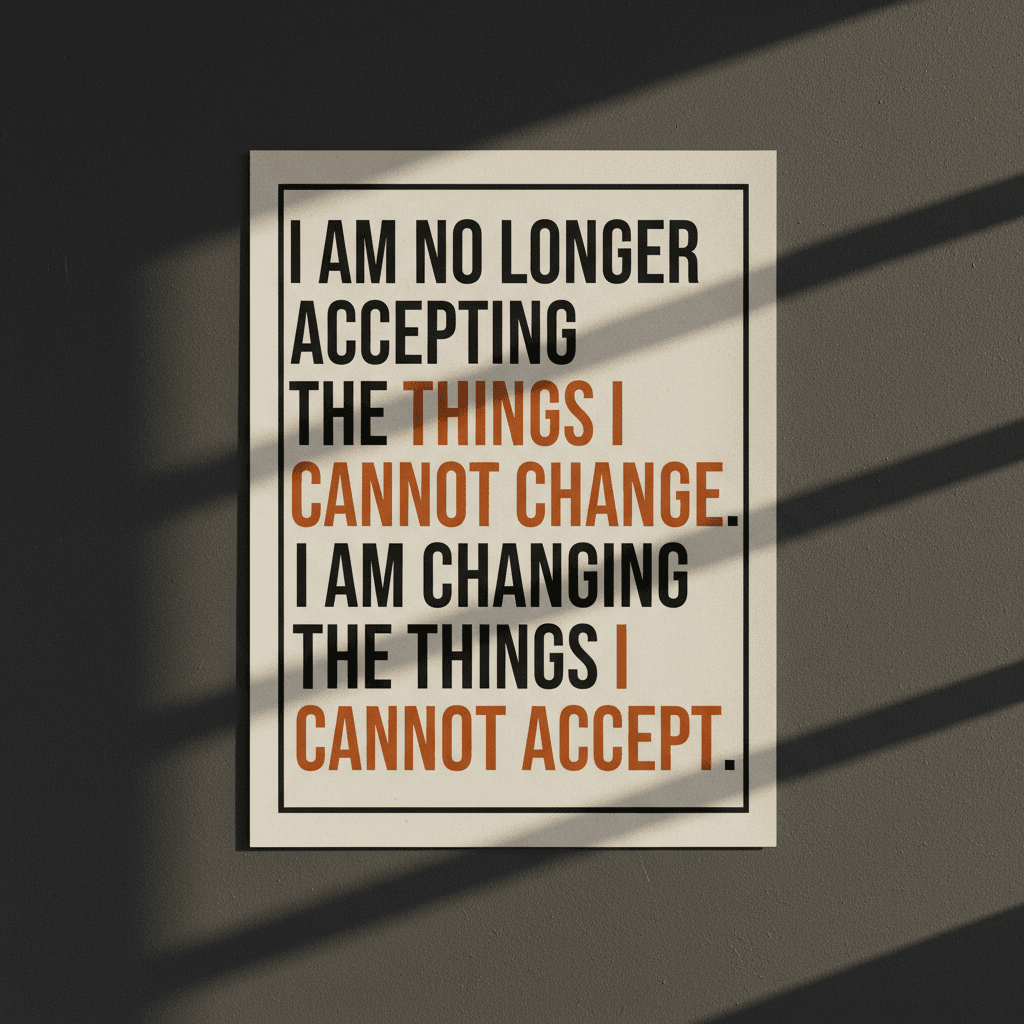
Changing What We Can No Longer Accept
Finally, the quote calls for courage paired with care. Audre Lorde’s “The Transformation of Silence into Language and Action” (1977) reminds us that speaking and acting carry risks, yet the cost of silence is greater. Sustainable change requires communities that protect one another while pressing forward. Thus, the arc from refusal to reconstruction is both ethical and practical. By tending to people as we transform policy, we ensure that the world we are building already embodies the values we refuse to live without. [...]
Created on: 11/18/2025

Organized Love: Steady Hands Build Justice
Consequently, turning love into justice means building structures that learn. Marshall Ganz’s organizing cycle emphasizes story, strategy, and action with measurable goals (Harvard Kennedy School), helping teams track wins, failures, and pivots. Campaigns that map power, cultivate leaders, and evaluate outcomes convert moral clarity into public change—policies passed, budgets reallocated, protections enforced. In this way, the feeling that begins in the heart becomes a scaffold others can climb. Love sets the aim; steady hands build the staircase and check each step. [...]
Created on: 10/29/2025

Unraveling Injustice with Steady, Imaginative Hands
Finally, endurance requires a way to count the unglamorous. Doug McAdam’s political process theory (1982) shows that movements win by aligning organization, strategy, and openings in power; many strikes fail early because they cannot outlast the calendar. Empirical work suggests that sustained participation by a small percentage of the populace can tip outcomes (Chenoweth, 2013). Baldwin’s No Name in the Street (1972) chronicles fatigue without surrender, reminding us that hope is practiced, not presumed. By setting proximate goals, marking incremental loosening, and returning tomorrow, we keep striking—steady, imaginative, and together. [...]
Created on: 10/27/2025

When Words Walk, Justice Finds Its Momentum
Finally, Ubuntu—"I am because we are"—explains why feet matter as much as words. Individual steps lower others’ thresholds to join (Granovetter, American Journal of Sociology, 1978), strengthening collective efficacy (Bandura, American Psychologist, 2000). The Truth and Reconciliation Commission of South Africa (1996–1998) embodied this ethic: testimony moved into amnesty decisions and reparations recommendations (TRC Final Report, 1998). In turning speech into process and process into repair, a nation learned to move together. [...]
Created on: 10/26/2025

Freedom Is Collective, Not a Private Possession
Finally, a globalized world renders Davis’s claim unmistakable. Movements like Black Lives Matter (2013–present) resonated across continents, while campaigns such as #EndSARS in Nigeria revealed shared patterns of state violence and youth precarity. Supply chains, data flows, and climate impacts bind our fates beyond borders, so freedom now demands cross-border solidarity. Thus the slogan becomes a practice: learn whose freedom is most constrained, align resources to remove those constraints, and measure success by how broadly dignity expands. [...]
Created on: 8/10/2025

When Love Takes Shape as Public Justice
Finally, what we measure signals what we value. Amartya Sen’s capabilities approach—Development as Freedom (1999)—asks whether people can actually do and be what they have reason to value. By that metric, public love is visible in lowered maternal mortality, fewer evictions, rising literacy, safer streets, and cleaner water. Municipal dashboards that track these outcomes, and adjust budgets accordingly, turn sentiment into systems. Thus the question becomes empirical as well as moral: if love is what justice looks like in public, do our institutions enable genuine capabilities—or merely recite ideals while lives fray at the edges? [...]
Created on: 8/10/2025

True Generosity: Tackling Injustice at Its Roots
Bringing this concept into our daily lives, it becomes clear that we can all move beyond simple charity by advocating for policy changes, supporting community organizing, or educating ourselves about social structures. Whether voting for equitable policies or volunteering with organizations working toward structural solutions, each act of true generosity brings us a step closer to a world where charity as a bandage is no longer needed—only justice remains. [...]
Created on: 5/27/2025

Facing Grief with Courageous and Just Action
Ultimately, Smith’s wisdom offers a framework for hope. By refusing to succumb to despair, people can sustain engagement and responsibility, even in dark times. Social psychologist Viktor Frankl ('Man’s Search for Meaning', 1946) famously argued that meaning is found through purposeful action regardless of circumstances. Smith channels this spirit, inviting everyone to respond to grief not with resignation, but with justice-minded presence—today and every day. [...]
Created on: 5/21/2025

Raise Your Voice for Truth and Compassion - William Faulkner
William Faulkner was an American writer known for his powerful explorations of the human condition. His works often dealt with social issues, morality, and personal struggle, making this quote reflective of his broader worldview. [...]
Created on: 3/27/2025

Injustice Anywhere Is a Threat to Justice Everywhere - Martin Luther King Jr.
Martin Luther King Jr. delivered this message during the civil rights movement in the United States, a time when racial injustice was rampant. His message serves as a timeless reminder of the ongoing struggle for equality and justice worldwide. [...]
Created on: 7/25/2024