
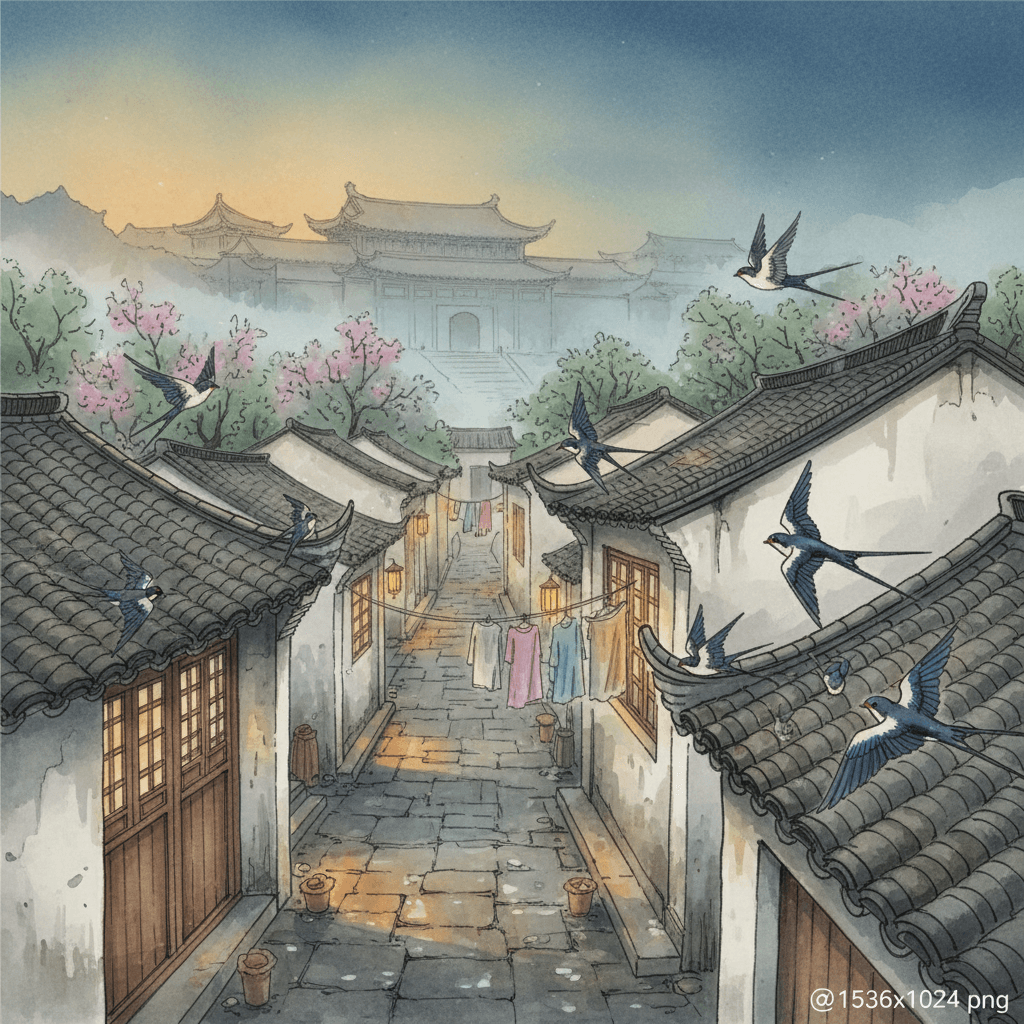
In former days the swallows of the mansions of Wang and Xie Have flown now into the homes of common folk.
—What lingers after this line?
A Glimpse into an Ancient Couple of Lines
These lines come from the Chinese poet Liu Yuxi’s famous poem often translated as “An Inscription for the Ruined Residence of the Prince of Chu” (9th century). On the surface, they describe swallows once nesting in the grand mansions of the aristocratic Wang and Xie families, who now alight in ordinary people’s homes instead. Yet as the poem unfolds, this simple observation grows into a meditation on impermanence, social change, and the quiet resilience of everyday life.
The Wangs and Xies: Symbols of Vanished Glory
To understand the force of the image, it helps to know that the Wang and Xie clans were elite families of the Eastern Jin dynasty, famed for their luxury and influence. Their mansions in the capital became shorthand for power and refinement, much as Versailles might evoke royal grandeur in France. By invoking these names, Liu Yuxi conjures a world of carriages, courtyards, and cultivated grace that once seemed unshakeable. However, this remembered splendor sets up the very contrast he wishes to explore: that which appears eternal is in fact brief and fragile.
Swallows as Carriers of Continuity
The swallows in these lines are not merely decorative birds; they act as living threads binding past to present. Year after year, swallows return to build nests under eaves, indifferent to who owns the house beneath them. Thus, when the poem notes that the same swallows now frequent common dwellings, it subtly insists that life continues even as status crumbles. This continuity of nature, seen also in works like Du Fu’s landscape poems, highlights how birds, rivers, and seasons outlast the rise and fall of any single family or regime.
From Aristocratic Courts to Common Doorsteps
The shift from ‘mansions’ to ‘homes of common folk’ marks more than a change of address; it signals a democratization of beauty and fortune. Once, the swallows’ presence might have been read as a sign of auspicious favor reserved for the powerful. Now, their arrival under humble roofs suggests that grace can settle anywhere, not just where titles and treasures abide. In this way, the poem moves from lamenting lost grandeur toward a quiet affirmation that ordinary spaces can become the new centers of meaning and vitality.
Impermanence, History, and Humble Resilience
Flowing from this image, the poem comments implicitly on the cycles of history: noble houses fall into ruin, great names fade, but new lives flourish where old ones once stood. This theme echoes broader Buddhist and Daoist ideas of impermanence and transformation, as seen in texts like the *Zhuangzi*, which delights in shifting forms and fortunes. Far from pure nostalgia, Liu Yuxi’s lines invite us to see decay as part of renewal. The swallows, untroubled by pedigree, model a quiet wisdom: they go where shelter and possibility exist, reminding us that value is not confined to former splendors but is continually reborn in modest, living places.
One-minute reflection
Where does this idea show up in your life right now?
Related Quotes
6 selectedFrom a distance, the mountains have color; up close, the water is silent. Though spring departs, the flowers remain; as people arrive, the birds are unperturbed.
Unknown
This quote highlights how perspective changes our perception of nature. From afar, the mountains appear vibrant and colorful, while up close, the calmness of the water becomes apparent.
Read full interpretation →Everything in our life keeps changing—our inner moods, our bodies, our work. We can't hold on to anything. — Tara Brach
Tara Brach
At its heart, Tara Brach’s reflection points to impermanence as the basic condition of human life. Our feelings rise and fall, our bodies age and heal, and even the work that structures our days shifts in ways we cannot...
Read full interpretation →Few words accord with nature; therefore a whirlwind does not last all morning, and a sudden rain does not last all day. -- Laozi
Laozi
Laozi begins with a simple observation: even nature’s fiercest displays are temporary. A whirlwind burns itself out, and a sudden downpour cannot sustain its intensity for long.
Read full interpretation →We don't need to learn how to let things go; we just need to learn to recognize when they are already gone. — Suzuki Roshi
Suzuki Roshi
At first glance, Suzuki Roshi’s remark gently overturns a familiar self-help idea. We often imagine letting go as a difficult skill, something we must force ourselves to do through discipline or emotional effort.
Read full interpretation →Plant ideas like seeds and tend them with action until forests of change grow — Marie Curie
Marie Curie
Marie Curie’s metaphor treats ideas not as static thoughts but as living seeds—small, vulnerable, and full of latent potential. A seed contains an entire future, yet it remains invisible until it meets the right conditio...
Read full interpretation →You are the sky. Everything else—it's just the weather. — Pema Chödrön
Pema Chödrön
Pema Chödrön’s line hinges on a simple but expansive metaphor: awareness is the sky, while thoughts, emotions, and circumstances are weather. The sky is vast enough to hold anything without being permanently altered by i...
Read full interpretation →More From Author
More from Unknown →The language is the substrate. The architecture is the contract.
The line sets up a deliberate pairing: language lies beneath everything, while architecture governs everything above it. In other words, what you can express determines what you can build, and what you commit to structur...
Read full interpretation →A scroll is not a break; it is a trap disguised as rest. — Unknown
The quote begins by challenging a familiar story we tell ourselves: that a brief scroll is a harmless pause between tasks. On the surface, it looks like recovery—no effort, no decision, no commitment.
Read full interpretation →Don't let your ice cream melt while you're counting someone else's sprinkles. — Unknown
The quote uses ice cream as a simple stand-in for life’s fleeting pleasures: what you have is delicious, but it won’t last forever if you ignore it. Meanwhile, “counting someone else’s sprinkles” captures the habit of mo...
Read full interpretation →If your absence doesn't affect them, your presence never mattered. — Unknown
The quote frames absence as a revealing experiment: remove yourself, and the reaction—concern, curiosity, indifference—becomes a kind of data. If nothing changes when you’re gone, it suggests your role was never integrat...
Read full interpretation →