
Singing Hope Into Bridges Across Distance
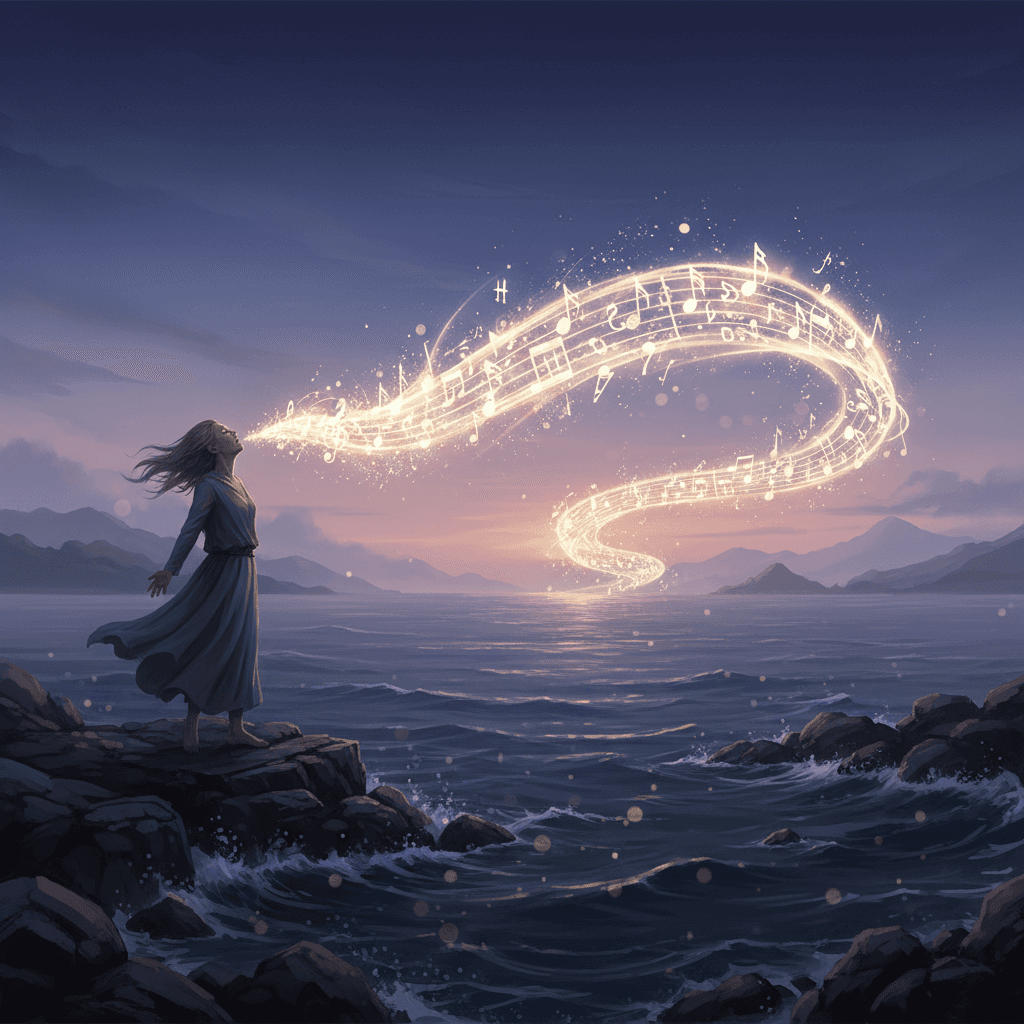
Sing what you hope into being; a single song can bridge you to distant shores. — Sappho
—What lingers after this line?
The Power of a Single Song
Sappho’s line centers on a deceptively simple image: one song, sung with intention, can alter reality. Rather than treating music as mere ornament, she suggests it is a creative force that shapes what has not yet arrived. To “sing what you hope into being” is to give your desires sound and form, transforming vague longings into something you can hear, repeat, and refine. In this way, the song becomes a blueprint for the future, turning inner wishes into a shared vibration that can be felt by others.
From Inner Longing to Outer World
Moving deeper, the quote traces a path from the private realm of feeling to the public world of action. Hopes are often silent, lodged inside us as unarticulated yearnings. Yet, when Sappho urges us to sing them, she is asking us to translate emotion into expression. This act of voicing hope does not guarantee immediate fulfillment, but it does reposition us: we shift from passive dreamers into active participants in our own becoming. In this transition, song works like a bridge between who we are and who we might yet be.
Bridging to Distant Shores
The image of “distant shores” widens the scope of the metaphor, suggesting goals, people, or futures that feel far beyond reach. Just as ancient sailors relied on stars and chants to steady themselves at sea, Sappho imagines song as a navigational tool that carries us over uncertainty. By singing, we orient ourselves toward the far side of our fears and limitations. The bridge is not a physical structure but a sustained act of attention and faith, turning separation into a passage that can actually be crossed.
Community, Echo, and Shared Resonance
Furthermore, a song rarely stays with the singer alone. Once released, it can be echoed, harmonized, or answered, creating community where there was once isolation. Sappho’s own fragments, preserved across millennia, show how lyric voice outlives the body, reaching listeners she never met. In a similar way, your hopeful song can draw others who recognize themselves in its melody, forming unexpected alliances. Thus the bridge spans not only distances in space and time, but also the gaps between individual lives and collective experience.
Choosing Hopeful Words and Melodies
However, Sappho’s counsel subtly carries a responsibility: what you sing matters. To sing hope into being is different from rehearsing despair. The lyrics and tone you choose become the atmosphere in which you live and act. By crafting words that lean toward possibility and melodies that invite courage, you cultivate a mindset more likely to notice opportunities and connections. Over time, this practice can reshape both perception and behavior, so that the world you inhabit gradually comes to resemble the one your song has been describing.
Living as a Continuous Song
Ultimately, the quote invites us to see life itself as a sustained composition. Each decision, gesture, and conversation becomes another verse in the song of what we hope to create. Rather than waiting for the distant shores to move closer on their own, we keep singing—through setbacks, doubts, and changing tides. In doing so, we allow our hopes to remain audible, both to ourselves and to others, until the bridge they form is strong enough to carry us across.
Recommended Reading
As an Amazon Associate, we earn from qualifying purchases.
One-minute reflection
What does this quote ask you to notice today?
Related Quotes
6 selectedHope is the thing with feathers that perches in the soul - and sings the tunes without the words - and never stops - at all. - Emily Dickinson
Emily Dickinson
Emily Dickinson uses the metaphor of a bird to represent hope. The 'thing with feathers' suggests that hope is light, delicate, but also persistent.
Read full interpretation →Hope is the thing with feathers that perches in the soul, and sings the tune without the words, and never stops at all. - Emily Dickinson
Emily Dickinson
Dickinson uses the metaphor of a bird with feathers to symbolize hope. Like a bird, hope can lift us and help us soar above challenges and difficulties.
Read full interpretation →In the depths of despair, one often finds the most beautiful hope.
Unknown
This quote highlights the human capacity to find hope during the darkest times. Even when faced with extreme challenges and despair, individuals can discover a profound sense of hope that can inspire them to move forward...
Read full interpretation →Hope is the thing with feathers that perches in the soul, and sings the tune without the words, and never stops at all. - Emily Dickinson
Emily Dickinson
Emily Dickinson personifies hope as a bird with feathers that resides within the soul. This metaphor captures the delicate yet persistent nature of hope.
Read full interpretation →In every dawn, there is a poem of hope, and at dusk, a melody of serenity.
Unknown
Dawn represents new beginnings, possibilities, and hope. The imagery of a 'poem of hope' suggests that each morning brings a fresh start filled with optimism and potential.
Read full interpretation →Some years ask you to survive before they ask you to dream. — Maggie Smith
Maggie Smith.
At its core, Maggie Smith’s line recognizes a painful truth: not every season of life is built for possibility. Some years demand endurance first, asking us to pay attention to basic emotional, financial, or physical sur...
Read full interpretation →More From Author
More from Sappho →Sow a single clear word and let it bloom into a chorus. — Sappho
Sappho’s line begins by shrinking expression down to its smallest unit: a single clear word. The emphasis on clarity suggests intention rather than verbosity, as if meaning can be planted only when it is cleanly chosen.
Read full interpretation →Let desire fuel your craft but let kindness steady the heart. — Sappho
Sappho’s line sets up a deliberate pairing: desire as the engine of making, and kindness as the stabilizer of being. Desire pushes the artist toward intensity—toward risk, experimentation, and the hunger to shape experie...
Read full interpretation →Let your voice fracture the silence; even a small sound reshapes the air. — Sappho
Sappho’s line begins by treating silence not as emptiness, but as a kind of held breath—an atmosphere with shape and tension. When she urges, “Let your voice fracture the silence,” she implies that quiet has weight, and...
Read full interpretation →Sing with the courage of a throat that will not be silenced by storms. — Sappho
Sappho’s line frames singing as more than art—it is a refusal to be erased. The “throat” is deliberately physical, reminding us that courage is not an abstract virtue but something practiced in a body that can tremble, t...
Read full interpretation →