
Hope Is the Thing with Feathers - Emily Dickinson
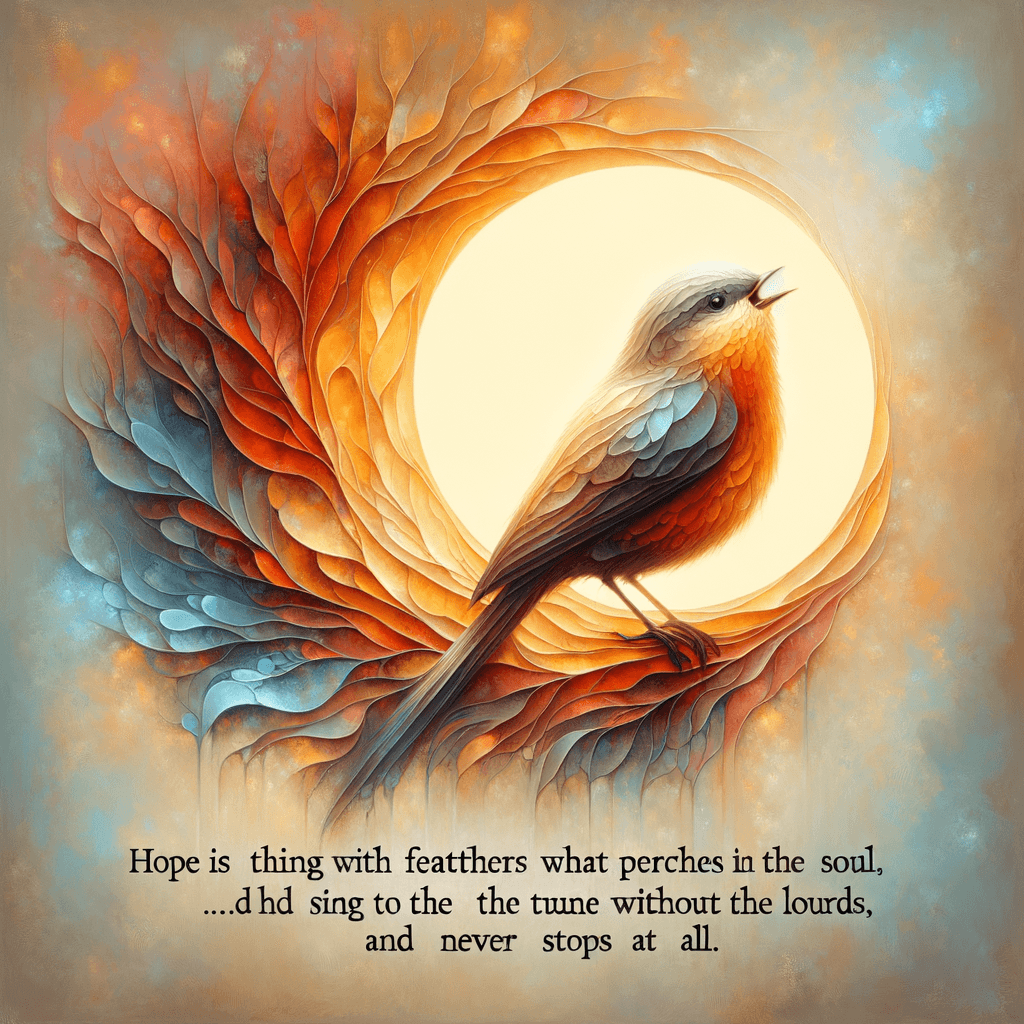
Hope is the thing with feathers that perches in the soul, and sings the tune without the words, and never stops at all. - Emily Dickinson
—What lingers after this line?
Metaphor of Hope
Emily Dickinson personifies hope as a bird with feathers that resides within the soul. This metaphor captures the delicate yet persistent nature of hope.
Resilience of Hope
The phrase 'never stops at all' highlights hope's unwavering and relentless existence, suggesting that it continues to inspire and uplift regardless of circumstances.
Hope as Comforting
The image of a bird singing continuously without words indicates that hope provides a sense of comfort and optimism, even in the absence of concrete solutions or explanations.
Inherent Presence
The description of hope as something that 'perches in the soul' implies that it is an inherent part of the human spirit, always present and ready to provide solace.
Emily Dickinson's Style
Dickinson’s poetic style often uses simple yet profound imagery to explore complex themes. Her metaphorical approach allows readers to relate to abstract concepts like hope on a personal level.
Recommended Reading
As an Amazon Associate, we earn from qualifying purchases.
One-minute reflection
What's one small action this suggests?
Related Quotes
6 selectedHope is the thing with feathers that perches in the soul - and sings the tunes without the words - and never stops - at all. - Emily Dickinson
Emily Dickinson
Emily Dickinson uses the metaphor of a bird to represent hope. The 'thing with feathers' suggests that hope is light, delicate, but also persistent.
Read full interpretation →Push past ease; that's where shape and strength form. — Emily Dickinson
Emily Dickinson
Emily Dickinson’s line, “Push past ease; that's where shape and strength form,” distills a timeless challenge: do not settle for what feels effortless. Rather than praising struggle for its own sake, she points toward th...
Read full interpretation →Hope is the thing with feathers that perches in the soul, and sings the tune without the words, and never stops at all. - Emily Dickinson
Emily Dickinson
Dickinson uses the metaphor of a bird with feathers to symbolize hope. Like a bird, hope can lift us and help us soar above challenges and difficulties.
Read full interpretation →Tend your inner light; even a small flame brightens a long night. — Emily Dickinson
Emily Dickinson
Dickinson’s image of a small flame surviving a long night invites a gentle rethinking of strength. Instead of glorifying blazing bonfires of achievement or joy, she suggests that resilience often looks modest: a candle,...
Read full interpretation →Instead of trying to return to how things were, build a flexible structure that can handle constant change. — Favor Mental Health
Favor Mental Health
The quote begins by challenging a common instinct: when life is disrupted, we often try to restore an earlier version of stability. Yet “how things were” is usually a moving target, shaped by circumstances that may not r...
Read full interpretation →Quietly cracking does not have to be your permanent state. — Dr. Sarah McQuaid
Dr. Sarah McQuaid
Dr. Sarah McQuaid’s line begins by giving language to a common but often invisible experience: feeling like you’re “quietly cracking.” It suggests a slow, internal strain—functioning on the outside while something splint...
Read full interpretation →More From Author
More from Emily Dickinson →Plant a question, harvest a path — Emily Dickinson
Emily Dickinson’s line, “Plant a question, harvest a path,” turns curiosity into agriculture: inquiry becomes a seed placed deliberately into the soil of experience. The image implies patience and faith, because planting...
Read full interpretation →Write the day you want to live into existence through honest action. — Emily Dickinson
Emily Dickinson’s line treats “the day you want to live” not as a wish but as something you can author. The verb “write” makes the future feel like a page that responds to a steady hand—shaped by choices, drafts, and rev...
Read full interpretation →One clear action dissolves a thousand excuses. — Emily Dickinson
Dickinson’s line hinges on a striking contrast: a single, concrete act can outweigh an entire inventory of explanations. Excuses multiply because they are easy to generate and hard to disprove, yet they remain weightless...
Read full interpretation →Let your hands speak louder than your doubts. — Emily Dickinson
Emily Dickinson’s line reads like a gentle imperative: when uncertainty grows loud inside you, let tangible effort answer it. By choosing “hands,” she spotlights the practical self—the part that can write, build, cook, m...
Read full interpretation →