
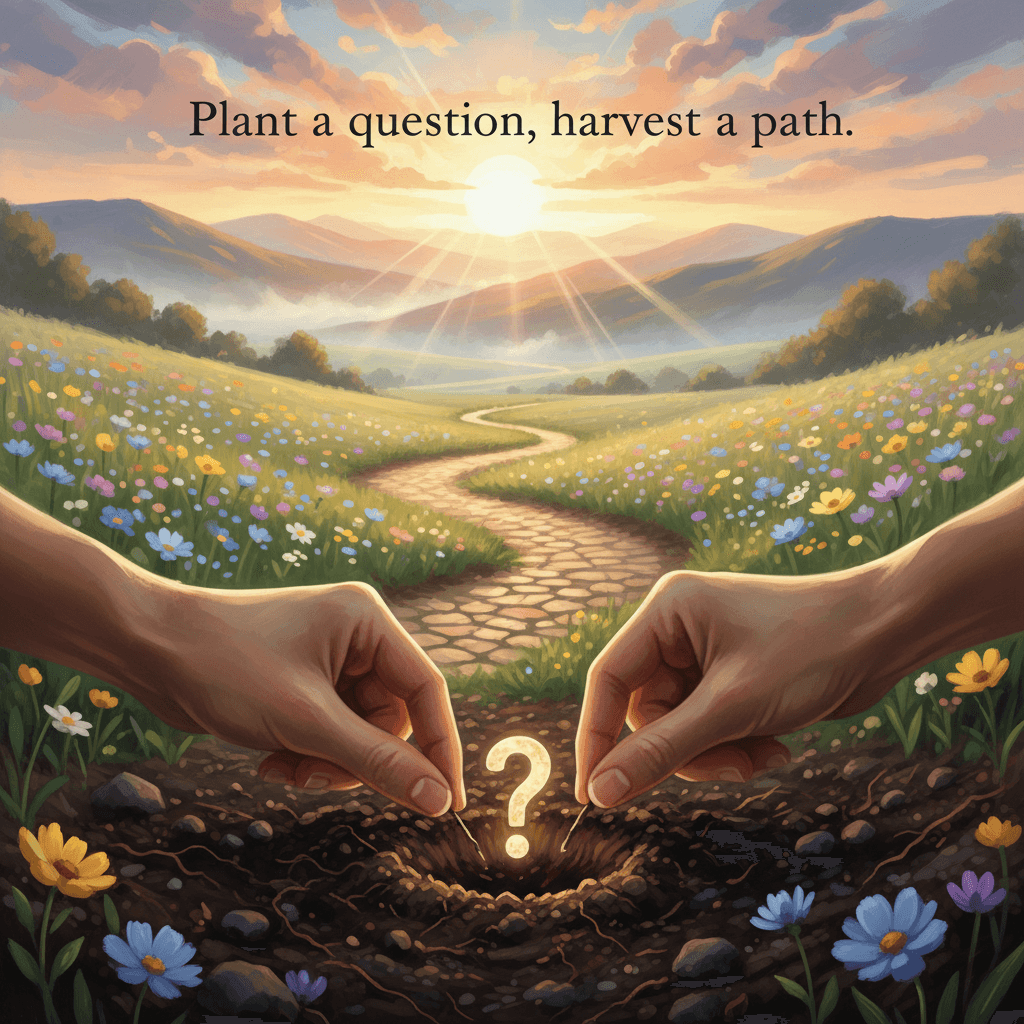
Plant a question, harvest a path — Emily Dickinson
—What lingers after this line?
A Seed Metaphor for Curiosity
Emily Dickinson’s line, “Plant a question, harvest a path,” turns curiosity into agriculture: inquiry becomes a seed placed deliberately into the soil of experience. The image implies patience and faith, because planting doesn’t yield immediate proof—only the possibility of growth. In that sense, the quote frames questioning not as a sign of ignorance but as a quiet act of creation. From here, the metaphor naturally shifts our attention from answers to outcomes. Dickinson suggests that what we ultimately gather is not a neat conclusion but a “path”—a direction, a way forward, a lived route shaped by what we dared to ask.
Questions That Move Life Forward
If the harvest is a path, then the value of a question lies in how it changes behavior. A person who asks, “What kind of work makes me feel useful?” may not receive a single definitive answer, yet the question can prompt experiments—new skills, conversations, risks—that gradually form a navigable life direction. The path is made by walking, but the question chooses where walking begins. This also reframes uncertainty as productive rather than paralyzing. Instead of demanding instant clarity, Dickinson’s phrasing invites us to treat good questions as catalysts that convert confusion into motion.
Learning as an Evolving Route
In education and self-development, strong questions often outperform strong opinions. Socrates’ method in Plato’s “Apology” (c. 399 BC) portrays inquiry as a discipline that doesn’t simply collect facts; it reshapes the thinker. Dickinson’s harvest image aligns with this: learning is less like stacking bricks and more like clearing a trail. As the trail lengthens, new questions appear, and the route becomes more personal. One inquiry leads to another, so the “path” is not a final destination but an evolving map drawn through continued attention.
Creativity and the Unasked Door
Creative breakthroughs often begin with questions that feel slightly strange: “What if I invert the usual structure?” or “What would happen if I remove the obvious solution?” Artists and writers frequently describe their process as following a thread rather than executing a plan. Dickinson, a poet known for compressed insight, implies that the question is that thread. This is why the harvest is a path rather than a product. A question can lead to a new style, a fresh subject, or an unforeseen collaboration—results that look less like a trophy and more like a widened horizon.
The Courage to Plant Without Guarantees
Planting requires accepting that some seeds won’t sprout. Likewise, asking serious questions—about identity, love, faith, ethics, or vocation—can be risky because the answers may disrupt comfort. Yet Dickinson’s line honors the attempt: the act of planting already changes the planter, training attentiveness and humility. Moreover, the metaphor implies seasons. Some questions take time, and their value may not be visible until later circumstances provide the right light and water. In that delay, the question quietly organizes choices and prepares a person to recognize a path when it finally appears.
Living by Better Questions
Ultimately, Dickinson offers a practical philosophy: if you want a different future, start by changing what you ask. Questions like “What am I avoiding?” or “Where do I feel most alive?” can function like compass points, not because they guarantee certainty, but because they orient action. The path emerges through repeated, honest inquiry. Seen this way, the quote is less about intellectual cleverness than about shaping a life. To plant a question is to invest in direction; to harvest a path is to discover that meaning often arrives as movement, not as a final answer.
One-minute reflection
What does this quote ask you to notice today?
Related Quotes
6 selectedThe artist's duty is to stay in the fire, to keep the question alive long after the answers have gone cold. — Adrienne Rich
Adrienne Rich
Adrienne Rich presents the artist not as a maker of neat conclusions, but as someone willing to remain inside uncertainty. The image of “staying in the fire” suggests discomfort, risk, and sustained attention; in other w...
Read full interpretation →We're all just walking each other home. — Ram Dass
Ram Dass
Ram Dass’s statement compresses an entire philosophy into a gentle image: life as a shared walk, and death as a kind of homecoming. Instead of framing existence as a solitary quest for achievement, it suggests that what...
Read full interpretation →It is good to have an end to journey toward; but it is the journey that matters, in the end. — Ursula K. Le Guin
Ursula K. Le Guin
Le Guin begins with what sounds like common sense: having an end point is useful. A destination can organize effort, give direction, and keep hope intact when the road is long.
Read full interpretation →A gentle question can unlock a stone of doubt; ask and then act. — Confucius
Confucius
Confucius frames doubt not as a fleeting mood but as a “stone,” something heavy, immovable, and quietly obstructive. That image matters: if uncertainty feels like weight, then it can’t be wished away by optimism alone; i...
Read full interpretation →Walk purposefully and the road will reveal itself. — Rabindranath Tagore
Rabindranath Tagore
Tagore’s line begins with a quiet reversal of how people usually imagine progress. Instead of waiting for certainty, you move with purpose first, and clarity follows.
Read full interpretation →Gather your questions like tools and craft answers that endure. — Kahlil Gibran
Kahlil Gibran
Gibran’s line reframes curiosity as craftsmanship: questions are not idle sparks but tools to be collected, carried, and chosen with intention. In the same way a carpenter selects a chisel or plane for a specific cut, a...
Read full interpretation →More From Author
More from Emily Dickinson →I know nothing in the world that has as much power as a word. Sometimes I write one, and I look at it, until it begins to shine. — Emily Dickinson
Emily Dickinson’s statement begins with a bold claim: among worldly things, few rival the power of a word. Rather than treating language as a neutral tool, she presents it as an active force that can move thought, alter...
Read full interpretation →The soul should always stand ajar, ready to welcome the roving experience. — Emily Dickinson
Emily Dickinson’s image of the soul standing “ajar” transforms inner life into a threshold rather than a fortress. Instead of sealing ourselves against surprise, she suggests that wisdom begins with a kind of deliberate...
Read full interpretation →Write the day you want to live into existence through honest action. — Emily Dickinson
Emily Dickinson’s line treats “the day you want to live” not as a wish but as something you can author. The verb “write” makes the future feel like a page that responds to a steady hand—shaped by choices, drafts, and rev...
Read full interpretation →One clear action dissolves a thousand excuses. — Emily Dickinson
Dickinson’s line hinges on a striking contrast: a single, concrete act can outweigh an entire inventory of explanations. Excuses multiply because they are easy to generate and hard to disprove, yet they remain weightless...
Read full interpretation →