
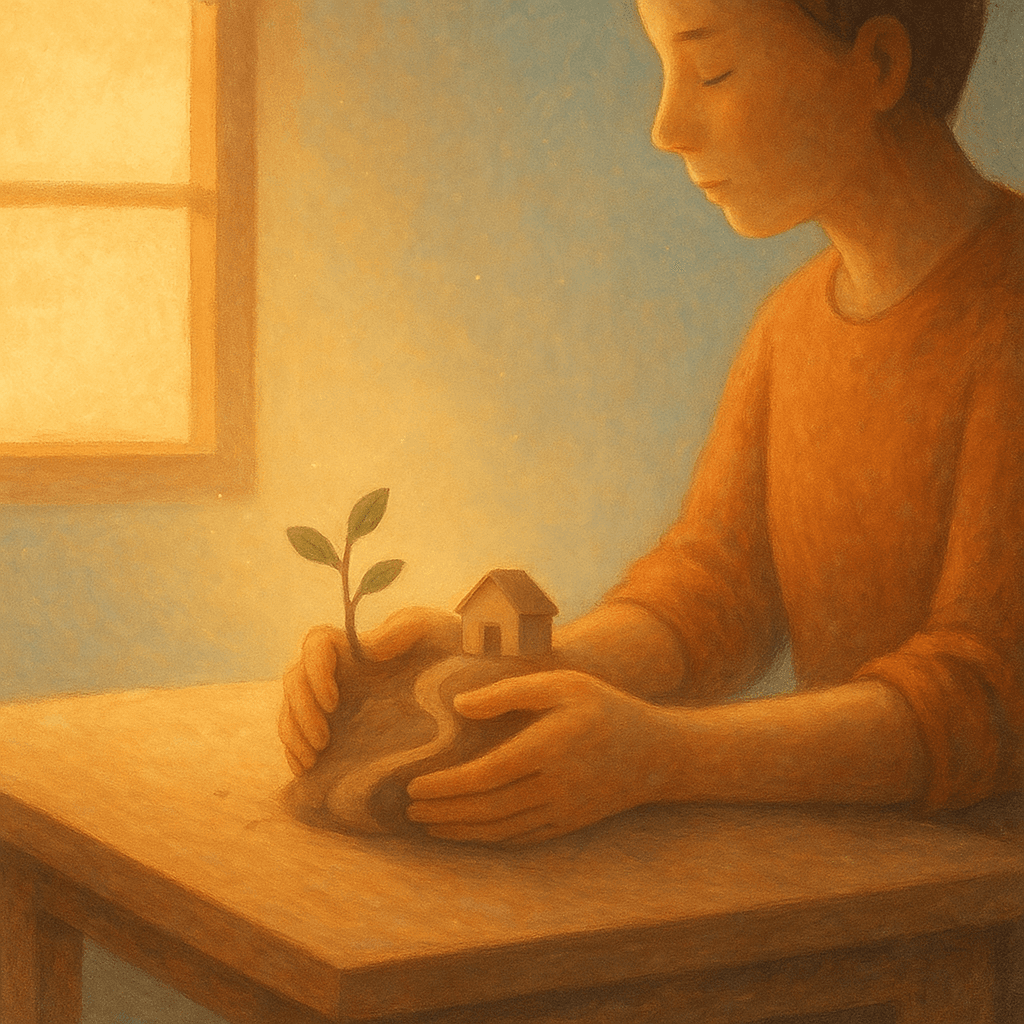
Begin where your hands already are; shape tomorrow with the clay of this hour. — Rumi
—What lingers after this line?
Beginning Exactly Where You Stand
Rumi’s call to “begin where your hands already are” refuses the temptation to wait for perfect conditions. Instead of searching for a more convenient moment, a better job, or a clearer plan, he directs our attention to the immediate sphere of action—our current tasks, relationships, and surroundings. Much like the Zen emphasis on “chopping wood, carrying water,” this line suggests that transformation starts not in grand gestures but in the next small, concrete move we are already positioned to make.
The Clay of the Present Moment
When Rumi speaks of “the clay of this hour,” he turns the present into something tangible, pliable, and alive in our hands. Clay is ordinary earth, yet it becomes art when engaged by a patient craftsperson. In the same way, the circumstances of this hour—our limitations, chances, and even frustrations—are the raw material from which our future is formed. Rather than dismissing the present as incomplete or unworthy, Rumi invites us to recognize its potential as a workable, shapeable substance.
Time as a Creative Continuum
This image also recasts time itself as a continuum of creative opportunity. Tomorrow does not arrive fully formed; it emerges from how we knead, press, and mold today’s choices and attitudes. Philosophers from Aristotle to William James have argued that character is built through repeated actions, and Rumi’s metaphor echoes that insight. By treating the present as clay rather than stone, we understand that each moment can be revised, refined, and reworked, gradually sculpting the contours of our lives.
Responsibility and the Artisan’s Mindset
Moreover, the metaphor places responsibility squarely in our hands, much like an artisan at the wheel who cannot blame the clay alone for a misshapen pot. This does not deny external constraints, but it emphasizes agency: within whatever conditions we face, there remain decisions we can make and attitudes we can adopt. Rumi’s Sufi context, as seen throughout the Masnavi, repeatedly urges active participation with the Divine will—humans are co-creators, not passive recipients, and each hour is a chance to collaborate in crafting a more truthful life.
From Abstraction to Daily Practice
Finally, this teaching gains power when translated into daily practice. To “shape tomorrow” through “this hour” might mean writing a single paragraph of a long-delayed book, initiating a hard conversation, or simply paying full attention to the task already in our hands. Like a potter returning to the wheel each day, we build skill and direction through consistent engagement. Over time, these small acts accumulate, and what once felt like distant aspiration gradually solidifies into the vessel of a new tomorrow, formed quietly from the clay of ordinary moments.
One-minute reflection
Why might this line matter today, not tomorrow?
Related Quotes
6 selectedWalk into the open field of today and plant seeds of wonder with your hands. — Rumi
Rumi
Rumi frames “today” as an “open field,” a wide, available space rather than a cramped schedule to survive. In that metaphor, the present is not merely a moment on a clock but a terrain we can step into—one that offers ro...
Read full interpretation →Act in the moment, for the moment is all we have. — Rumi
Rumi
This quote emphasizes the importance of living in the present. It encourages mindfulness and awareness, reminding us that the past is gone and the future is uncertain.
Read full interpretation →Yesterday is gone. Tomorrow has not yet come. We have only today. Let us begin. — Mother Teresa
Mother Teresa
This quote emphasizes the importance of focusing on the present moment. Yesterday is already in the past and cannot be changed, and tomorrow is uncertain.
Read full interpretation →Begin doing what you want to do now. We are not living in eternity. We have only this moment, sparkling like a star in our hand—and melting like a snowflake. — Francis Bacon
Francis Bacon
This quote emphasizes the importance of taking action now rather than postponing your dreams and desires. It suggests that the present moment is fleeting and should be fully utilized.
Read full interpretation →Bringing awareness to our breathing, we remind ourselves that we are here now, so we might as well be fully awake for whatever is happening. — Jon Kabat-Zinn
Zinn
Jon Kabat-Zinn’s reflection begins with something deceptively ordinary: the breath. By bringing awareness to inhaling and exhaling, we anchor ourselves in the immediate moment rather than drifting into regret about the p...
Read full interpretation →The only way to move forward is to stop pretending that the past is still happening. — Pema Chödrön
Pema Chödrön
Pema Chödrön’s line begins with a gentle but piercing insight: suffering often persists not only because something painful happened, but because part of us keeps reliving it as if it were still unfolding. In that sense,...
Read full interpretation →More From Author
More from Rumi →Everything that happens is a form of instruction if you choose to listen. — Rumi
At its core, Rumi’s line reframes ordinary experience as a living classroom. Nothing is merely random noise if one approaches it with attention; instead, each success, disappointment, encounter, or delay carries the poss...
Read full interpretation →Do not mistake movement for progress; a spinning top stays in one place, while a seed grows by staying rooted in the dark. — Rumi
Rumi’s image draws an immediate contrast between busyness and true development. A spinning top dazzles with speed and motion, yet it remains fixed in essentially the same place.
Read full interpretation →You don't need to escape the chaos to find peace—it's already inside you, waiting to be remembered. — Rumi
At first glance, Rumi’s line overturns a common assumption: that peace must be found by fleeing noise, conflict, or uncertainty. Instead, he suggests that peace is not an external destination but an inner condition alrea...
Read full interpretation →Confidence is silent. Insecurities are loud. Do not feel the need to broadcast your worth to a world that doesn't understand your path. — Rumi
At its core, this saying contrasts two very different emotional states: confidence, which rests quietly within, and insecurity, which seeks constant outward expression. The point is not that confident people never speak,...
Read full interpretation →