
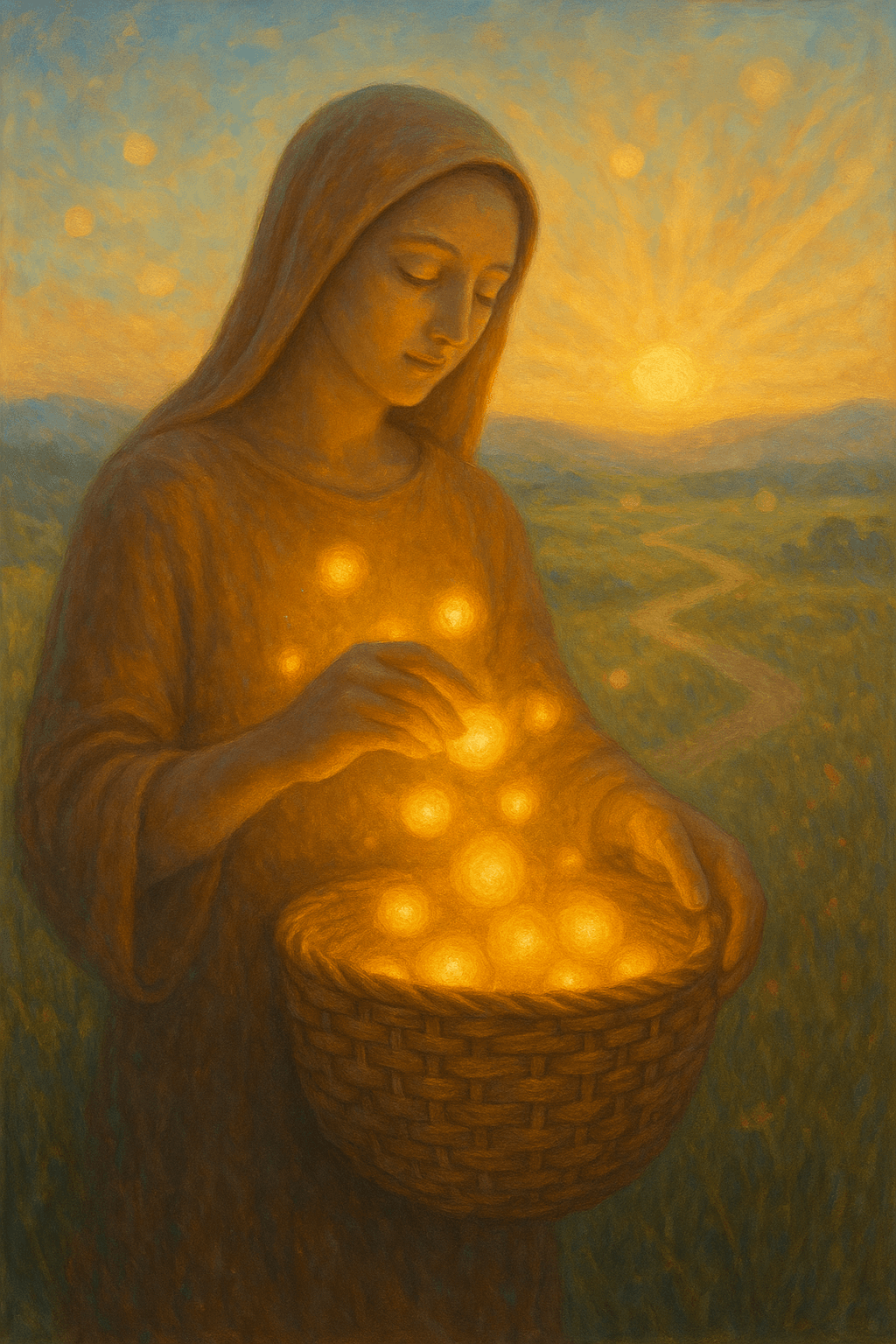
Gather your scattered joys into a basket and carry them into each undertaking. — Alice Walker
—What lingers after this line?
The Image of a Basket of Joys
Alice Walker’s line begins with a domestic, almost pastoral image: scattered joys being gathered into a basket. This metaphor suggests that happiness is not always a grand event but a collection of small, overlooked moments—like berries on the ground waiting to be picked up. Rather than letting these joys remain random and forgotten, Walker urges us to make them intentional, held together in one place. In doing so, joy becomes something portable and deliberate, not just an occasional surprise. This simple image reframes emotional life as a kind of gentle harvest, where we recognize the abundance already around us.
From Scattered Moments to Conscious Attention
Following this image, the act of gathering implies attention and choice. Scattered joys are easy to step over: a kind word, morning light on a window, a small success at work. By pausing to notice and collect them, we begin to curate our inner landscape. This mirrors practices like gratitude journaling, where people list daily blessings to counterbalance stress. Walker’s metaphor reaches further, however, suggesting not just private reflection but preparation. The basket becomes a storehouse of remembered goodness, ready to be drawn from when life’s demands increase.
Carrying Joy Into Work and Responsibility
Walker then shifts from gathering to carrying, moving us from contemplation into action. To carry a basket of joys “into each undertaking” means approaching tasks, duties, and challenges with an inner reserve of positivity. Instead of waiting for work or obligations to generate happiness, we arrive already resourced. This perspective aligns with research in positive psychology showing that people who enter tasks with a positive mindset are more creative and resilient. Joy, in this sense, is not a reward at the end of effort but a tool we bring along to make the effort more humane and sustainable.
Transforming Undertakings Through Inner Wealth
As we extend this idea, undertakings themselves begin to change under the influence of carried joy. A difficult conversation, a demanding project, or an unfamiliar responsibility may remain challenging, yet they are infused with a different quality when approached from an inner fullness. The basket image suggests that we are not empty-handed before life’s demands; we bring stories, memories, laughter, and meaning with us. This shift echoes Walker’s broader work, where marginalized characters often draw on inner richness to navigate external hardship, transforming survival into an expression of dignity and creativity.
A Quiet Practice of Resistance and Renewal
Ultimately, gathering and carrying joy can be read as a subtle form of resistance. In a world that scatters our attention and amplifies fear or scarcity, choosing to collect and protect small joys pushes back against emotional depletion. It becomes a daily discipline of renewal, much like tending a garden in harsh soil. By repeatedly returning to the basket—recalling a friend’s support, a moment of beauty, a hard-earned achievement—we refuse to let difficulty define the whole picture. Thus, Walker’s sentence offers a compact ethic: train yourself to notice, gather, and transport joy so that every undertaking, however modest or daunting, is accompanied by a quiet, sustaining light.
One-minute reflection
Where does this idea show up in your life right now?
Related Quotes
6 selectedClutter is not just the stuff on your floor; it's anything that stands between you and the life you want to be living. — Peter Walsh
Peter Walsh
At first glance, Peter Walsh’s quote seems to address physical mess, yet it quickly expands into something much broader. Clutter, in his view, is not merely a pile of objects on the floor; rather, it is any obstacle—mate...
Read full interpretation →Do the work of naming the highest, eulogy-worthy priorities in your life. Then do the work of putting them at the center of your life, every day. — Brooke McAlary
Brooke McAlary
Brooke McAlary’s quote begins with a difficult but clarifying task: identifying the priorities so important they would belong in your eulogy. In other words, she asks us to look beyond errands, ambitions, and social nois...
Read full interpretation →Instead of hustling to build a life that looks good, what if you slowed down and cultivated a life that feels good. — Erica Layne
Erica Layne
Erica Layne’s quote begins by challenging a familiar modern reflex: the urge to “hustle” toward a life that looks impressive from the outside. In doing so, she contrasts external validation with internal well-being, sugg...
Read full interpretation →Intentional living is the art of making our own choices before others' choices make us. — Richie Norton
Richie Norton
Richie Norton’s quote frames intentional living as an active rather than passive way of being. At its core, it argues that a meaningful life is shaped by deliberate decisions made in advance, not by drifting along with e...
Read full interpretation →Edit your life frequently and ruthlessly. It's your masterpiece after all. — Nathan W. Morris
Nathan W. Morris
Morris frames life not as a fixed identity but as an ongoing creation—something drafted, tested, and refined over time. By calling it a “masterpiece,” he implies both ownership and intention: you are not merely living th...
Read full interpretation →Be the designer of your world and not merely the consumer of it. — James Clear
James Clear
James Clear’s line draws a sharp distinction between drifting through what’s offered and intentionally shaping what’s possible. To “consume” is to accept default options—default schedules, default opinions, default ambit...
Read full interpretation →More From Author
More from Alice Walker →The most beautiful things are those that take time to grow, requiring a commitment to the process rather than a hunger for the end. — Alice Walker
Alice Walker’s reflection shifts beauty away from instant results and toward slow formation. At its heart, the quote suggests that what becomes truly beautiful does so through time, care, and endurance rather than speed...
Read full interpretation →Hard times require furious dancing. Each of us is the proof. — Alice Walker
Alice Walker’s line treats “hard times” not as a cue for silence, but as a summons to movement. The phrase “furious dancing” reads like an intentional contradiction—how can joy or art survive suffering?
Read full interpretation →The most common way people give up their power is by thinking they don't have any. — Alice Walker
Alice Walker’s line points to a paradox: people often lose power not through force, but through a belief that power was never theirs to begin with. That assumption quietly reshapes behavior—choices narrow, risks feel poi...
Read full interpretation →In an age of speed, I began to think nothing is as precious as slowness. — Alice Walker
Alice Walker’s line begins with a modern assumption—life is accelerating—and then performs a quiet reversal: the rarer something becomes, the more it is worth. In an age that prizes quick replies, rapid production, and c...
Read full interpretation →