
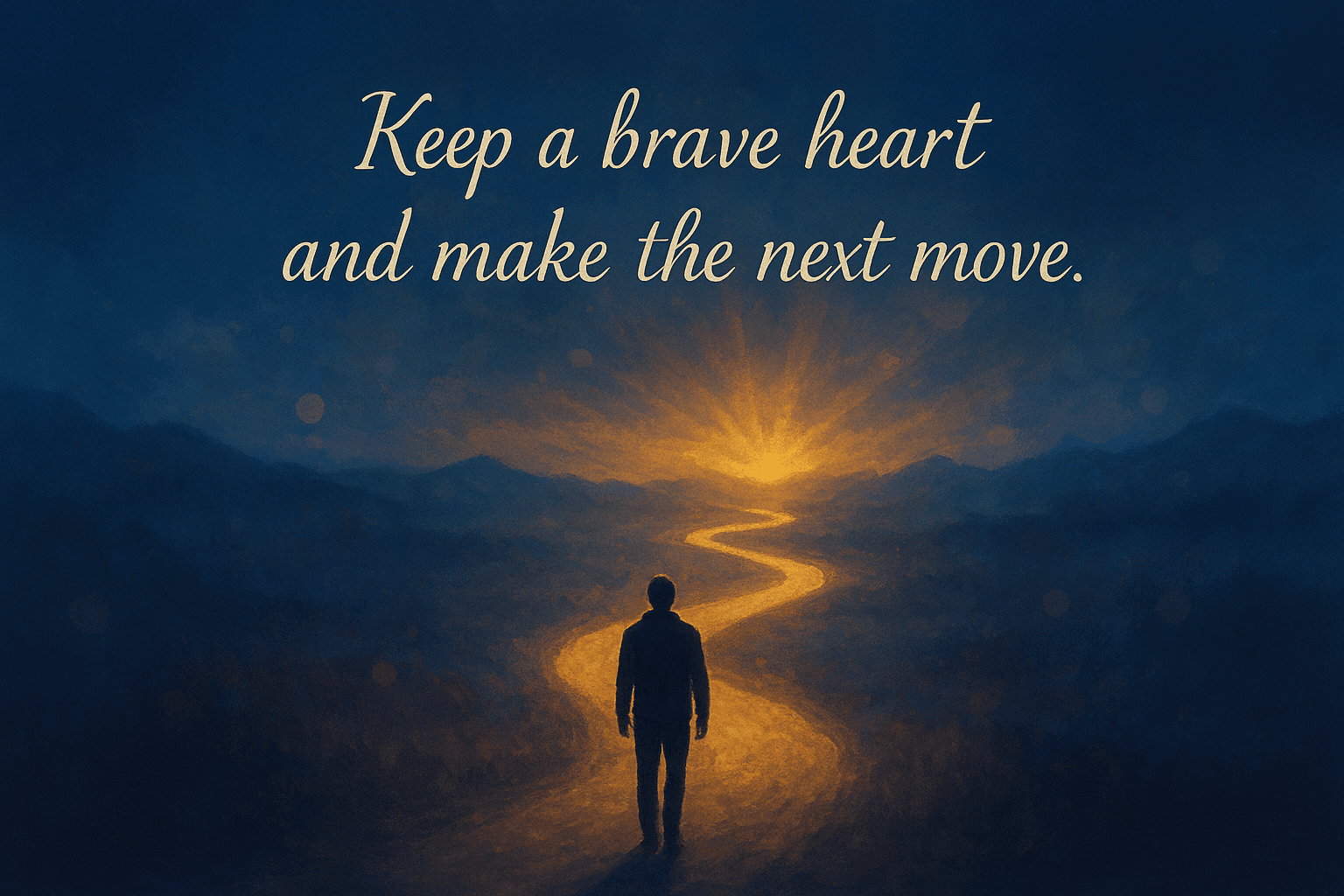
Keep a brave heart and make the next move. — Anna Akhmatova
—What lingers after this line?
Courage as the Quiet Beginning
Anna Akhmatova’s call to “keep a brave heart” begins not with action but with inner stance. Before any visible step is taken, she insists on a certain steadiness of spirit, the refusal to be ruled by fear or paralysis. This kind of courage is rarely loud; instead, it is the quiet decision to remain open and present when retreat feels safer. From this interior firmness, the rest of her advice naturally follows, suggesting that the heart must first be fortified before the body can move.
The Necessity of the “Next Move”
Once courage is established, Akhmatova shifts the focus toward motion: “make the next move.” This phrase acknowledges that life unfolds as a sequence of decisions rather than a single grand choice. Just as a chess player can only act from the current position on the board, we, too, must work with what stands immediately before us. The emphasis on the “next” move frames progress as incremental, reminding us that transformation rarely arrives in one dramatic leap but in a string of small, deliberate advances.
Living with Uncertainty and Risk
Moving forward inevitably exposes us to uncertainty, and Akhmatova’s counsel implicitly accepts this risk. To act bravely is not to guarantee success; it is to proceed without such guarantees. In her own life—writing under censorship and political terror in Soviet Russia—remaining still often meant a different kind of danger. Her words thus point to a difficult truth: inaction is not neutral. By stressing both bravery and motion, she suggests that choosing, even imperfectly, may be safer for the soul than surrendering to indecision.
From Inner Resolve to Outward Action
The quote also traces a clear bridge between feeling and doing. A brave heart without a “next move” risks becoming a private fantasy, while action without courage easily devolves into panic or impulsiveness. Akhmatova subtly joins these two elements, implying that genuine resilience manifests as decisions made in alignment with one’s deepest values. In this way, each step outward—accepting a challenge, ending a harmful pattern, or starting something new—becomes evidence of an inward strength that has refused to collapse.
Reframing Progress as a Series of Small Steps
Finally, the simplicity of “the next move” offers a practical reframe of progress. Instead of demanding a full roadmap, Akhmatova invites us to ask a humbler question: what is the single, concrete step available now? This perspective can loosen the grip of perfectionism and fear, much as cognitive-behavioral therapists encourage clients to focus on manageable, immediate actions rather than distant outcomes. By returning our attention to the very next move, her words turn overwhelming futures into a sequence of brave, bearable moments.
One-minute reflection
What feeling does this quote bring up for you?
Related Quotes
6 selectedTo be courageous is to act with the heart. — Molière
Molière
Molière’s line suggests that courage is not merely the absence of fear, but the decision to move despite it. By connecting courage with the heart, he frames bravery as an emotional and moral act rather than a simple disp...
Read full interpretation →You do not have to be fearless to be brave. You only need to be present enough to take the next deliberate action. — Pema Chödrön
Pema Chödrön
At first glance, Pema Chödrön’s quote gently overturns a common misconception: that bravery belongs only to people untouched by fear. Instead, she presents courage as something far more accessible.
Read full interpretation →Movement does not always mean speed; sometimes, the most courageous step you can take is to slow down and breathe. — Sarah Ban Breathnach
Sarah Ban Breathnach
At first glance, movement is often confused with speed, productivity, or constant visible progress. Sarah Ban Breathnach’s quote gently corrects that assumption by suggesting that motion can also take the form of pause,...
Read full interpretation →Confidence is not pretending you're fearless. It's walking straight into fear and realizing it doesn't own you. — Emma Watson
Emma Watson
At first glance, Emma Watson’s quote challenges a common misunderstanding: confidence is not the absence of fear. Many people imagine confident individuals as naturally bold, untouched by doubt or anxiety.
Read full interpretation →To ignite your life you must focus on one thing long enough for it to catch fire. — Gary Keller
Gary Keller
Gary Keller’s quote begins with a simple but demanding idea: transformation rarely comes from scattered effort. To “ignite your life” is to create momentum, meaning, and visible progress, yet that spark needs sustained a...
Read full interpretation →The best people possess a feeling for beauty, the courage to take risks, the discipline to tell the truth, the capacity for sacrifice. — Ernest Hemingway
Ernest Hemingway
Hemingway’s line presents goodness not as politeness or success, but as a demanding inner code. The “best people” are those who combine sensitivity, bravery, honesty, and self-denial—qualities that do not always coexist...
Read full interpretation →More From Author
More from Anna Akhmatova →