
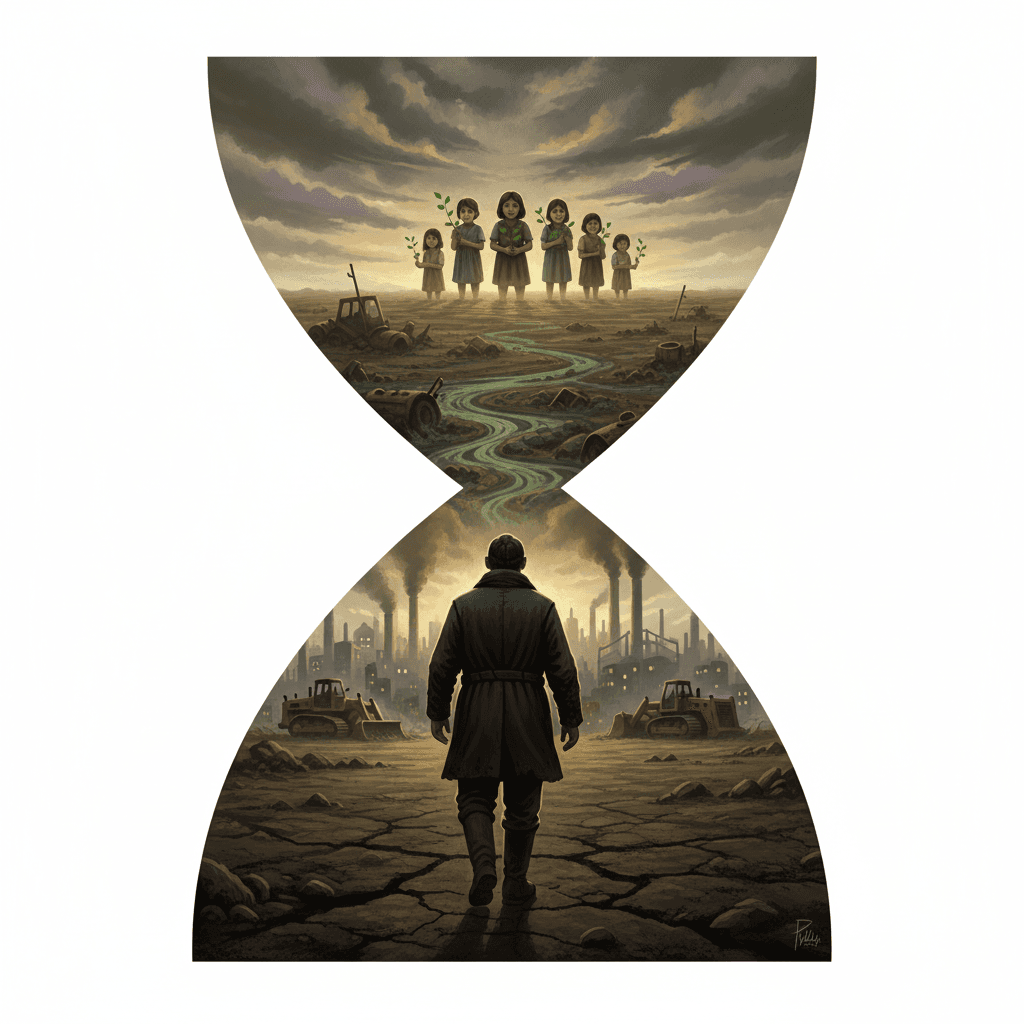
The generation that destroys the environment is not the generation that pays the price. That will be our children and grandchildren. — Wangari Maathai
—What lingers after this line?
A Debt Passed Down the Generational Line
Wangari Maathai’s warning exposes a moral imbalance at the heart of modern development: those who benefit most from environmental destruction are rarely those who bear its full costs. Instead, today’s comforts—fossil-fueled transport, throwaway plastics, unchecked deforestation—create long-term harms that unfold slowly. Because climate shifts, ecosystem collapse, and resource depletion operate on decades-long timescales, the consequences arrive when the original decision-makers are gone, leaving children and grandchildren to navigate a damaged world they did not choose.
Environmental Injustice and Intergenerational Ethics
This temporal gap is also a form of injustice. Just as pollution often harms marginalized communities more than the wealthy, it also burdens future people who have no political voice today. Philosophers of intergenerational justice, such as John Rawls in *A Theory of Justice* (1971), argue that a fair society must consider the interests of those not yet born. Maathai’s words translate this abstract principle into everyday language, insisting that ethical responsibility extends beyond voting cycles and quarterly profits to the lives of descendants we will never meet.
Climate Change as a Case Study in Delay
Climate change starkly illustrates Maathai’s insight. The bulk of historical greenhouse gas emissions came from industrial growth in the 19th and 20th centuries, yet the most extreme impacts—rising seas, intensified heatwaves, and shifting crop zones—are projected for the mid-to-late 21st century and beyond. Reports from the Intergovernmental Panel on Climate Change (IPCC) show that even if emissions stopped today, existing carbon in the atmosphere would continue warming the planet for decades. Thus, children born now inherit locked-in risks created by choices made long before they could influence them.
Ecological Losses That Cannot Be Reversed
Beyond climate, many environmental damages cannot be easily undone once set in motion. When old-growth forests are cleared, it takes centuries—not election terms—for similar ecosystems to recover, if they recover at all. Coral reefs bleached by warming seas often fail to regenerate, erasing food sources and coastal protection for future communities. These irreversible or slow-healing losses mean that each act of short-term exploitation quietly narrows the options available to the next generation, limiting where they can live, what they can grow, and how safely they can thrive.
Responsibility, Stewardship, and Moral Imagination
Recognizing this hidden transfer of costs demands a shift from extraction to stewardship. Maathai’s own work with Kenya’s Green Belt Movement—planting millions of trees with local women—demonstrated how present actions can restore rather than deplete the ecological inheritance of the young. To act justly, societies must cultivate moral imagination: the ability to picture our grandchildren asking why rivers were poisoned or forests destroyed, and to answer them honestly. Policies such as carbon pricing, conservation laws, and investment in renewable energy become, in this light, not merely technical choices but promises to those who come after us.
Choosing a Different Legacy for Tomorrow
Ultimately, Maathai’s message invites a choice about legacy. Either we continue on a path where prosperity is built on hidden ecological debt, or we deliberately design economies that live within planetary boundaries. By integrating long-term environmental impacts into everyday decisions—from urban planning to personal consumption—we begin to align the interests of the living with those yet unborn. In doing so, the generation that holds power today can transform from a force of destruction into a guardian of possibility, ensuring that children and grandchildren inherit not a crisis, but a livable and vibrant Earth.
One-minute reflection
What does this quote ask you to notice today?
Related Quotes
6 selectedNurture what you care for—each planted tree becomes the birthplace of shade and shelter. — Wangari Maathai
Wangari Maathai
Wangari Maathai’s line fuses ecology with ethics: whatever we truly care for, we must also tend. A planted tree is not just an object; it is a promise.
Read full interpretation →Plant today the tiny project that will shade your future self. — Wangari Maathai
Wangari Maathai
Wangari Maathai’s metaphor urges immediate, humble beginnings: a tiny project planted today can mature into tomorrow’s shelter. Like a seed, the act may be barely visible at first, yet it contains the architecture of a f...
Read full interpretation →The Earth is what we all have in common. — Wendell Berry
Wendell Berry
Wendell Berry’s line sounds almost obvious at first, yet its force comes from how quickly it dissolves our usual divisions. Before nationality, ideology, or profession, we inhabit the same planet with the same basic depe...
Read full interpretation →We do not inherit the earth from our ancestors, we borrow it from our children. — Native American Proverb
Native American Proverb
This proverb highlights the idea that we are stewards of the earth for future generations. Our actions today should be guided by their impact on the environment and resources available to our descendants.
Read full interpretation →Take only pictures, leave only footprints. — Chief Seattle
Chief Seattle
This quote emphasizes the need to respect and preserve nature. It suggests that humans should engage with the natural world in a way that minimizes impact and leaves it unspoiled for future generations.
Read full interpretation →Take only pictures, leave only footprints. — Unknown
Unknown
This phrase advocates for respecting natural environments by enjoying their beauty without causing harm or leaving behind waste.
Read full interpretation →More From Author
More from Wangari Maathai →A single steady step often redraws the map of what's possible. — Wangari Maathai
Wangari Maathai’s line begins with a deceptively small image: a single steady step. Yet the consequence is enormous—“redraws the map of what’s possible”—suggesting that reality is not fixed so much as revised by action.
Read full interpretation →Nurture one task at a time; collective care becomes a resilient world. — Wangari Maathai
Wangari Maathai’s line begins with a deceptively simple instruction: focus on one task at a time. Rather than glorifying grand gestures, she frames transformation as something built from manageable steps, repeated steadi...
Read full interpretation →I will be a hummingbird. I will do the best I can. — Wangari Maathai
By saying, “I will be a hummingbird,” Wangari Maathai chooses a creature defined less by size than by relentless motion. The hummingbird becomes a metaphor for the person who keeps showing up—quick, focused, and undeterr...
Read full interpretation →Act with small, steady fires; they will warm the coldest doubt. — Wangari Maathai
Wangari Maathai’s image of “small, steady fires” reframes change as something cultivated rather than forced. Instead of one dramatic blaze that flares out, she points to consistent, modest actions that keep heat alive ov...
Read full interpretation →