
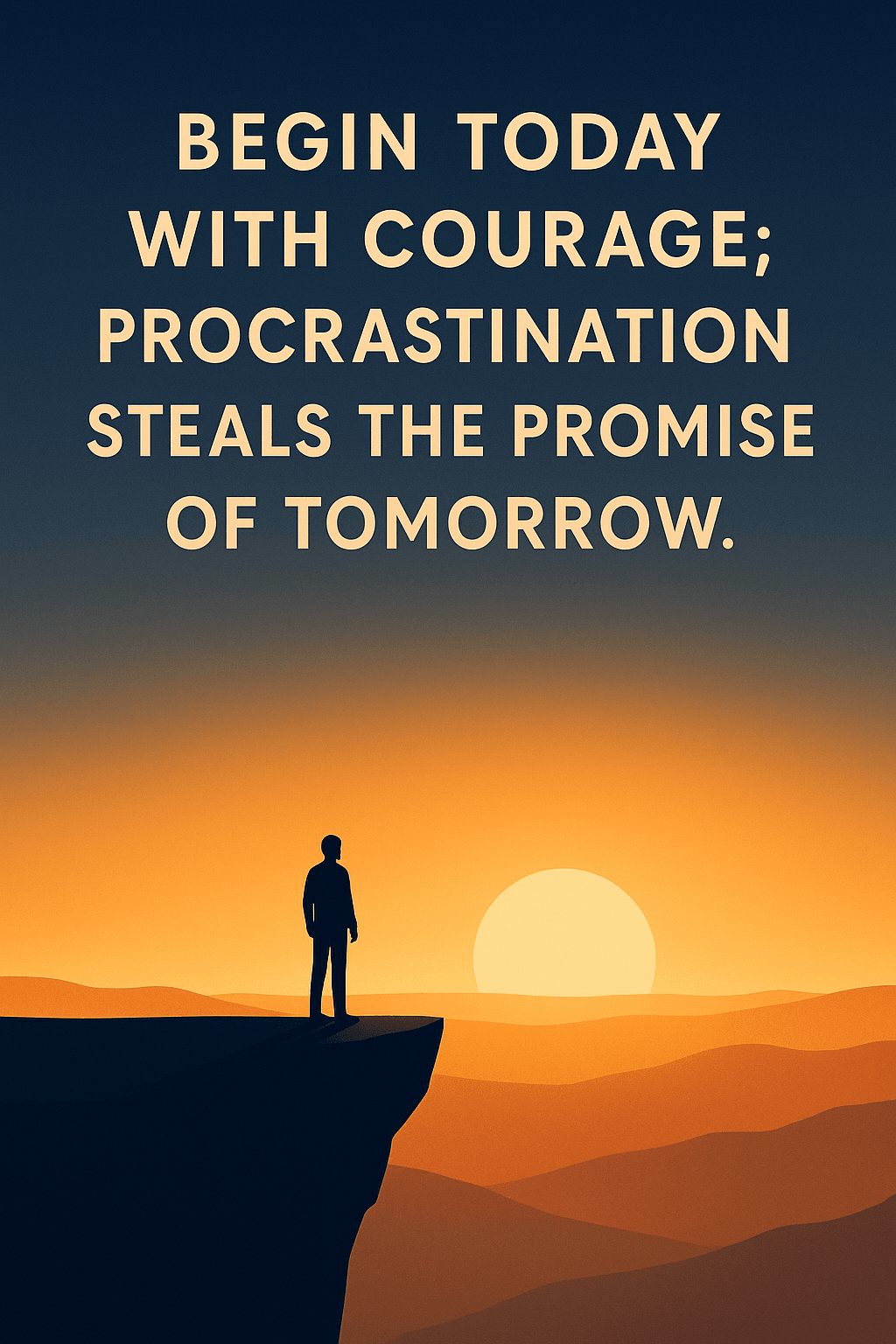
Begin today with courage; procrastination steals the promise of tomorrow — Seneca
—What lingers after this line?
Seneca’s Warning About Lost Tomorrows
Seneca’s injunction to “begin today with courage” captures a core Stoic insight: the future is shaped, and often stolen, by what we fail to do in the present. When he says procrastination “steals the promise of tomorrow,” he is not speaking only of missed deadlines, but of wasted potential. In his letters, especially in *On the Shortness of Life* (c. 49 AD), Seneca argues that life feels short not because we have too little time, but because we squander the time we have. Thus, this quote frames delay not as a harmless habit but as a quiet thief that robs us of the life we might have lived.
Courage as the Antidote to Delay
To understand why courage is placed at the beginning of the sentence, we must see procrastination as a form of fear. We delay difficult conversations, ambitious projects, and necessary changes because they expose us to judgment, failure, or discomfort. By contrast, courage does not eliminate fear; it enables us to act alongside it. The Stoics believed that virtue is revealed in action, not intention, so choosing to start—even imperfectly—becomes a moral act. In this way, courage is not only heroic defiance in crises, but also the quiet decision to write the first page, make the first call, or take the first step today.
The Psychology Behind Procrastination’s Theft
Modern psychology reinforces Seneca’s intuition by describing procrastination as an “emotion regulation problem” rather than a mere time-management flaw. Studies by Piers Steel (*The Procrastination Equation*, 2010) show that we delay tasks that trigger anxiety, boredom, or self-doubt, trading long-term benefits for short-term relief. This emotional bargain makes tomorrow look generous and today unbearably tight, encouraging the illusion that there will always be more time later. Yet, as Seneca would insist, each postponed effort compounds into a future loss—of options, competence, and confidence—quietly eroding the promise that tomorrow once held.
Time, Ownership, and the Stoic Present
For Seneca, the only time we truly own is the present moment. Past time is irretrievable, and future time is uncertain; therefore, to give today away to hesitation is to gamble with the only coin we definitely possess. In *On the Shortness of Life*, he criticizes those who guard their money but freely spend their hours on trivialities, implying that procrastination is a kind of spiritual negligence. By beginning today with courage, we reclaim ownership of our schedule and, more importantly, of our character. Each decisive action affirms that we are stewards—not victims—of our allotted time.
Practical Ways to Begin with Courage
Translating this philosophy into daily practice means reducing the distance between intention and action. One practical approach is to identify a single meaningful task and commit to just five minutes of courageous effort, lowering the emotional barrier to starting. Another is to ask, in Seneca’s spirit, “If today were all I had, what would deserve my energy?” This question shifts focus from vague future hopes to concrete present choices. Over time, small acts of timely bravery—sending the application, initiating reconciliation, starting the routine—accumulate into a life where tomorrow’s promise is preserved rather than plundered by delay.
Redefining Success as Timely Action
Ultimately, Seneca invites us to redefine success not as grand achievement, but as the willingness to act when action is called for. While outcomes are never fully in our control, the decision to start today always is. By measuring ourselves by our readiness to take the next right step, we weaken procrastination’s grip and strengthen our sense of agency. In this light, every courageous beginning—no matter how modest—becomes a quiet victory over the theft of time, ensuring that tomorrow remains a field of possibility rather than a cemetery of postponed intentions.
Recommended Reading
As an Amazon Associate, we earn from qualifying purchases.
One-minute reflection
Why might this line matter today, not tomorrow?
Related Quotes
6 selectedGrow courage by practicing small choices that favor your better self — Seneca
Seneca
At the outset, Seneca’s counsel frames courage not as a thunderclap but as an accretion: the result of many minor decisions that, taken together, lean toward one’s better self. Instead of waiting for heroic moments, he s...
Read full interpretation →We grow taller by stretching toward what scares us. — Seneca
Seneca
Seneca’s line suggests growth happens at the edge of fear. In Stoic practice, adversity is not an enemy but a training partner.
Read full interpretation →To begin again is not a weakness; it is the most courageous act you can perform when the weight of the past becomes too heavy to carry. — Rupi Kaur
Rupi Kaur
At first glance, starting over can look like failure, as though one has lost ground and must return to the beginning. Yet Rupi Kaur’s line overturns that assumption by framing renewal as an act of bravery rather than sur...
Read full interpretation →I have accepted fear as part of life, especially the fear of change. I have gone ahead despite the pounding in the heart that says: turn back. — Erica Jong
Erica Jong
Erica Jong’s statement begins with an act of realism rather than defeat: she does not claim to conquer fear, only to accept it as part of life. That distinction matters, because it shifts courage away from fearlessness a...
Read full interpretation →It is not the critic who counts; not the man who points out how the strong man stumbles. The credit belongs to the man who is actually in the arena. — Theodore Roosevelt
Theodore Roosevelt
Roosevelt draws an immediate line between observation and participation, arguing that commentary alone is not the measure of character. The “critic” may be eloquent, even accurate about mistakes, yet still remains safely...
Read full interpretation →I like work; it fascinates me. I can sit and look at it for hours. — Jerome K. Jerome
Jerome K. Jerome
Jerome K. Jerome’s quip turns a familiar virtue—loving work—into a sly confession: he loves it most as a spectator.
Read full interpretation →More From Author
More from Seneca →To bear trials with a calm mind robs misfortune of its strength and burden. — Seneca
Seneca’s line captures a central Stoic conviction: suffering is made heavier not only by events themselves, but by our agitation before them. To bear trials with a calm mind is not to deny pain; rather, it is to refuse p...
Read full interpretation →How does it help to make troubles heavier by bemoaning them? — Seneca
At its core, Seneca’s question exposes a habit that feels natural but rarely helps: lamenting hardship as though complaint could lighten it. Instead, he suggests that bemoaning suffering often adds a second burden to the...
Read full interpretation →He who suffers before it is necessary suffers more than is necessary. — Seneca
At its core, Seneca’s line warns that much of human suffering is self-inflicted long before reality demands it. The quote distinguishes between necessary pain—the hardship actually encountered—and imagined pain, which ar...
Read full interpretation →The mind that is anxious about future events is miserable. — Seneca
Seneca’s line targets a specific kind of suffering: the pain produced not by what is happening, but by what might happen. An anxious mind lives in a projected tomorrow, rehearsing losses, embarrassments, and disasters th...
Read full interpretation →