
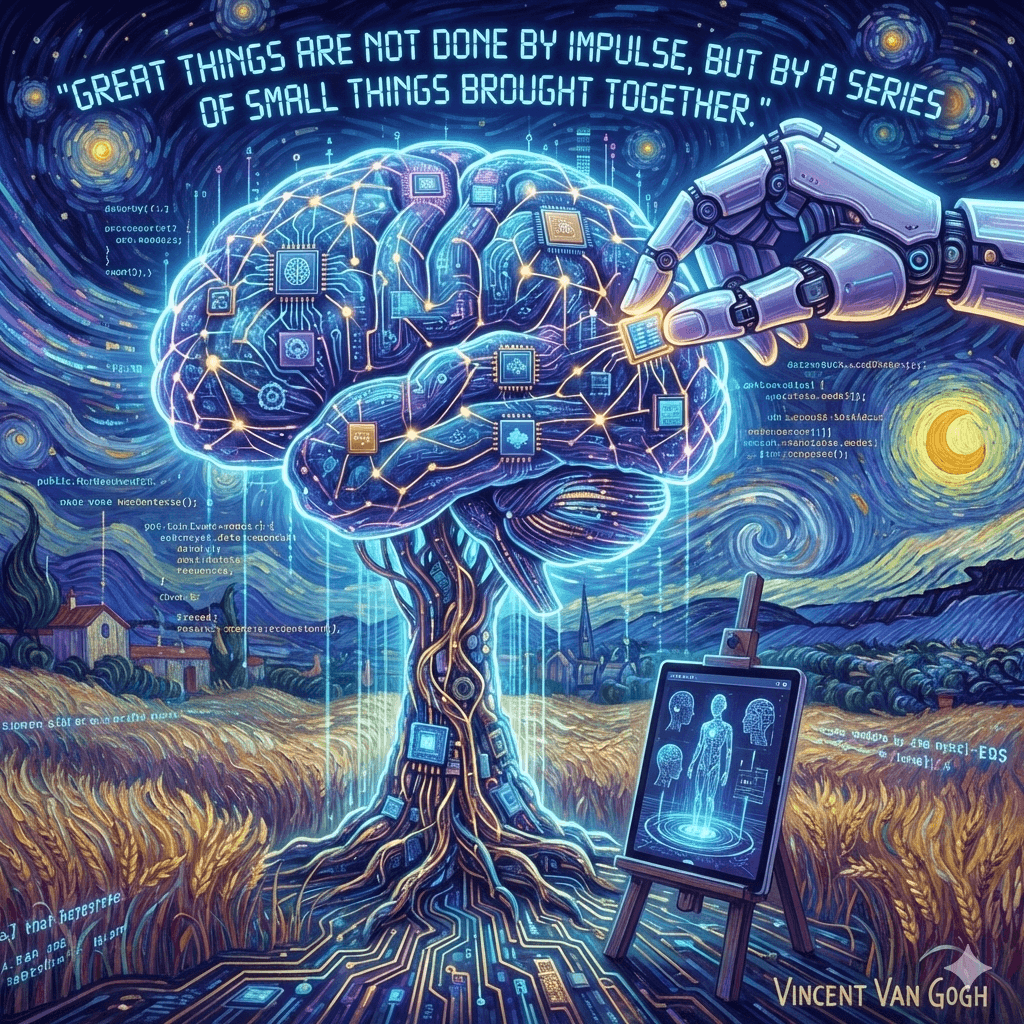
Great things are not done by impulse, but by a series of small things brought together. — Vincent Van Gogh
—What lingers after this line?
A Blueprint for Real Achievement
Van Gogh’s line reframes “greatness” as an accumulation rather than a lightning strike. Instead of crediting sudden inspiration, he points to the quieter architecture of progress: small actions arranged with patience until they become something substantial. In that sense, the quote doubles as encouragement and correction—encouragement for anyone moving slowly, and correction for the belief that only dramatic leaps matter. This perspective naturally shifts attention from grand moments to daily practice. If great things are “brought together,” then the work is less about waiting for the perfect impulse and more about reliably adding one more piece to the whole.
Van Gogh’s Own Method Behind the Myth
The quote also pushes back against the popular myth of the artist as pure spontaneity. Van Gogh’s letters, such as those compiled in “The Letters of Vincent van Gogh” (many written 1870s–1890), show someone intensely deliberate about study, repetition, and craft—working through sketches, color experiments, and disciplined observation. Even when his brushwork looks urgent, it is supported by countless prior trials. Seen this way, his statement is less a moral lesson and more a report from experience. The visible “great thing”—a painting that feels alive—emerges from many smaller decisions made before the final canvas ever appears coherent.
Why Impulse Feels Powerful but Fades
Impulse can be useful as a spark, but Van Gogh warns against mistaking a spark for a fire. A burst of motivation often lacks endurance: it can start a project, yet it rarely carries someone through setbacks, boredom, or the long middle where results are still invisible. By contrast, small steps don’t require constant emotional intensity; they only require enough commitment to keep returning. From there, a practical implication follows: if you rely on impulse, you will work only when you feel ready. If you rely on small actions, you become the kind of person who progresses even when readiness never arrives.
Compounding: The Hidden Engine of Excellence
The “series of small things” is essentially a description of compounding. One sketch improves the next; one draft makes revision possible; one conversation makes the following meeting sharper. Over time, tiny improvements stack into expertise, and the end result can look like genius to outsiders who did not witness the incremental buildup. This is why sustained practice can be surprisingly transformative. A single 1% improvement feels trivial in isolation, yet repeated across weeks and months, it changes what you can produce—and, importantly, what you believe you are capable of attempting.
Assembling the Pieces into a Coherent Whole
Still, Van Gogh doesn’t celebrate smallness for its own sake; he emphasizes “brought together.” That phrase highlights integration: the small parts must connect into a larger design. In creative work, that might mean unifying studies into a final composition; in business, it might mean aligning hiring, product, and customer feedback into one strategy. Consequently, the quote suggests a rhythm: do the small tasks, then periodically step back to arrange them. Great outcomes appear when consistent effort is paired with occasional synthesis—moments where the pieces are evaluated, reordered, and made to serve a single purpose.
A Practical Ethic of Patience and Persistence
Ultimately, the quote offers a humane standard for ambition. It allows greatness to be built by ordinary days rather than extraordinary moods, which makes it accessible without making it easy. The discipline is not heroic impulse but steady return: one more page, one more study, one more attempt. And because small steps are repeatable, they create resilience. When one effort fails, the series continues; you can add the next small thing. Over time, that persistence becomes its own kind of artistry—an art of showing up until the pieces finally resemble the “great thing” you set out to make.
One-minute reflection
Where does this idea show up in your life right now?
Related Quotes
6 selectedGreat things are done by a series of small things brought together. — Vincent Van Gogh
Vincent van Gogh
This quote emphasizes that significant achievements are the result of many smaller efforts combined. Success is not often the result of a single grand action but rather the accumulation of numerous small steps.
Read full interpretation →The small things, if put together, are greater than the big things. - Henry Barbusse
Henry Barbusse
This quote highlights the collective power of small actions or elements. Individually, they may seem insignificant, but when combined, they surpass larger, seemingly more important things.
Read full interpretation →Every small step in the right direction counts. — Unknown
Unknown
This quote emphasizes that even minor progress is valuable. Every small action taken towards a goal accumulates and contributes to overall success.
Read full interpretation →A mountain is not conquered in a day. Each step, no matter how small, is a victory in itself. The summit is the destination, but the path is where the true essence of the traveler is forged.
Unknown
This quote emphasizes that significant achievements take time and effort. Progress may be slow, but each small step forward is important and should be celebrated as a success.
Read full interpretation →Build with attention: steady, exact, and believing in small progress. — Susan Sontag
Susan Sontag
Sontag’s imperative wraps three virtues—attention, steadiness, and exactness—inside a quiet faith in incremental gains. Rather than promising breakthroughs, she recommends a temperament: look closely, move deliberately,...
Read full interpretation →Take action, every day, and you will find that the smallest step can lead to the greatest journey. — Auliq Ice
Auliq Ice
This quote emphasizes that taking consistent action, no matter how small, is essential for achieving goals and initiating change in one’s life.
Read full interpretation →More From Author
More from Vincent van Gogh →Learning technique is a way to make your soul grow. So do it. — Vincent van Gogh
Van Gogh’s brief statement turns learning into more than a practical task; it becomes an ethical and spiritual imperative. By saying that learning technique helps the soul grow, he suggests that disciplined study does no...
Read full interpretation →A great fire burns within me, but no one stops to warm themselves at it, and passers-by only see a wisp of smoke. — Vincent van Gogh
Van Gogh’s image begins with a painful contrast: immense inner warmth exists, yet it goes unreceived. The “great fire” suggests passion, generosity, and creative force, while the absence of anyone who “stops to warm them...
Read full interpretation →I cannot rest, I must draw, however poor the result, and when I have a bad time come over me it is a stronger desire than ever. — Vincent van Gogh
Van Gogh’s words present drawing not as a hobby or even a disciplined profession, but as an inner command he cannot silence. The phrase “I must draw” carries the force of survival, suggesting that artistic creation answe...
Read full interpretation →As we advance in life it becomes more and more difficult, but in fighting the difficulties the inmost strength of the heart is developed. — Vincent van Gogh
Van Gogh’s sentence begins with a sober observation: life does not necessarily become simpler as we grow older. Instead, responsibilities deepen, losses accumulate, and choices carry heavier consequences.
Read full interpretation →