
When Fear Says Pause, Let Hope Try
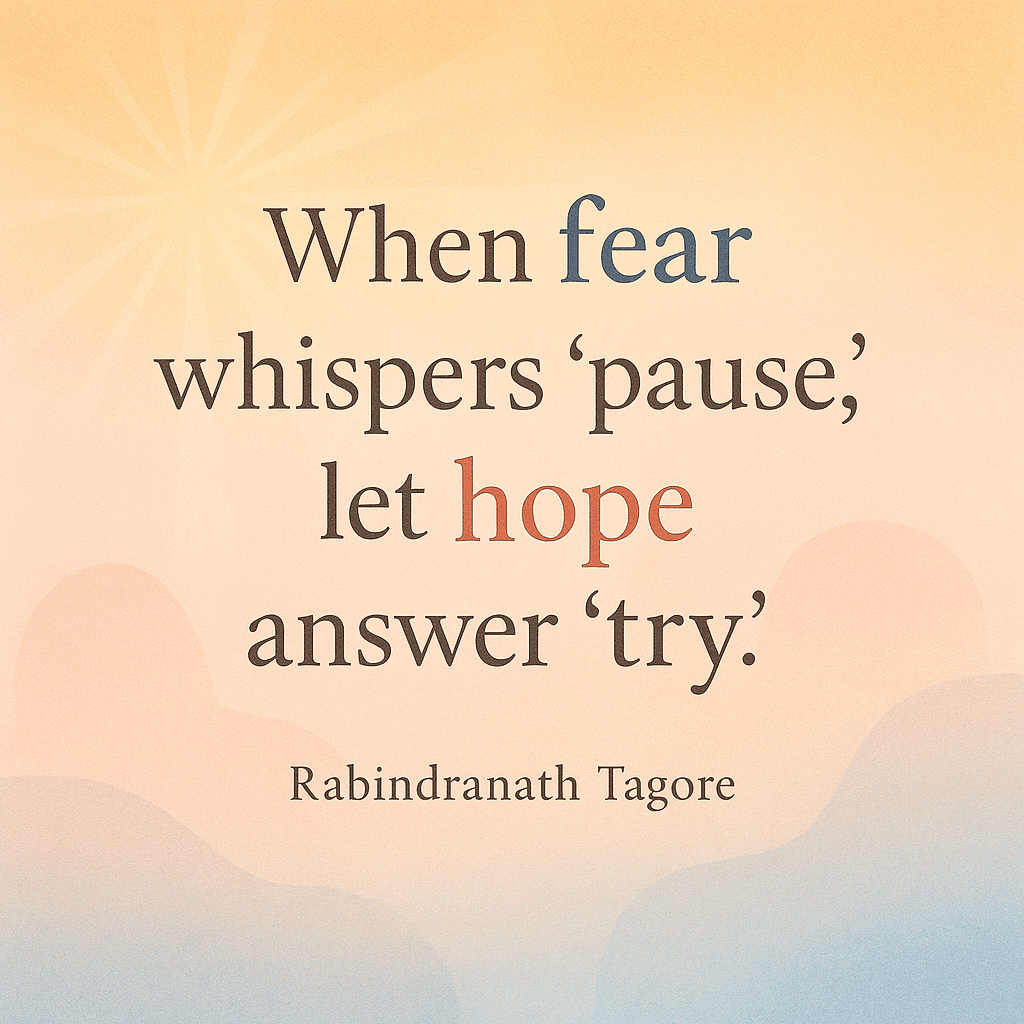
When fear whispers 'pause,' let hope answer 'try'. — Rabindranath Tagore
—What lingers after this line?
A Dialogue Between Inner Voices
Tagore’s line stages a quiet yet powerful drama within the human mind: fear whispers “pause,” while hope responds “try.” Rather than depicting emotions as vague moods, he personifies them as conversational partners, each offering competing advice at moments of decision. This inner dialogue is familiar to anyone who has stood at the edge of change, sensing both the pull of possibility and the tug of caution. By framing the conflict as a call-and-response, Tagore suggests that our choices emerge not from a single dominant feeling, but from how we answer the feelings that speak to us. Fear speaks first, but the quotation clarifies that the story is not complete until hope has replied.
Fear’s Protective Caution and Its Limits
To understand why fear whispers “pause,” it helps to see fear not only as an enemy, but as a guardian. Biologically, fear evolved to protect us from danger, prompting hesitation before we step into the unknown. In this sense, the whisper to pause is often a prudent warning, similar to the internal alarm that stops a child from touching fire. Yet, as psychologists note, the same mechanism can overfire, turning reasonable caution into chronic avoidance. When fear generalizes from real threats to imagined failures or social judgment, the protective pause becomes a paralyzing stop. Tagore does not condemn fear outright; instead, he acknowledges its voice while refusing to let it have the last word.
Hope as the Courage to Act
Against fear’s gentle command to halt, Tagore sets hope’s simple answer: “try.” Hope does not guarantee success; it merely opens the door to action. Philosophers from William James to existentialist thinkers have argued that many truths about our lives can only be discovered by committing ourselves first and understanding later. Likewise, Tagore’s hope is not naïve optimism but a willingness to move with incomplete information, trusting that meaning often unfolds through effort. The word “try” is modest and unheroic, yet it embodies a profound courage—the resolve to take one more step, attempt one more time, or explore one more path when certainty is unavailable.
Moments of Decision and the Edge of Growth
This tension between pausing and trying becomes especially vivid at turning points: choosing a career, starting a relationship, or sharing an unpopular idea. In such moments, fear whispers about what might go wrong—rejection, embarrassment, loss—while hope imagines what might go right. Developmental psychology often describes growth as occurring at the “edge of competence,” where tasks are challenging but not impossible. Tagore’s counsel directs us to that edge: instead of surrendering to paralysis, we allow hope to push us just far enough past our comfort zone to learn. Thus, the quote becomes a guide for navigating transitions, suggesting that meaningful change begins with a small, hopeful experiment.
Tagore’s Humanism and the Ethics of Hope
Placed within Tagore’s broader humanist philosophy, the quote reflects his enduring faith in the human spirit’s capacity to renew itself. In works like “Gitanjali” (1910), he often portrays hope as a spiritual force that connects individuals to a larger horizon of possibility. Here, urging hope to answer fear is not only a psychological strategy but an ethical stance: a refusal to let despair dictate our contribution to the world. When we choose “try” over endless “pause,” we affirm both our own agency and our responsibility to act, even imperfectly. In this way, Tagore transforms a brief inner exchange into a lifelong practice of courageous, hope-driven living.
Integrating Pause and Try in Everyday Life
Finally, Tagore’s wording suggests not an outright muting of fear, but a sequence: first the pause, then the try. In practical terms, this can mean allowing a moment of reflection—assessing risks, gathering information—before letting hope nudge us forward. A person considering a career shift might listen to fear’s concerns about stability, then let hope frame those concerns as design challenges rather than barriers. In everyday choices, the healthiest path often blends both voices: fear slows us enough to be thoughtful; hope ensures we do not stall indefinitely. By inviting hope to answer fear, Tagore offers a balanced approach in which caution and courage cooperate to move us toward a fuller, more engaged life.
Recommended Reading
As an Amazon Associate, we earn from qualifying purchases.
One-minute reflection
Why might this line matter today, not tomorrow?
Related Quotes
6 selectedBreathe courage; the rest will learn to follow — Rabindranath Tagore
Rabindranath Tagore
Tagore’s line, “Breathe courage; the rest will learn to follow,” begins with the intimate image of breath. By tying courage to something as fundamental as breathing, he suggests it is not an external add‑on but a primary...
Read full interpretation →Build bridges with your hands and sow hope with your heart — Rabindranath Tagore
Rabindranath Tagore
Tagore’s image pairs tangible action with inner intention: hands build what people can cross; hearts cultivate what people can trust. By invoking bridges and seeds, he marries engineering to agriculture, suggesting that...
Read full interpretation →Some years ask you to survive before they ask you to dream. — Maggie Smith
Maggie Smith.
At its core, Maggie Smith’s line recognizes a painful truth: not every season of life is built for possibility. Some years demand endurance first, asking us to pay attention to basic emotional, financial, or physical sur...
Read full interpretation →There is hope, even when your brain tells you there isn't. — John Green
John Green
John Green’s line begins by acknowledging a familiar conflict: the mind can deliver convincing arguments for despair, yet hope can still exist alongside them. Rather than treating hope as a naïve feeling, he frames it as...
Read full interpretation →Courage is less about fearlessness than training the mind to act with clarity and conviction. — Ranjay Gulati
Ranjay Gulati
Ranjay Gulati’s line begins by overturning a common myth: that courage belongs to people who simply don’t feel afraid. Instead, he frames fear as normal—and even expected—while locating courage in what happens next.
Read full interpretation →No one should fear shadows. It simply means there's a light shining somewhere nearby. — Gabriel García Márquez
Gabriel García Márquez
Gabriel García Márquez turns a common source of unease into a quiet reassurance: shadows are not threats in themselves, but evidence. When we fear shadows, we often respond to what is vague, enlarged, or half-seen—our mi...
Read full interpretation →More From Author
More from Rabindranath Tagore →Opinions are nothing; better is the self-contained calm of true realization. — Rabindranath Tagore
Tagore’s line draws a sharp contrast between what people say and what a person is. “Opinions” are portrayed as weightless—changeable, socially contagious, and often untethered from lived truth—while “true realization” im...
Read full interpretation →The butterfly counts not months but moments, and has time enough. — Rabindranath Tagore
Tagore’s line immediately reframes time as something felt rather than counted. The butterfly does not live by calendars or long-term schedules; it lives by what is available right now.
Read full interpretation →Rest belongs to the work as the eyelids to the eyes. — Rabindranath Tagore
Tagore’s image is deceptively simple: eyelids are not an extra feature of the eye but part of how seeing works. In the same way, rest is not an optional reward after labor; it is built into the very functioning of meanin...
Read full interpretation →Sing with your hands and teach the world by doing. — Rabindranath Tagore
Tagore’s line begins with a paradox that clarifies his intent: to “sing with your hands” suggests a song made not of sound but of visible, tangible motion. In other words, expression is not limited to words; it can be ca...
Read full interpretation →