
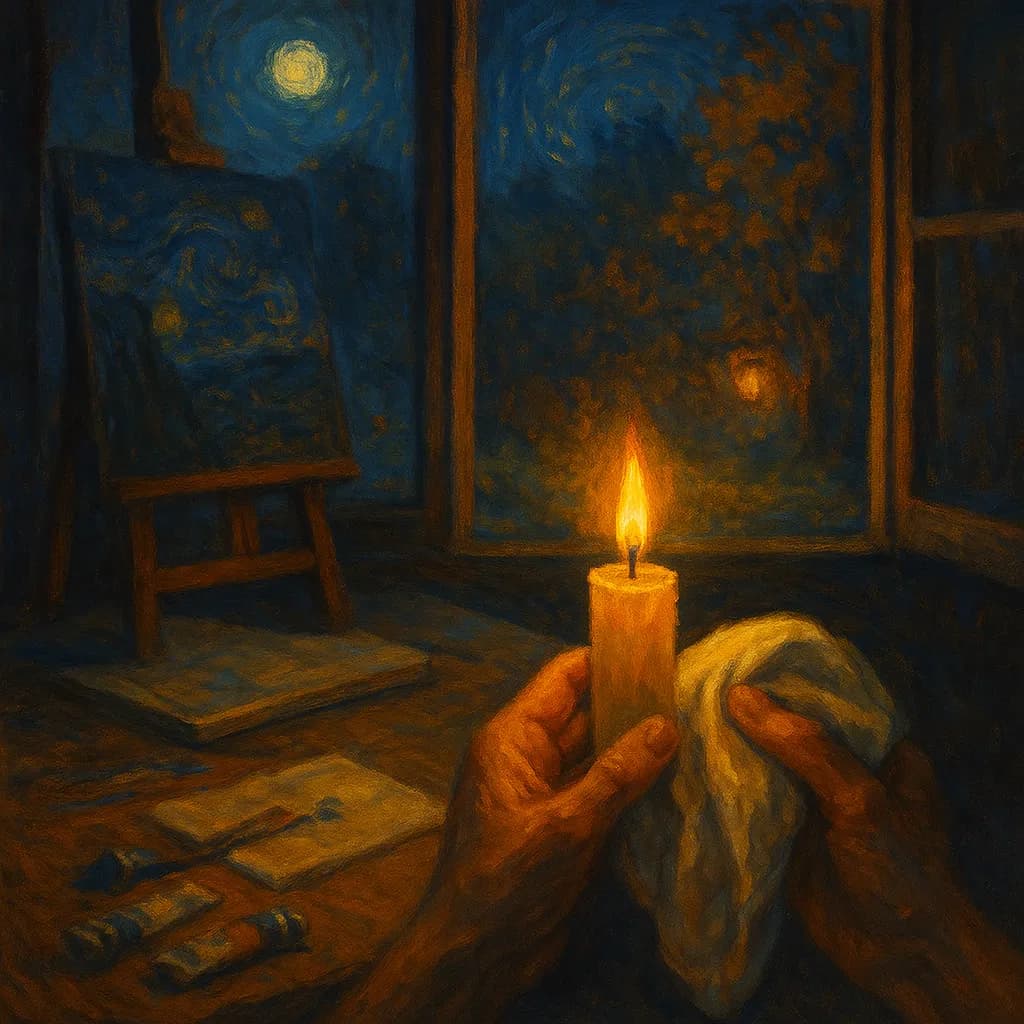
Work with urgency and tenderness; creation needs both flame and care. — Vincent van Gogh
—What lingers after this line?
A Twofold Command for Making
Van Gogh’s line reads like a practical creed: work fast enough that the moment doesn’t cool, yet gently enough that the work isn’t bruised by haste. Urgency and tenderness are not competing moods here but paired tools, each correcting the other’s excess. Without urgency, creation can stall in endless preparation; without tenderness, it can become forceful and brittle. From this starting point, the quote frames creativity as a discipline rather than a muse—something you choose repeatedly. The phrasing “needs both” makes it sound less like advice and more like a requirement of the craft itself, as if the work has its own ecology that must be respected.
Flame: The Necessity of Speed and Risk
The word “flame” suggests more than energy; it implies a window of time in which something is burningly possible. In artistic life, that can mean catching light before it shifts, seizing an idea before doubt buries it, or finishing a draft before self-critique turns into paralysis. Van Gogh’s own practice—working intensely and producing in rapid bursts—often carried this kind of combustible momentum. Yet flame is also dangerous. Because urgency can tip into recklessness, it benefits from a second force that makes it sustainable. This leads naturally to tenderness, which functions like a safeguard that lets passion remain productive rather than destructive.
Care: Precision, Patience, and Respect for the Work
Tenderness is not softness in the sense of lowered standards; it is attentive contact. It means treating the materials, the subject, and even one’s imperfect attempts as worthy of careful handling. In practice, tenderness can look like revising without contempt, adjusting a brushstroke rather than attacking it, or allowing an experiment to be unfinished without declaring it a failure. Because creation involves vulnerability—showing what you saw, felt, or thought—care becomes a kind of ethical stance toward your own interior life. Once that stance is adopted, urgency becomes less frantic: you work quickly, but you do not punish yourself to do so.
Why Creation Requires Both at Once
The quote’s power comes from its insistence on simultaneity: not flame then care, or care then flame, but both together. Urgency provides forward motion; tenderness provides continuity. One is the impulse to begin and complete; the other is the willingness to listen and refine. When they interlock, you get a rhythm of decisive action followed by humane adjustment. This also explains why creative blocks often feel like the absence of one of the two. If flame is missing, work becomes over-deliberate and bloodless; if care is missing, work becomes rushed, harsh, and difficult to return to. Balanced together, they form a reliable engine.
A Human Psychology of Sustainable Intensity
Seen psychologically, “urgency” aligns with activation—dopamine, novelty, and the drive to pursue—while “tenderness” aligns with regulation—self-compassion, patience, and the ability to tolerate imperfection. Modern conversations about burnout echo this pairing: intensity without care consumes the maker, and care without intensity can drift into avoidance. Van Gogh’s phrasing anticipates this by treating creative output as something that must be protected as it is produced. In other words, tenderness is not a break from work; it is part of the work’s survival strategy. With that in place, urgency can stay bright without becoming corrosive.
Practicing the Quote in Everyday Creative Work
A simple way to live this principle is to separate speed from violence. You might draft quickly—giving the flame its full permission—then revise gently, asking what the piece is trying to become rather than what you did wrong. A composer can sketch themes in one sitting and orchestrate later with meticulous care; a writer can sprint a first draft and edit with patience; a painter can block in forms boldly and return to edges and light with tenderness. Ultimately, van Gogh’s sentence offers a compassionate urgency: a reminder that the world does not wait, but neither should the maker be sacrificed to the making. When flame and care cooperate, creation becomes both alive in the moment and capable of lasting.
One-minute reflection
Where does this idea show up in your life right now?
Related Quotes
6 selectedLife is too short to be subtle — Mary Quant
Mary Quant
Mary Quant’s line begins with a blunt accounting: life is finite, and that fact should change how we show up in the world. If time is scarce, then excessive restraint can become a kind of self-sabotage—postponing honest...
Read full interpretation →Stop acting as if life is a rehearsal. — Marcus Aurelius
Marcus Aurelius
Marcus Aurelius’ line cuts through a common habit: treating the present like a draft version of life. If we assume the “real” moment is still ahead—after we’re more prepared, more confident, more secure—we postpone the v...
Read full interpretation →Tenderness is not a sign of weakness. It is the signature of a soul that has learned the value of its own heart. — Yung Pueblo
Yung Pueblo
Yung Pueblo opens by challenging a familiar cultural reflex: the assumption that softness equals fragility. In many environments, emotional restraint is treated like armor, while tenderness is misread as a crack in the s...
Read full interpretation →Wear tenderness like armor and act with fierce kindness — Alice Walker
Alice Walker
Alice Walker’s line pivots on a deliberate paradox: armor is meant to harden, yet she asks us to “wear tenderness” as if softness could be protective. By pairing “tenderness” with “armor,” she challenges the assumption t...
Read full interpretation →Dare to be tender in a world that confuses softness with weakness. — Emily Dickinson
Emily Dickinson
Dickinson’s line begins with a verb of courage: “Dare.” From the outset, tenderness isn’t presented as a personality trait you either have or lack, but as a choice that carries consequences. To be tender is to remain ope...
Read full interpretation →Find the work that wakes your joy, and do it with stubborn tenderness — Helen Keller
Helen Keller
Helen Keller’s line begins by treating joy as more than a fleeting mood—it becomes an instrument of direction. The “work that wakes your joy” implies something latent inside you, not manufactured on command, that rises w...
Read full interpretation →More From Author
More from Vincent van Gogh →Learning technique is a way to make your soul grow. So do it. — Vincent van Gogh
Van Gogh’s brief statement turns learning into more than a practical task; it becomes an ethical and spiritual imperative. By saying that learning technique helps the soul grow, he suggests that disciplined study does no...
Read full interpretation →A great fire burns within me, but no one stops to warm themselves at it, and passers-by only see a wisp of smoke. — Vincent van Gogh
Van Gogh’s image begins with a painful contrast: immense inner warmth exists, yet it goes unreceived. The “great fire” suggests passion, generosity, and creative force, while the absence of anyone who “stops to warm them...
Read full interpretation →I cannot rest, I must draw, however poor the result, and when I have a bad time come over me it is a stronger desire than ever. — Vincent van Gogh
Van Gogh’s words present drawing not as a hobby or even a disciplined profession, but as an inner command he cannot silence. The phrase “I must draw” carries the force of survival, suggesting that artistic creation answe...
Read full interpretation →As we advance in life it becomes more and more difficult, but in fighting the difficulties the inmost strength of the heart is developed. — Vincent van Gogh
Van Gogh’s sentence begins with a sober observation: life does not necessarily become simpler as we grow older. Instead, responsibilities deepen, losses accumulate, and choices carry heavier consequences.
Read full interpretation →