
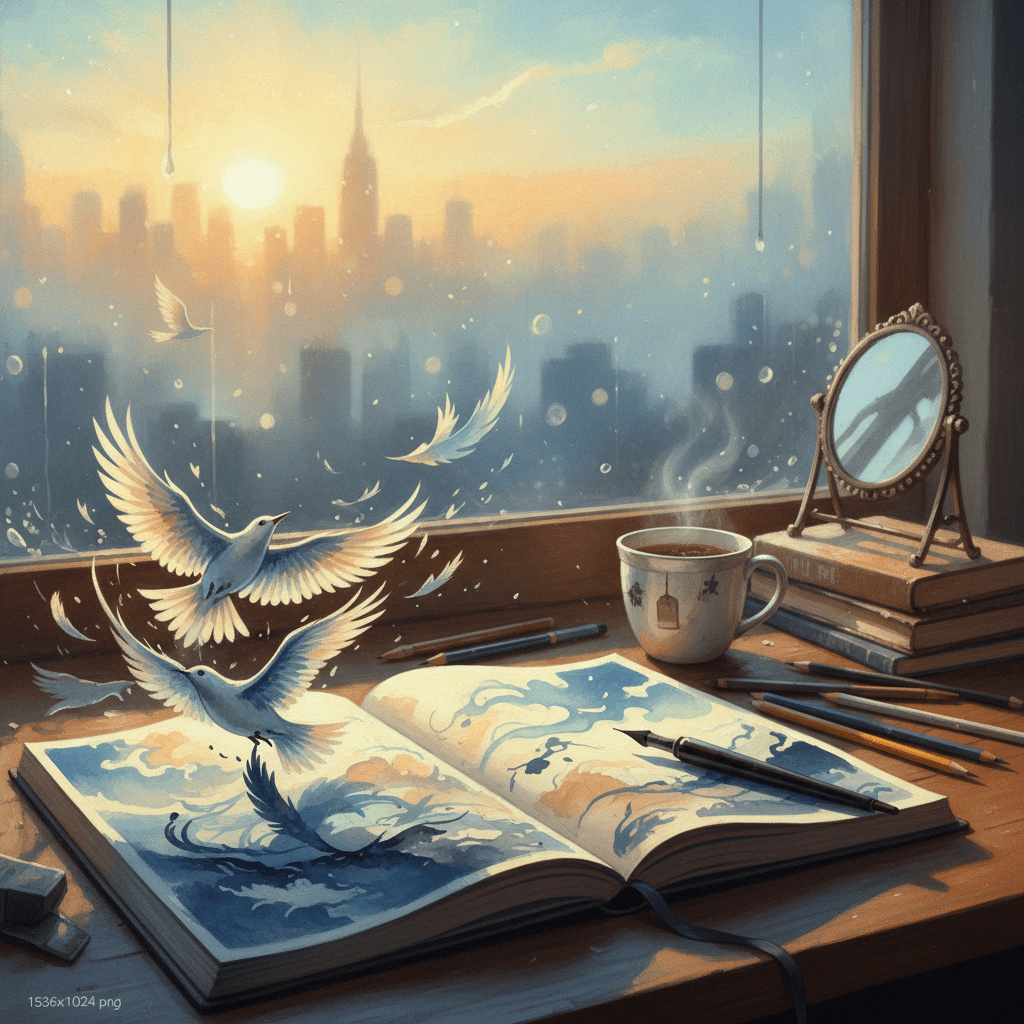
Sketch your days with daring strokes; intimacy with yourself paints freedom. — Anaïs Nin
—What lingers after this line?
Life as a Work in Progress
Anaïs Nin frames daily living as an artistic act: to “sketch your days” suggests that life is not merely endured or recorded, but deliberately composed. The phrase “daring strokes” implies risk—choices made without waiting for perfect certainty, like an artist committing ink to paper knowing it cannot be erased. In this way, the quote opens by shifting responsibility back to the individual: your ordinary hours are the canvas where meaning is made. From there, Nin nudges us toward a crucial question: what keeps our strokes timid? Often it is not a lack of talent or opportunity, but the fear of disapproval and the habit of postponing the life we actually want to live.
The Courage to Choose Your Palette
If days are sketches, then habits, commitments, and boundaries become the palette. “Daring” doesn’t necessarily mean reckless adventure; it can mean the quieter bravery of selecting what matters and declining what doesn’t. A person might take a new job, begin writing at dawn, or end a draining friendship—each a bold line that changes the composition of the week. This is where the quote’s first half naturally turns toward inner authority. Rather than letting the world dictate the colors, Nin suggests you decide what deserves emphasis, even if the result looks unlike anyone else’s idea of a well-drawn life.
Intimacy With Yourself as a Practice
The quote then pivots inward: “intimacy with yourself” points to a relationship that must be cultivated, not assumed. Self-intimacy is the skill of noticing what you feel, want, and fear without immediately performing for an audience or escaping into distraction. Nin’s own diaries, later published as The Diary of Anaïs Nin (1931–1974), model this kind of interior candor—using reflection to turn confusion into clarity. As a result, daring becomes less about proving something and more about listening accurately. When you can name your desires and limits, your choices stop being imitations and start becoming expressions.
Why Self-Knowledge Produces Freedom
Nin’s most striking claim is that this inner intimacy “paints freedom.” The metaphor matters: freedom is not announced like a slogan; it is gradually created, layer by layer, through attention and honest self-contact. When you understand your triggers, values, and longings, you become harder to manipulate—by trends, guilt, or the need to be liked. In practical terms, someone who knows they are lonely might choose community over prestige; someone who knows they are overextended might protect rest without apology. In this sense, freedom isn’t the absence of constraints, but the presence of alignment.
Daring Without Losing Yourself
However, “daring strokes” can also become performative if they are made to impress rather than to express. The quote’s second half works as a safeguard: intimacy with yourself ensures boldness remains rooted. Instead of chasing intensity for its own sake, you act from a center that understands what you are actually seeking—growth, love, mastery, peace. This balance echoes a timeless artistic discipline: the strongest compositions pair energy with structure. Likewise, the freest life is rarely chaotic; it is often one where courageous choices are guided by self-trust, not by impulse.
A Daily Method: Sketch, Reflect, Adjust
Taken together, Nin offers a simple rhythm. First, sketch the day with one deliberate, courageous act—speak honestly, start the project, take the walk, set the boundary. Then, return to yourself through reflection: a journal entry, a quiet pause, a truthful conversation. Finally, adjust the next day’s sketch based on what you learned, rather than repeating yesterday out of inertia. Over time, this creates a compounding effect: daring expands your sense of possibility, and self-intimacy keeps that expansion coherent. The freedom Nin describes is therefore not a destination, but an evolving portrait you repaint each day.
One-minute reflection
What feeling does this quote bring up for you?
Related Quotes
6 selectedEach day is a blank canvas; paint on it the life you desire.
Unknown
This quote emphasizes the potential each day holds. Every dawn brings a fresh start, offering countless opportunities to shape your life according to your wishes and goals.
Read full interpretation →Before complaining that you are a slave to another, be sure that you are not a slave to self. — James Allen
James Allen
James Allen’s warning begins with a reversal: the most immediate master may not be another person, institution, or circumstance, but one’s own impulses. Before condemning external control, he asks us to examine whether a...
Read full interpretation →There is no must in art because art is free. — Wassily Kandinsky
Wassily Kandinsky
At its core, Kandinsky’s statement rejects the idea that art must obey fixed obligations. By saying there is no ‘must’ in art, he frees creation from rigid formulas, academic demands, and social expectation.
Read full interpretation →Often what the artist expresses is unconscious, but we can learn to decode the story by collaboratively finding the pieces to the puzzle that create new possibilities for innovation. — Ben Okri
Ben Okri
At the heart of Ben Okri’s statement is the idea that art often says more than the artist consciously intends. A poem, painting, or song may carry hidden fears, cultural memories, or emotional truths that emerge without...
Read full interpretation →I think that when you create something, you leave a part of yourself in it. — Henri Matisse
Henri Matisse
At its core, Matisse’s reflection suggests that making anything—a painting, a poem, a song, even a room—inevitably transfers something inward into outward form. Creation is not merely the arrangement of materials; rather...
Read full interpretation →There is a deep peace that comes from creating something that didn't exist before. It is your way of telling the universe that you were here, and you felt something. — Maya Angelou
Maya Angelou
At its heart, Maya Angelou’s reflection suggests that creation is not merely productive but restorative. To make something that did not exist before—a poem, a garden, a melody, even a repaired room—is to experience a rar...
Read full interpretation →More From Author
More from Anaïs Nin →Perfection is static, and I am in full progress. — Anaïs Nin
Anaïs Nin’s line immediately contrasts two ways of being: perfection, which she calls static, and progress, which she embraces as alive and ongoing. In that contrast, she challenges the common fantasy that a flawless sel...
Read full interpretation →Each friend represents a world in us, a world possibly not born until they arrive, and it is only by this meeting that a new world is born. — Anais Nin
Anaïs Nin’s reflection begins with a striking premise: each person contains unrealized possibilities, as though entire inner worlds lie dormant beneath ordinary life. In this view, friendship is not merely companionship...
Read full interpretation →We are the architects of our own perception; the world looks the way we choose to frame it. — Anais Nin
Anaïs Nin’s statement begins with a striking reversal: instead of treating perception as a passive mirror, she presents it as an act of construction. In other words, we do not simply receive the world; we organize, inter...
Read full interpretation →Where people fail is that they wish to elect a state and remain in it. — Anaïs Nin
Anaïs Nin points to a common human temptation: treating life as a set of destinations rather than an unfolding process. We imagine that if we can finally “elect a state”—confidence, happiness, success, certainty—we can s...
Read full interpretation →