
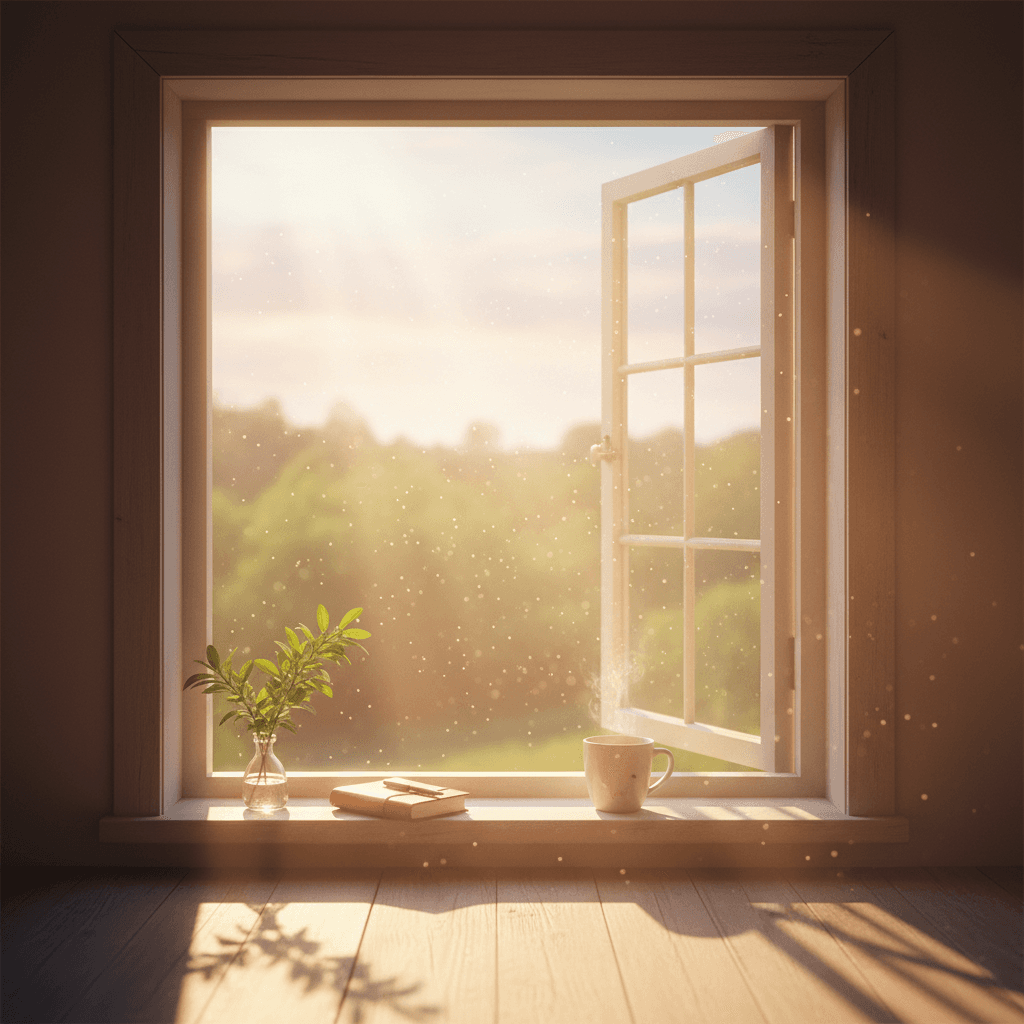
Open one window of wonder each day and the light of possibility will rush in. — Gabriel García Márquez
—What lingers after this line?
Wonder as a Daily Practice
García Márquez frames wonder not as a rare accident, but as something you can choose—one “window” at a time. The image suggests a small, deliberate action: a pause, a question, a moment of attention. In that sense, wonder becomes a practice of noticing rather than a talent you either have or lack. From there, the quote implies consistency matters more than scale. You don’t need to overhaul your life to feel renewed; you need a daily opening—brief but sincere—through which the world can re-enter your awareness.
Why a “Window” Matters
The metaphor of a window is quietly instructive: it creates a boundary between inside and outside, between routine and revelation. A window doesn’t erase walls; it simply offers a vantage point. Likewise, daily wonder doesn’t deny responsibilities—it reframes them by letting in a wider view. As a transition, this also hints at agency. Windows are opened by someone. The quote nudges you to become the caretaker of your own attention, choosing when to let new sights, ideas, and feelings interrupt the closed loop of habit.
The Light of Possibility
When the window opens, “light” rushes in—an image associated with clarity, warmth, and direction. Possibility here isn’t presented as abstract optimism; it is a kind of illumination that changes what you can see. What felt fixed may suddenly look flexible, and what seemed distant may appear reachable. In this way, possibility behaves less like a miracle and more like a shift in perception. Once you notice alternatives, you begin to act differently, and those actions create the very opportunities that once appeared absent.
A Márquez-Like Sensibility of the Everyday
Although the quote stands alone, it resonates with the sensibility often associated with García Márquez’s fiction, where the ordinary and the astonishing coexist. Works like One Hundred Years of Solitude (1967) are frequently read as invitations to see the marvelous within the daily rhythms of life, not only in distant fantasies. Following that logic, wonder is not an escape from reality but an enriched encounter with it. The “window” becomes a way of granting the everyday the dignity of mystery—an attitude that keeps life from hardening into mere repetition.
Small Rituals That Open the Window
Practically speaking, the quote suggests simple rituals: take a different route to work, read a page of poetry, ask someone a question you’ve never asked, or spend three minutes observing the sky. These are modest actions, yet they disrupt the automation of the day and make room for surprise. To illustrate, consider the common experience of overhearing a stranger’s remark that reframes a problem you’ve been stuck on. Nothing “big” happened, but the window opened—and suddenly a new solution felt possible. The rush of light is often that quick.
From Possibility to a More Spacious Life
Over time, opening one window a day compounds. The mind becomes trained to look for alternatives, to expect learning, and to stay permeable rather than defensive. That posture doesn’t guarantee easy outcomes, but it does protect you from the quiet despair of believing that nothing can change. Finally, García Márquez’s line reads like a gentle contract with yourself: offer one daily act of receptivity, and life will answer with more than you predicted. The promise isn’t certainty—it’s spaciousness, the sense that the future still has doors you haven’t tried.
One-minute reflection
What feeling does this quote bring up for you?
Related Quotes
6 selectedMake room for the impossible; sometimes truth blooms where doubt cleared. — Gabriel García Márquez
Gabriel García Márquez
Márquez’s line marries caution to wonder: by clearing space with doubt, we make room for realities we could not previously imagine. Doubt, then, is not mere negation; it is the gardener’s pruning that lets light in.
Read full interpretation →The beauty of the universe is reflected in each star, in each flower, in each being. Whoever keeps wonder in their heart will never cease to be amazed.
Unknown
This quote emphasizes that beauty exists in all aspects of the universe. Whether it's the stars in the sky, the flowers on the ground, or any living creature, everything holds a unique form of beauty.
Read full interpretation →The world is full of possibilities, but you must first believe they are there. — David Bohm
David Bohm
This quote emphasizes that in order to recognize and seize opportunities, one must first believe that they exist. A mindset of possibility is essential to discovering new paths in life.
Read full interpretation →Open a window in your mind and let possibility breeze through — Virginia Woolf
Virginia Woolf
At the outset, the image of opening a mental window suggests deliberate permeability: we choose to unlatch the frame, and in doing so we invite change. This echoes Virginia Woolf’s modernist insistence that consciousness...
Read full interpretation →Hope is passion for the possible. — Søren Kierkegaard
Søren Kierkegaard
At first glance, Kierkegaard’s line transforms hope from a passive feeling into an active force. To call hope “passion for the possible” means that hope is not mere daydreaming; rather, it is an inward energy that leans...
Read full interpretation →I would maintain that thanks are the highest form of thought, and that gratitude is happiness doubled by wonder. — G. K. Chesterton
G. K. Chesterton
Chesterton’s remark begins by elevating gratitude beyond manners and placing it within the life of the mind. To say that thanks are the highest form of thought is to suggest that real intelligence does not end in analysi...
Read full interpretation →More From Author
More from Gabriel García Márquez →No one should fear shadows. It simply means there's a light shining somewhere nearby. — Gabriel García Márquez
Gabriel García Márquez turns a common source of unease into a quiet reassurance: shadows are not threats in themselves, but evidence. When we fear shadows, we often respond to what is vague, enlarged, or half-seen—our mi...
Read full interpretation →Persist like a river: find the cracks and flow through them. — Gabriel García Márquez
García Márquez’s image begins with something ordinary but unstoppable: a river. It doesn’t “win” by force or by arguing with the landscape; it keeps moving, day after day, and that continued motion becomes its power.
Read full interpretation →Imagine boldly, then write the first line with your feet. — Gabriel García Márquez
Gabriel García Márquez’s line, “Imagine boldly, then write the first line with your feet,” begins with an impossibility. No one literally writes with their feet, yet the image lingers because it challenges our sense of w...
Read full interpretation →Carry a quiet rebellion of joy and let it dismantle doubt brick by brick — Gabriel García Márquez
Gabriel García Márquez’s image of a “quiet rebellion of joy” invites us to imagine resistance that does not shout, but endures. Instead of anger or spectacle, this rebellion chooses delight, gratitude, and tenderness as...
Read full interpretation →