
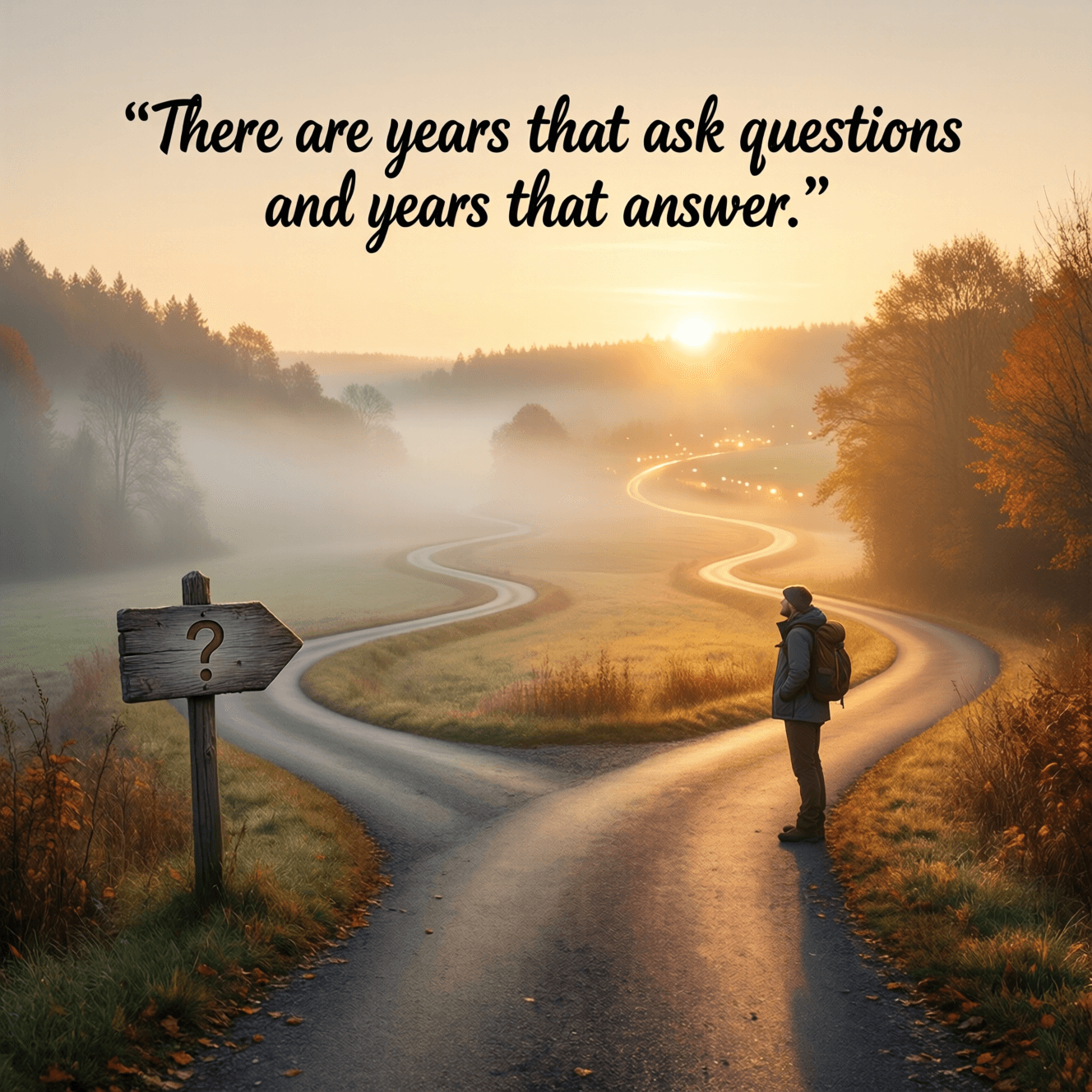
There are years that ask questions and years that answer. — Zora Neale Hurston
—What lingers after this line?
A Calendar With a Personality
Zora Neale Hurston’s line treats time as something more intimate than a sequence of dates: some years interrogate us, and others respond. In that sense, a “questioning” year is not simply difficult, but actively formative—forcing choices, exposing gaps in certainty, and demanding that we define what we value. Conversely, an “answering” year isn’t necessarily easy; it is clarifying, when consequences arrive and patterns finally make sense. From the start, Hurston reframes the passage of time as a dialogue between lived experience and understanding.
The Seasons of Uncertainty
To see how a year can “ask,” think of periods when life becomes all provisional: a move, an illness, a breakup, a new job, a political upheaval. In such years, even routine decisions—where to live, whom to trust, what to pursue—feel like open-ended prompts. This is why the question is often not intellectual but existential: Who am I now, given what has changed? As Hurston implies, the point of the asking is not immediate resolution, but pressure that shapes the self through repeated, sometimes uncomfortable inquiry.
How Answers Actually Arrive
Yet answers rarely come as a single revelation; they accumulate through evidence, repetition, and aftermath. A year “answers” when the results of earlier risks become visible, when grief softens into memory, or when a hard-won skill finally feels natural. In that way, an answering year can be quiet: you notice you’re no longer bracing for impact, or you realize you’ve stopped negotiating with a reality you can’t change. This shift echoes the spirit of Viktor Frankl’s Man’s Search for Meaning (1946), where meaning emerges not from instant certainty but from enduring a process until a clearer stance becomes possible.
Questions and Answers as a Life Rhythm
Importantly, Hurston’s phrasing suggests alternation rather than a permanent state: the asking and answering are phases, not verdicts. That rhythm aligns with older reflections on time and transformation, such as Ecclesiastes 3 (“a time to…,” traditionally dated to the 3rd century BC), which portrays life as a sequence of fitting seasons rather than a linear climb toward closure. Once we accept that rhythm, the presence of unanswered questions becomes less like failure and more like a normal part of the cycle that precedes understanding.
Why the Questions Matter More Than We Admit
Moreover, questioning years often do essential work that can’t be skipped. They reveal what we’ve been avoiding, or what we’ve been living on borrowed assumptions. A common anecdote is the “career-question” year: someone feels restless, tries one brave experiment—taking a class, changing teams, volunteering—and discovers not an instant solution but a sharper set of preferences. The year asks, and the person answers not with a single plan, but with a new capacity to choose. In this way, the question itself becomes a tool that refines perception.
Living So the Answers Can Find You
Finally, Hurston’s insight carries a practical invitation: if some years answer, we should make ourselves available to hear them. That means keeping records, noticing patterns, and leaving room for reflection so that hindsight can do its work—whether through journaling, therapy, prayer, or long conversations with trusted friends. At the same time, it means acting during questioning years, because answers often depend on motion. Over time, the dialogue Hurston describes becomes a kind of wisdom: not the end of uncertainty, but the confidence that time can transform confusion into clarity.
One-minute reflection
What does this quote ask you to notice today?
Related Quotes
6 selectedMaturity of mind is the capacity to endure uncertainty. — John Finley
John Finley
John Finley’s statement reframes maturity as something deeper than confidence or quick judgment. Rather than treating uncertainty as a weakness, he presents the ability to endure it as a mark of inner strength.
Read full interpretation →Do you have the patience to wait until your mud settles and the water is clear? — Lao Tzu
Lao Tzu
Lao Tzu’s question frames patience not as passive delay but as an active kind of wisdom. The image of muddy water settling on its own suggests that confusion often clears not through force, but through restraint.
Read full interpretation →For what matters in life is not whether we receive a round of applause; what matters is whether we have the courage to venture forth despite the uncertainty of acclaim. — Amor Towles
Amor Towles
At its core, Amor Towles shifts attention away from public approval and toward private resolve. The quote argues that a life’s value is not determined by applause—those visible signs of recognition—but by the willingness...
Read full interpretation →You don't lack discipline, you lack clarity. — Ross Harkness
Ross Harkness
Ross Harkness’s line reframes a common personal frustration. People often blame themselves for inconsistency, assuming they are lazy or weak-willed, yet the quote suggests a different problem: they may simply not know ex...
Read full interpretation →Clutter is not just physical; it is the visual noise that prevents us from seeing what truly matters. — Fumio Sasaki
Fumio Sasaki
At first glance, Fumio Sasaki’s remark appears to be about untidy rooms, yet it quickly reaches further. He reframes clutter not merely as an excess of objects but as a form of visual interference that competes for our a...
Read full interpretation →Burnout is more an issue of poor energy management and low clarity than of over-giving. — Rob Bell
Rob Bell
At first glance, burnout is often described as the inevitable cost of caring too much or giving too much. Rob Bell’s statement shifts that assumption by arguing that the deeper problem is not generosity itself, but the m...
Read full interpretation →More From Author
More from Zora Neale Hurston →Longing for a thing is a way of wasting it. — Zora Neale Hurston
Zora Neale Hurston’s line draws a sharp boundary between appreciation and obsession. On the surface, longing seems like evidence of valuing something; yet she suggests it can also be a form of misuse, because the mind tr...
Read full interpretation →If you are silent about your pain, they'll kill you and say you enjoyed it. — Zora Neale Hurston
Hurston’s line is not simply about personal sadness; it is a blunt warning about what happens when suffering is kept private in a world that prefers comfort over confrontation. When pain remains unspoken, it can be treat...
Read full interpretation →How can any deny themselves the pleasure of my company? It's beyond me. — Zora Neale Hurston
Hurston’s line lands like a bright laugh in the middle of a room: she treats her own company as an obvious pleasure, not a negotiable perk. The question isn’t whether she is enjoyable, but how anyone could fail to recogn...
Read full interpretation →No, I do not weep at the world—I am too busy sharpening my oyster knife. — Zora Neale Hurston
Hurston’s line opens with a denial that feels almost defiant: she will not “weep at the world.” Rather than dramatizing pain for sympathy or surrendering to despair, she rejects the expectation that suffering must always...
Read full interpretation →