
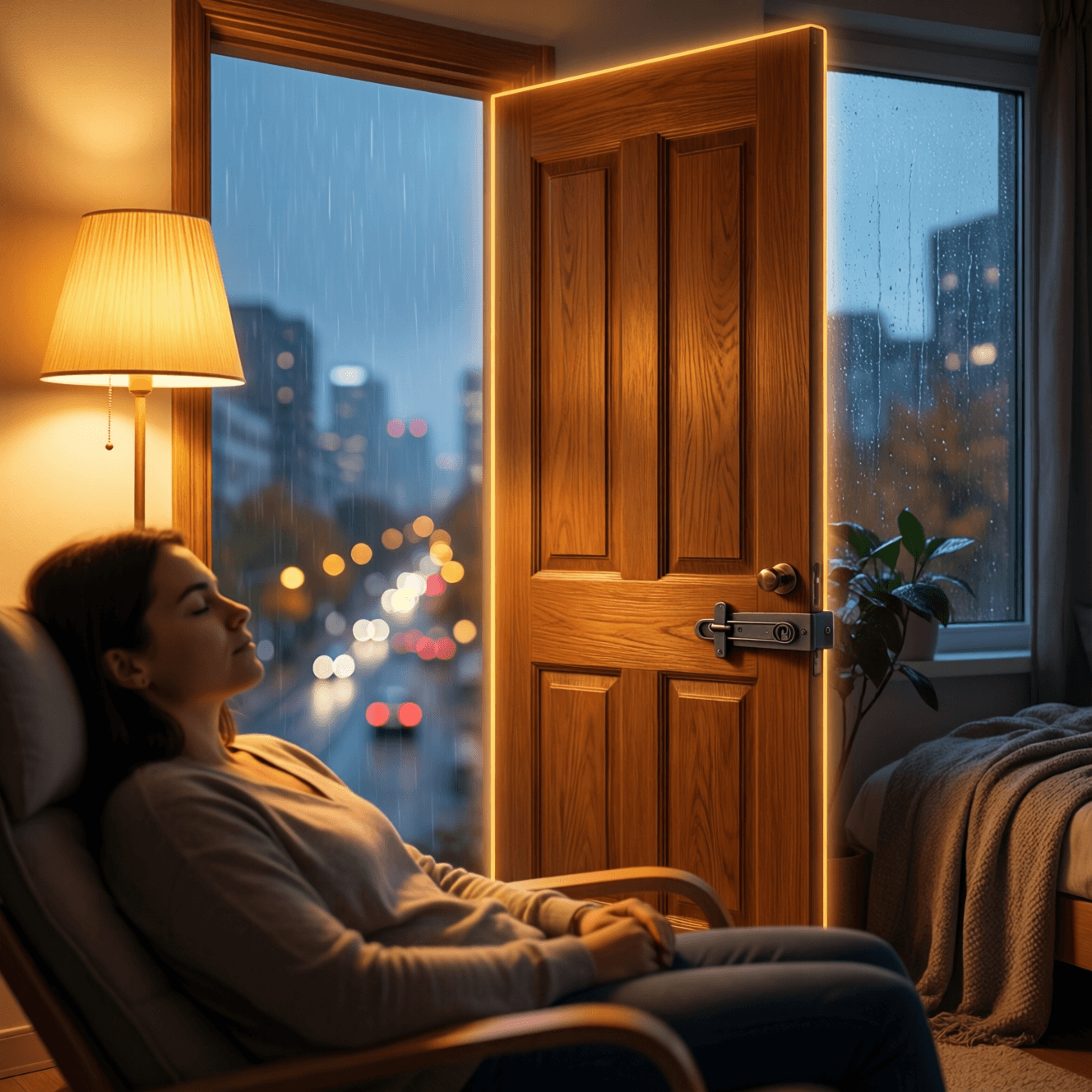
Your nervous system is your home; keep the doors closed to unnecessary noise. — Unknown
—What lingers after this line?
The Body as a Place You Live
The quote begins with a powerful metaphor: your nervous system is not just anatomy, but a home—an intimate interior where your moods, attention, and sense of safety reside. Framing it this way shifts self-care from an optional luxury to basic household management: you maintain what you inhabit. From there, the image suggests that what enters this “home” shapes how it feels to live inside yourself. Just as a cluttered, loud house makes rest difficult, a constantly stimulated nervous system can make calm feel unreachable, even when nothing is outwardly wrong.
Noise Isn’t Only Sound
Although the word “noise” can mean literal volume, the quote quickly widens the idea to include informational and emotional static—endless notifications, contentious conversations, doomscrolling, or the pressure of other people’s urgency. In this sense, “unnecessary” noise is whatever agitates the system without offering real value or actionable clarity. This matters because the nervous system processes more than facts; it processes threat, novelty, and social cues. So even a quiet room can feel loud if you’re absorbing constant micro-stressors, and that’s when the metaphor of closing doors becomes a practical instruction rather than a poetic flourish.
Boundaries as Nervous-System Architecture
With the home metaphor established, “keep the doors closed” reads as a call for boundaries—selective entry, not total isolation. A closed door is not hostility; it’s design. It implies you can decide what gets access to your attention, your time, and your emotional bandwidth. In everyday life, this might look like choosing when to check messages, declining arguments that go nowhere, or limiting exposure to people who continually escalate your stress. The transition from metaphor to behavior is straightforward: if inputs dysregulate you, they don’t belong in the house unsupervised.
How Overstimulation Becomes a Way of Living
Once you let too much “noise” in, the nervous system can start treating that level of stimulation as normal, even if it’s exhausting. Over time, calm may feel unfamiliar, and silence can even provoke restlessness. This is why the quote emphasizes prevention—closing the door before the noise becomes the background. A common anecdote illustrates this: someone takes a weekend away from social media and initially feels anxious, then suddenly sleeps better and notices their thoughts slowing down. The shift isn’t magic; it’s the nervous system re-learning what it’s like to live in a quieter house.
Selective Listening as a Form of Respect
Importantly, the quote doesn’t argue against caring or staying informed; it argues for discernment. Keeping doors closed to unnecessary noise is a way of respecting your capacity—acknowledging that attention is finite and that constant exposure to urgency can distort priorities. This discernment also improves relationships. When you’re less flooded, you can listen more deeply to what truly matters, respond instead of react, and show up with steadier presence. In other words, limiting noise isn’t withdrawal from life; it’s creating the conditions to meet life with clarity.
Turning the Metaphor Into Daily Practice
Finally, the “home” image invites small rituals of upkeep: quiet mornings, scheduled news intake, notification limits, or a rule that certain conversations wait until you’re regulated. These aren’t productivity hacks so much as household rules for your inner space. When practiced consistently, the result is not a sealed fortress but a well-kept home—one where helpful information can enter, meaningful connection is welcomed, and needless disturbance is refused at the threshold. The quote’s wisdom is simple: peace often begins with what you don’t let in.
One-minute reflection
What feeling does this quote bring up for you?
Related Quotes
6 selectedSaying no is not just about time management; it is about nervous system regulation. Every 'yes' you don't mean is a betrayal your body has to carry. — Unknown
Unknown
The quote reframes “no” as something deeper than a scheduling tactic. Instead of treating boundaries as a tool for optimizing output, it positions them as a way of keeping the body within a tolerable range of stress and...
Read full interpretation →Healing is the art of teaching your nervous system that it is finally safe. — Unknown
Unknown
This quote frames healing not as the mere absence of pain, but as a process of education—an “art” that gradually convinces the nervous system it no longer needs to stay on guard. In other words, recovery is less like fli...
Read full interpretation →An exhausted nervous system requires wise rest, not more relentless productivity. — Unknown
Unknown
The quote begins by challenging a common moral framing of fatigue: when the nervous system is depleted, pushing harder is not a virtue but a mismatch between need and response. What looks like “lack of discipline” can in...
Read full interpretation →Nervous system regulation is the new mental fitness. You cannot pour from an empty cup, nor can you build a sanctuary while the world is still burning. — April Koh
April Koh
April Koh’s quote reframes wellness by suggesting that mental fitness is no longer just about discipline, productivity, or positive thinking. Instead, it begins with the body’s capacity to return to steadiness after stre...
Read full interpretation →The most important work you will ever do is to curate the state of your own nervous system. — Deb Dana
Deb Dana
Deb Dana’s statement reframes personal growth at its foundation: before productivity, relationships, or even insight, there is the state of the body that makes all of those possible. By using the word “curate,” she impli...
Read full interpretation →Stop trying to optimize your life for productivity and start nurturing your nervous system for peace; you are a human, not a machine. — Erica Diamond
Erica Diamond
Erica Diamond’s quote begins by confronting a modern habit: treating life as something to optimize endlessly. In that mindset, every hour must be efficient, every routine must produce measurable results, and even rest be...
Read full interpretation →More From Author
More from Unknown →The language is the substrate. The architecture is the contract.
The line sets up a deliberate pairing: language lies beneath everything, while architecture governs everything above it. In other words, what you can express determines what you can build, and what you commit to structur...
Read full interpretation →A scroll is not a break; it is a trap disguised as rest. — Unknown
The quote begins by challenging a familiar story we tell ourselves: that a brief scroll is a harmless pause between tasks. On the surface, it looks like recovery—no effort, no decision, no commitment.
Read full interpretation →Don't let your ice cream melt while you're counting someone else's sprinkles. — Unknown
The quote uses ice cream as a simple stand-in for life’s fleeting pleasures: what you have is delicious, but it won’t last forever if you ignore it. Meanwhile, “counting someone else’s sprinkles” captures the habit of mo...
Read full interpretation →If your absence doesn't affect them, your presence never mattered. — Unknown
The quote frames absence as a revealing experiment: remove yourself, and the reaction—concern, curiosity, indifference—becomes a kind of data. If nothing changes when you’re gone, it suggests your role was never integrat...
Read full interpretation →